Sustainability Is A Contradictory Fad

60706The original Dodge Dart, with the slant-six engine, was not much to look at, but was built to last. While cars were expected to last ten years or a hundred thousand miles, Darts easily lasted twice as long or twice as far. A few are still going now! Such resiliency really made a reputation for Dodge. The problem was that those who bought Darts had no need to buy another car for a long time.

That is a problem with sustainable plants too. Those that last too long, or are too easy to propagate, eliminate the need to buy new plants from nurseries. Many of the most traditional plants that have been popular for a long time probably earned their popularity by being so reliable and sustainable. These are the plants that the nursery industry would prefer to replace with newer varieties.

Good old fashioned lily of the Nile is about as tough and reliable as a perennial can be. If it gets crowded after a few years, it can be dug, divided and replanted over a much larger area, and even shared with friends. Kangaroo paw has been a fad for a few years because it is purported to be tough and drought tolerant too, but like a 1982 Oldsmobile Omega, it dies out in only a few years.

Kangaroo paw is certainly worth growing for striking blooms, even if it is enjoyed for only a few years. It is not too demanding, and can be sustained longer with a bit of specialized grooming and plugging (replanting shoots slightly deeper than they naturally grow). It is just important to realize that kangaroo paw sustains the nursery industry more than it should be expected to sustain itself.

Many of the trendiest modern varieties of old fashioned plants are not so justifiable. Perennials are the most notorious, especially if they are labeled as annuals. Sensational labeling with buzzwords like ‘sustainable’, ‘eco-freindly’ or ‘riot of color’ (seriously!?) can sometimes be a clue. Plants that seem to be ‘doped up’ (blooming with ridiculous profusion) might look their best when first planted, only to decline afterward, instead of growing into their garden space.

Delta Maidenhair Fern

90904Some of us might remember Delta maidenhair fern, Adiantum raddianum, as a houseplant that was popular for terrariums in the 1970s and into the 1980s. Although quite happy in terrariums, it eventually gets big enough to crowd other plants in such tight spaces. It prefers to be potted on a porch, or in a regularly watered and sheltered spot in the garden. It tolerates quite a bit of shade.

Regular watering is important to keeping the foliage well hydrated, particularly among potted plants that are unable to disperse their roots into surrounding soil. The stolons bellow the foliage are not so sensitive, so can regenerate new foliage if partly desiccated old foliage needs to be cut back. They want good rich soil or potting media, and appreciate occasional application of fertilizer.

Individual fronds (leaves) have the potential to get as long as a foot, and half as wide, although they are mostly significantly smaller, and might be only half as long. Each frond is intricately divided into many small leaflets that are almost triangular, except that their out edges are curved and scalloped. Foliage is lighter green than that of most other ferns. Rachi (leafstalks) are black and thin.

Ferns Are Delightful Without Bloom

90904thumbMany of the most popular plants are expected to bloom to add color and fragrance to the garden. Many others are grown to produce fruit or vegetables. Some are appreciated for their foliar color in autumn. Big trees are grown for shade. Turf grasses are grown as lawn. Evergreen shrubbery makes hedges. It seems that all plants perform particular tasks in the gardens which they inhabit.

Ferns only need to provide rich foliage. They do so very efficiently, with remarkably stylish and distinctive textures, and deep green color. Most ferns are evergreen, so only need to be groomed of their old foliage as it gets replaced by new foliage. Most of the few deciduous ferns are bare only briefly during their respective dormant seasons. Some can grow wild without any grooming at all.

Many ferns are famously tolerant of partial shade that is too dark for many other types of plants. Many are tolerant of confinement, so are happy in pots, planters and small atriums, or under stairs. Some ferns that are tolerant of both shade and confinement are popular as houseplants. Those that get too big or their situations are generally easy to dig and relocate, or divide into more plants.

There are only two species of tree fern that are common here; the Australian tree fern, and the New Zealand tree fern. Australian tree fern is taller with leaner trunks. Tasmanian tree fern is short and stout. These and more rare tree ferns are the only ferns that leave the ground as they develop ‘trunks’ of tightly bundled fibrous roots dispersed through the decayed remains of their rhizomes.

Their rhizomes are just their thick herbaceous stems. Those of tree ferns do not branch into more than a single terminal bud, so can not be divided. Rhizomes of most other ferns split into clumps of a few or many individual budded rhizomes, which can be divided if they get too crowded. Leaves that grow from the rhizomes are known as fronds. The fronds of almost all ferns are divided into smaller leaflets known as pinnae, which are suspended by leafstalks known as rachi.

Another One Bites The Dust

P90825If this looks familiar, it is because it is the second big camellia to be killed here in the same manner in not much more than two months. The damage is not fresh, likely because the gopher that caused it started chewing on the roots as soon as the other camellia was removed. The other camellia succumbed about two months after a similarly damaged cherry tree was removed.

We are now concerned for a remaining third camellia in the same spot, as well as others in the vicinity. There is also concern that the gopher may take interest in something else, such as the birches. We would typically find and destroy any gopher that causes such problems. The difficulty here is that the area is thoroughly covered with a dense layer of Algerian and English ivies.

All evidence of gopher excavation is obscured. Even if we could locate such excavation, it would be very difficult to cut through the thicket of ivy without collapsing the tunnels that we would need to put the traps into. It would be excellent to get rid of the ivy as well as the gopher, but that would be a major project for another time. As voracious as gophers are, they don’t eat ivy!

For now, we can only watch the adjacent camellia and other camellias in the vicinity for distress. Of course, by the time a problem is noticed, it will likely be too late to do much about it. We could only apply blood meal, and hope that it works as a repellent. These camellias get blood meal as fertilizer anyway, so would only need more applied off schedule and around the trunks.

The remains of the deceased camellia were removed from the site, and respectfully interred into the green waste recycle bin.

Fake Six on Saturday

P90824K‘Six on Saturday’ is a weekly tradition for many of us who enjoy sharing six horticulturally oriented pictures on Saturday. I just did it earlier this morning.

This is not ‘Six on Saturday’. It is just one picture of six arborvitae. What’s worse is that there is an indistinguishable seventh at the far end of the row. It blends into the sixth in this picture. There are seven barberry between them, with the seventh beyond the last arborvitae. This picture was taken more than a week ago, so most of the amaryllis are done blooming now.

This row of arborvitae and barberry was installed early last winter, after a grungy hedge of photinia was removed. It would have been nice to salvage the photinia, but they were such a mess that the process would have taken more than two years, and even then, would have been patchy.

These arborvitaes will not grow into a contiguous hedge like the photinia were, but already soften the otherwise uninviting visual impact of the plain and uniform fence behind. They will grow taller and broader, but will never get so big that they will be difficult to maintain. It should be easy enough to get behind them to prune away parts that get too close to the fence.

I happen to be pleased that we were able to incorporate this sort of formality into an otherwise completely informal landscape. The irregularity of the terrain, as well as the randomness of the big forest trees that were here before landscapes were installed, make such formality nearly impossible. Even if it were easier, formality is not exactly fashionable in landscape design.

Despite their imposed formality and exotic origins, both the arborvitae and the barberry are remarkably compatible with the native flora of the surrounding forest landscape.

Six on Saturday: The Shining


‘Shiners’ have nothing to do with Rudbeckia hirta, which is commonly known as ‘black eyed Susan’. (Why did rude Becky hurt Susan like that anyway?) Shiners are the wounds left from pruning significant limbs from their supporting limbs or main trunks. They shine most blatantly when fresh, and then fade in the weather.

The best shiners are those that will be compartmentalized (healed over) most efficiently. They should not be cut too deeply, or be left with stubs that interfere with compartmentalization. There is quite a bit of science to shiners.

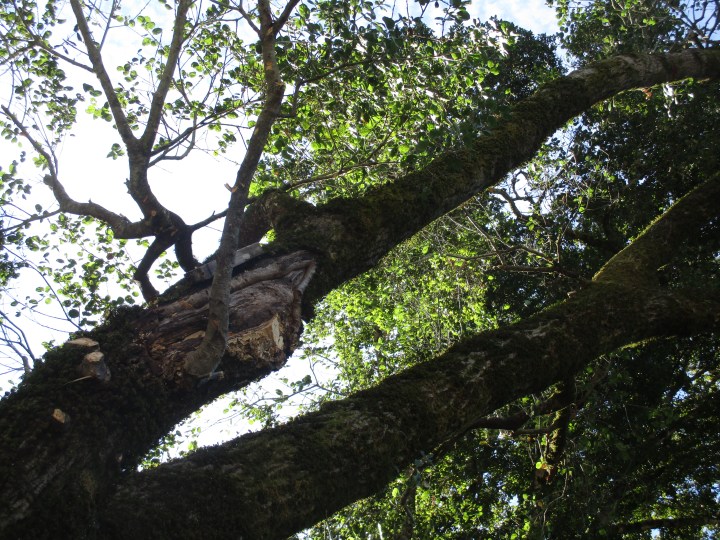
1. This is a good example of a bad shiner. (I could have gotten a better picture of it, but thought that the sun shining from behind was appropriate to the topic.) This shiner was not made by pruning a limb away from a main trunk, but by pruning a main trunk away from a limb. The main trunk leans over so much that most of it needed to be removed to maintain minimal clearance over a driveway. The only two options were to prune it back the the limb on the left, or remove the entire tree. Because the shiner is wider than the remaining limb, which will become the main trunk, it will take several years to be compartmentalized. By that time, decay will have extended downward from the shiner into the main trunk below.P90824

2. Removal of a limb that was battering the topsides of delivery trucks left the shiner above and left of the center of the picture. The scar to the lower left of the shiner, and another scar farther the lower right, closer to the lower right corner of the picture, were caused by a single altercation with one truck that drove off the edge of the driveway. Since it is not really encroaching into the driveway, or interfering with minimal clearance, this particular damaged limb remains.P90824+

3. This is the thrashed limb that was removed from the limb in the #2 picture above. The freshest damage is still red. This limb had been up above minimal clearance for a few years before the supporting limb sagged with the weight of the growing canopy above. Damage to the trucks is more of a concern than the limbs, so it had to go.P90824++

4. This is another good example of a bad shiner. The main trunk to the right would not have been able to compartmentalize over the stub until it grew out past it, or the stub rotted and fell away. The stub was partly rotten, but also partly viable, with a small branch growing from it. The viable portion would have taken more time to rot away. The whole mess was cut away after this picture was taken; but the resulting shiner that I did not get pictures of has another problem. This picture shows how the stub wraps around the main trunk from behind. The bark compressed between the stub and the main trunk, which is known as ‘included bark’ or ‘bark inclusion’, will temporarily be in the way of compartmentalization of the shiner. Fortunately, the tree is young and vigorous enough to figure it all out.P90824+++

5. What looks like shark jaw bones without the teeth is the callus growth that once surrounded a well cut shiner. After the shiner was cut, and the tree started to compartmentalize over it, the tree died suddenly. As the trunk decayed, this dense callus growth that started to compartmentalize the shiner decayed slower. The uniformity of the callus growth shows how evenly the shiner was cut. I believe that the bottom of the shiner is to the left, but that could be backward. I can only say that the shiner is sideways in this picture.P90824++++

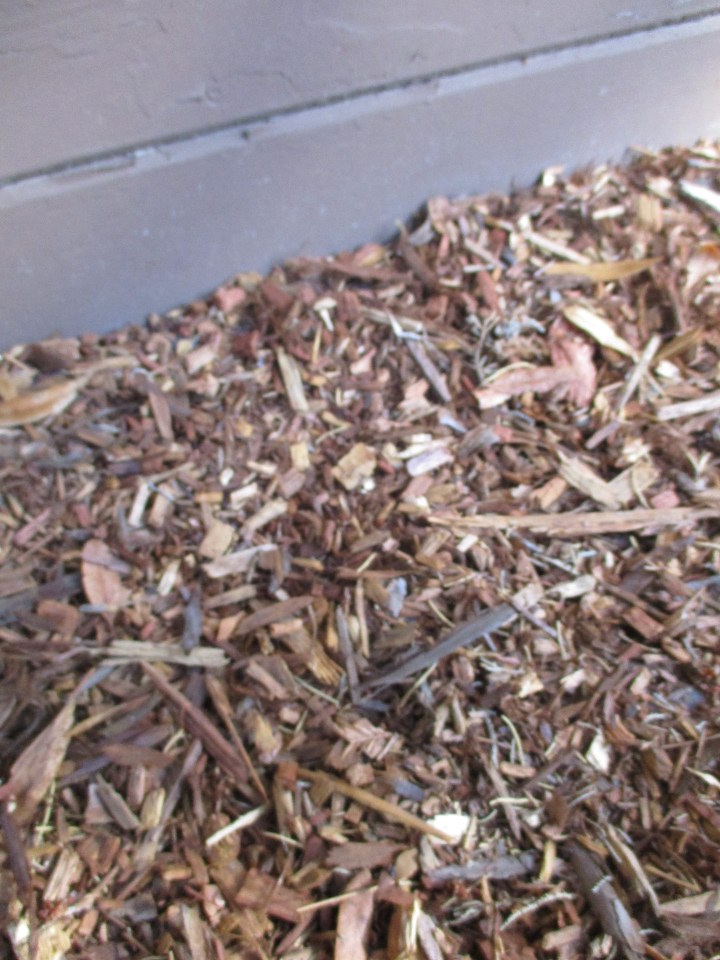
6. Coast live oak, Quercus agrifolia, is the only species in all five of the pictures above, and also provided the biscuits to the lower left and the upper right in this picture. ‘Biscuits’ are sometimes cut to adjust a shiner after the main part of a limb is pruned away, or perhaps to cut a stump slighter lower after a tree is cut down. I really do not remember why I saved the biscuit to the lower left, although I can remember the tree that it came from. The fresher one to the upper right is from the shiner in the first picture #1 above. I kept the Hollywood juniper biscuit to the upper left because I thought it would smell like the related Eastern red cedar (which is actually a juniper rather than a cedar) that cedar chests and closets are made with. The deteriorating biscuit to the lower right is from a very dead white fir that needed to be cut down. I kept it because I happen to be very fond of white firs, but so rarely see them here.P90824+++++

This is the link for Six on Saturday, for anyone else who would like to participate:

https://thepropagatorblog.wordpress.com/2017/09/18/six-on-saturday-a-participant-guide/

Bell Peppers

90320The weather here is excellent for growing all sorts of fruits and vegetables, but is not exactly ideal for bell peppers. Cool nights between warm days are comfortable for us, but limit production of even the healthiest and most robust of plants. Although they like warm nights, the fruit can be sensitive to hot days, and can even get scalded. Bell pepper plants like rich soil and regular watering.

Bell peppers lack capsaicin, which causes other peppers (‘chiles’) to be distinctively ‘hot.’ The fruits of the more popular varieties of green bell pepper are generally harvested while immature, but would otherwise ripen to red. However, most popular red bell peppers are different varieties that produce somewhat elongated fruits with milder flavor. Other varieties produce orange or yellow fruits. Uncommon purple, lavender, brown and white bell peppers are just . . . weird.90320thumb

Vegetables Get Harvested At Their Prime

90327’Zucchini’ is Italian for ‘little squash.’ They certainly can grow to become big squash, but by then, they do not taste so good. They are best before they get to about six inches long. As they mature, they get bitter and tough, and the seedy pulp within develop an unappealing texture. Maturing zucchini also waste resources that would otherwise go to the development of more younger zucchini.

Other summer squash, as well as cucumbers, should likewise be harvested while young and tender, not only because the juvenile fruits are best, but also because the plants are more productive if regularly deprived of developing fruit. Patty pan squash should be only about three inches wide. Except for lemon cucumbers, most cucumbers should be uniformly deep green, before yellowing.

Green beans, even if they are purple or yellow or some other unnaturally weird color, should be harvested while still lean and smooth, before they get lumpy from the developing seeds within. Lumpy beans, although preferred for some types of cuisine, are a bit starchier, and a bit firmer. Just like squash and cucumber, bean vines are more productive if the fruits are harvested regularly.

Shelling beans that remain on the vines until they mature completely are of course completely different. They should probably be harvested faster than birds and rodents take them, but need not be rushed otherwise. The same applies to black-eyed peas, sunflower seeds and popcorn, or any other dried corn. However, these sorts of vegetables are uncommon in local vegetable gardens.

Fresh corn is ready when the formerly light green silk protruding from the end of each ear is brownish tan. By the time the silk dries out, or the husks start to yellow, the corn within will be starchy. Blunt ears are better developed than more tapered ears. Because it wants so much water, fertilizer and space, corn should not be as popular as it is; but some of us like it fresh from the garden.

Although, it last a good while, corn really should be eaten as soon as possible after harvest. Flavor and texture start to deteriorate as soon as the ears are separated from the stalks. Likewise, tomatoes, peppers and eggplants are best straight from the garden as soon as they ripen and get to their best color. Refrigeration slows decay, but accelerates deterioration of flavor and texture.60824+

Horridculture – True Colors

P90821Bearded iris can bloom in almost any color. It is expected of them. There is not much they can do to surprise us.

Dahlias exhibit a remarkable range of both color and floral form. Only a few colors are beyond their range.

Roses, gladiolus, freesias, tulips, hyacinths, petunias, pansies, primroses and several of the most prolific bloomers are expected to provide many choices of color.

Other flowers are not so diverse. Forsythia blooms only in bright yellow, or perhaps a lighter hue of yellow. Mock orange blooms only in white, either single or double. Until recently, before purple was invented, the common species of lily-of-the-Nile were either blue or white. We tend to appreciate such flowers for their simplicity, and do not expect anything more from them.

Decades ago, hydrangeas were either white or pink or blue. I say ‘either’ because what seems to be three choices is actually only two. White hydrangeas were always white. Pink or blue hydrangeas were the same, but were pink in alkaline soil, or blue in acidic soil. Blue hydrangeas planted into alkaline soil turned pink. Conversely, pink hydrangeas turned blue in acidic soil.

In the slightly alkaline soil of the Santa Clara Valley, pink hydrangeas were common. Blue hydrangeas were fertilized regularly with aluminum sulfate or some sort of acidifying fertilizer.

In the more acidic soil of the West Coast of Washington, pink hydrangeas would have been blue without lime.

Some more recently bred cultivars of hydrangea excel at either pink or blue. It does not take much to convince them to exhibit their preferred color in less than conducive conditions. These cultivars made it easier to grow blue hydrangeas in the Santa Clara Valley, or pink hydrangeas on the West Coast of Washington.

Then breeding got ridiculous. Hydrangeas were bred to bloom reliably in rich shades of purple, red, or dark blue, with minimal sensitivity to the pH of the soil. They are appealing to those who like these unnaturally rich colors; but to those of us who expect hydrangeas to bloom in white or traditionally soft hues of pink or blue, they are just too weird.

Himalayan Blackberry

90828Of all the aggressively invasive exotic species on the West Coast, Himalayan blackberry, Rubus armeniacus, could be the nastiest! It seems to be impossible to kill. It forms dense thickets of wickedly thorny canes that develop roots where they touch the ground. Even if canes are cut to the ground, and the roots are pulled out, new plants regenerate quickly from remaining bits of roots.

Individual canes can grow more than twenty feet long in their first year! They may lay on the ground to creep under a thicket, or arch up and over other plants that are fifteen feet tall. These canes develop blooming and fruiting branches in their second year. By their third year, they are replaced by new canes. The palmately compound leaves are smaller for the fruiting second year canes.

Trusses of white or very pale pink flowers bloom late in spring. Dark purplish black berries that started ripening a few weeks ago are now being depleted. Some experts believe that Himalayan blackberries are bigger and sweeter than the fruit of most garden varieties. However, berries are only bigger among well cultivated canes; and keeping canes contained and pruned is not easy.