Six on Saturday – II: Six More


Six on Saturday‘ is a popular popular gardening meme that many of us garden bloggers participate in on Saturdays. The link explains how it works. Simply, we post six pictures of what is happening in our gardens or landscapes at the time, along with brief explanations. Mine just posted at midnight. I know I should be done, but I happened to find a few more pictures to share.

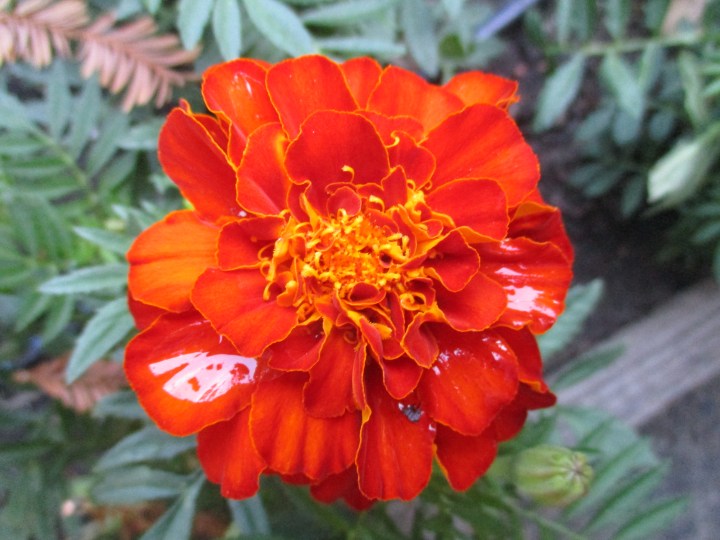
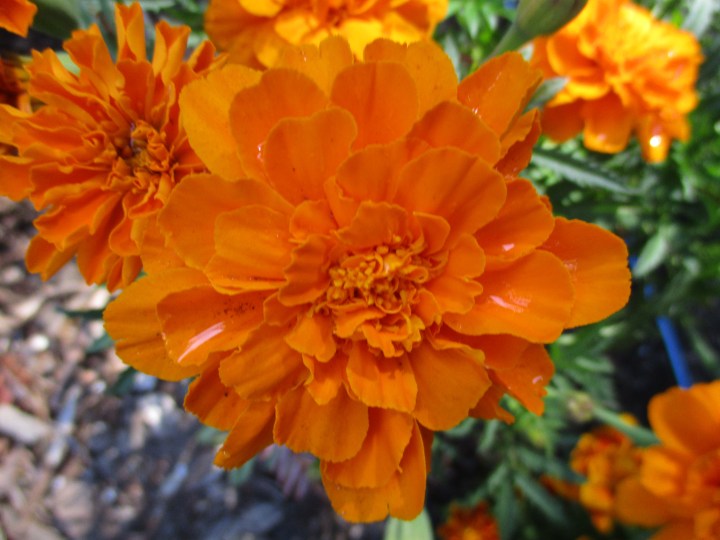
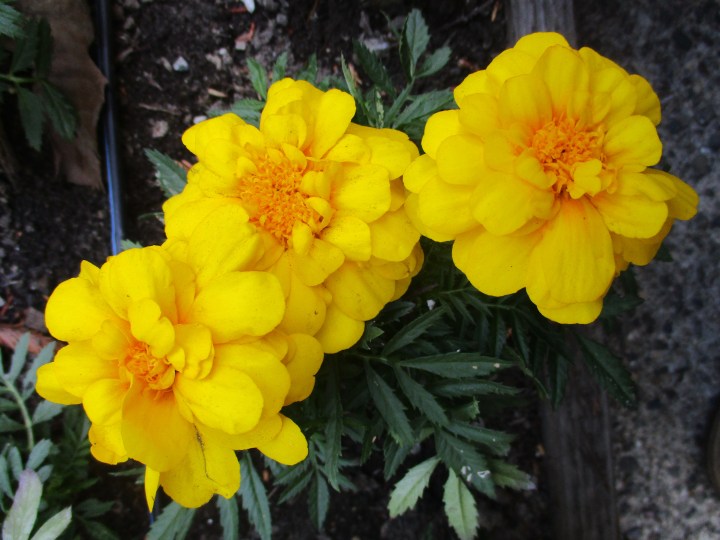
These six pictures of marigolds that were just installed at work are not as interesting as the topic I wrote about earlier, but are just too pretty to be discarded before I show them off. The second and third pictures, as well as the fourth and the fifth pictures, might be redundant to each other if they show the same varieties of marigolds, but I do not care. They are all so pretty.

Marigold will not likely be featured in my weekly gardening column this year, because the bigger but related African marigold was featured last October. These here are the smaller and more traditional French marigold. Their bright yellows, bright oranges and rusty reds suit late summer and autumn like miniature chrysanthemums. Their foliage is so delightfully aromatic.

Although I am none too keen on annual bedding plants, I happen to like marigold. They were more popular when I was a kid. They were not so variable back then; and there were certainly none of those pathetic fake white sorts that are really just pale yellow. They were plain and simple orange, yellow and rusty red, in blends or uniform. We could easily grow them from seed.

Unfortunately, marigolds will not be with us for long. They were planted to replace petunias that did not last long enough. At the end of autumn, they will be replaced by cyclamen for winter.
P90921KP90921K+P90921K++P90921K+++P90921K++++P90921K+++++

This is the link for Six on Saturday, for anyone else who would like to participate:

https://thepropagatorblog.wordpress.com/2017/09/18/six-on-saturday-a-participant-guide/

Gardenia

40917It seems that everyone who has ever experienced the seductive yet powerful fragrance of gardenia, Gardenia jasminoides, wants to grow it, but very few actually can. Gardenias like warmth, but prefer more humidity than they get here, which is why they seem to be happier in partial shade, in atriums, or in urns that can be moved out of harsh exposure during summer. In such sheltered spots, aphid, scale and sometimes whitefly can be problematic.

Gardenias want their own space, where their roots will not be bothered by excavation or roots of more aggressive plants. They do not even want annuals around them, because annuals need such regular cultivation. Docile ground cover plants or simple mulch is best. Gardenias like rich soil and acid fertilizer or fish emulsion to be applied regularly as long as the weather is warm.

The creamy white flowers that fade to French vanilla can seem mundane relative to their alluring fragrance and handsomely glossy foliage. The largest flowers rarely get to three inches wide. ‘Mystery’, which can slowly get four feet tall, is the most familiar cultivar, even though it does not bloom so much after spring. ‘Veitchii’, which can eventually get three feet tall and twice as wide, has small inch-wide flowers, but is still blooming. Modern cultivars bloom just as late, but with larger flowers.

Four O’ Clock

40910Not only does it start to bloom late in summer, but as the name implies, four o’clock, Mirabilis jalapa, blooms late in the afternoon to attract nocturnal moths for pollination overnight. By morning, the white, yellow, variable pink or rarely pastel orange flowers are closed, and their yummy fragrance is gone. Individual flowers often display irregular stripes or blotches of alternate colors, and can be divided into zones that are shaped like slices out of a pizza. Plants get nearly three feet high, but then die to the ground with the first frost. They regenerate from big tuberous roots as winter ends, and can seed profusely.
Six on Saturday: White (but not) Trash


That is, of course, a matter of perspective. Some of us might find some of the six species represented here to be trashy. Some of us might find all six to be appealing. After a slight expression of disapproval of my insensitive designation of my six pictures as ‘White Trash’ last week, I considered that I should perhaps be more tactful with my opinions this week. Then, I got over it.

These six just happen to be rather innocuous, so I have nothing too objectionable to say about them. I am actually rather fond of them. The last comment about #5 refers to the 2-in-1 graft.

1. Oregano, Oringamum vulgare, is civilly naturalized in a few spots. I let it bloom because it is rather pretty. There are plenty of unbloomed stems for anyone who wants a bit of the foliage.P90907

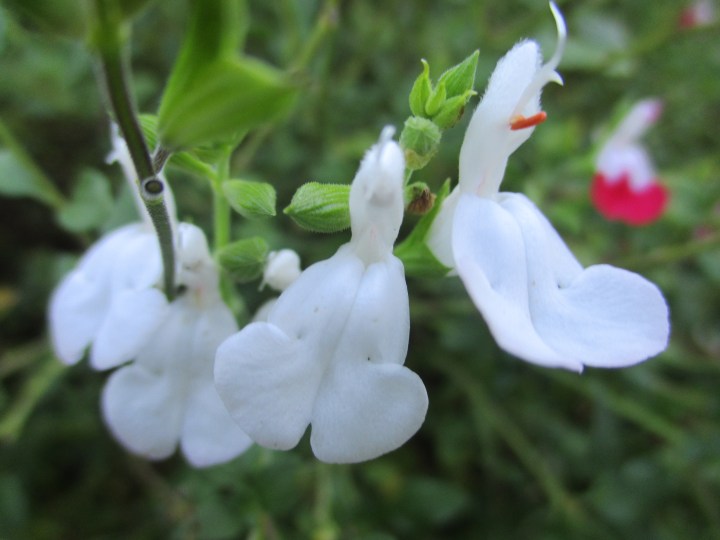
2. Autumn sage, Salvia greggii, with white flowers, developed within a colony that was originally of the cultivar ‘Hot Lips’. The more typical flower is blurred in the upper right background.P90907+

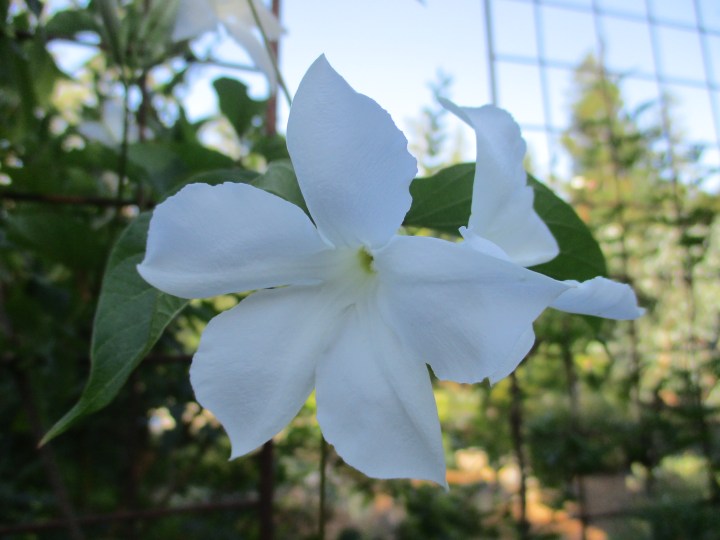
3. Chilean jasmine, Mandevilla laxa, is a mildly fragrant mandevilla. The fragrance is barely perceptible here. I am impressed anyway. I do not expect any fragrance at all from a mandevilla.P90907++

4. Star jasmine, Trachelospermum jasminoides, is much more fragrant, especially in abundance. I know it is common, but I like it anyway, as much for the foliage as for the fragrant bloom.P90907+++

5. Rose, Rosa spp., seems to be the all too common floribunda cultivar, ‘Iceberg’. It is grafted together with what seems to be ‘Burgundy Iceberg’, onto standards (rose trees). 2-in-1 = tacky!P90907++++

6. Oleander, Nerium oleander, to many, is even tackier. I really like it. Besides, it does so well without irrigation in the rustic or unrefined landscapes. It might be the cultivar, ‘Sister Agnes’.P90907+++++

This is the link for Six on Saturday, for anyone else who would like to participate:

https://thepropagatorblog.wordpress.com/2017/09/18/six-on-saturday-a-participant-guide/

Black-Eyed Susan

40903A flower that is so prominent in American culture should have a more appealing name than black-eyed Susan. Even the Latin name, Rudbeckia hirta, sounds bad. Is Becky really so rude? Did she hirt Susan? Well, black-eyed Susan is good enough to be the state flower of Maryland, and is one of the most popular of flowers for prairie style gardens of the Midwest. After all, it naturally grows wild in every state east of Colorado. Here in the West, it is a light-duty perennial that is more often grown as an annual. As a cut flower, it can last more than a week.

In the wild, the three inch wide flowers of black-eyed Susan are rich yellow with dark brown centers, and can stand as high as three feet. The typically smaller but more abundant flowers of modern varieties can be orange, red or brownish orange, on more compact stems. Gloriosa daisies are fancier cultivars, with larger flowers that are often fluffier (double) or patterned with a second color. Individual plants do not get much wider than a foot, with most of their rather raspy foliage close to the ground. All black-eyed Susans bloom late in summer or early in autumn.

Color Wanes As Summer Ends

40903thumbBlack-eyed Susan, sunflowers and a few of the late warm season annuals and perennials are still blooming, and a few will continue into autumn. By that time, cool season annuals can move in; and some of the deciduous trees, shrubs and vines that turn color for autumn will be doing so. Realistically though, this can be the leanest time of year for color in the garden. Even some of the foliage that is colorful through spring and summer has faded.
There are certainly plenty of flowers in season now. However, not many are colorful. Honeysuckle vine is pleasantly fragrant as it bloom in random phases until the weather gets cooler, but the flowers are only pale yellowish white. Some melaleuca trees bloom profusely enough to make a mess, but are just as pale, and do not even provide fragrance; although some have pretty light pink flowers. Abelia flowers are pink and abundant, but are really not all that flashy against their bronzy foliage.

Some of the more colorful flowers are not quite as reliable. Princess flower, hibiscus, blue hibiscus and mandevilla certainly can bloom in late summer or autumn, but sometimes bloom earlier than expected, so have nothing left for later. The bright red flowers of blood red trumpet vine are quite impressive, but only if they are not obscured by the accompanying foliage. Some roses bloom in phases as late as the weather will allow, but actually, most are done by now.

Fuchsia and angel’s trumpet likewise bloom in a few phases once they get started, but unlike the many cultivars of roses, they are much more reliable for a late bloom phase. Escallonia blooms late with small but colorful flowers, but only if they have not been shorn in the past few months. Shearing deprives them of the blooming stem tips that they had worked most of the year for.

Butterfly bush, tree mallow, cape plumbago, bee balm and several varieties of sage and salvia are among the most reliable plants for late summer or autumn bloom. Even without multiple bloom phases, they just naturally bloom at the end of their growing season, before winter dormancy.

Six on Saturday: White Trash


This is getting close to the in-between time for annuals. Warm season annuals that bloomed through summer will soon be getting replaced with cool season annuals that will perform through winter. Of course, our seasons are neither as distinct nor as severe as they are elsewhere. Many annuals are actually perennial here. Some stay later than they should, just because they can.

Aging annuals and perennials can get somewhat trashy if they are not pruned back or replaced soon enough. Their replacements might not be very impressive until they get established and start to grow. So far, only a few violas have been installed here for autumn, and only because the petunias that were where they are now were getting tired prematurely. There will be more.

There is certainly much more color in the landscapes than what these pictures show. White just happens to be my favorite color.

1. Alyssum is supposed to be a cool season annual for spring or autumn. It does not like cold winter weather or warm summer weather. In our mild climate though, it does well in any season. In sunny spots, it self sows to replace itself before it gets old and deteriorates. This batch will eventually get removed, just so we can put something else here. It is prettier in sunnier spots.P90831

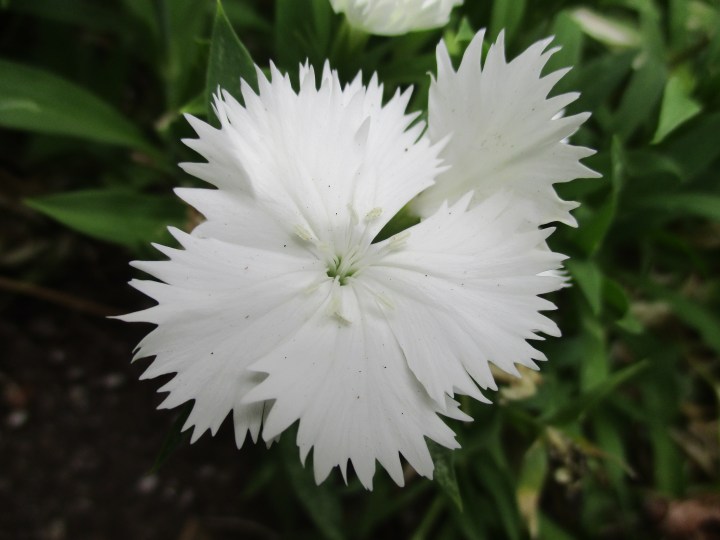
2. Dianthus, like alyssum, is supposed to be a cool season annual. It just does not succumb to the minor summer warmth here. Nor does it succumb to the mildly cool winter weather. It could grow as a short term perennial if we did not need to remove it to plants something else later. It also would perform better with better sun exposure. Here, bloom is not as full as it should be.P90831+

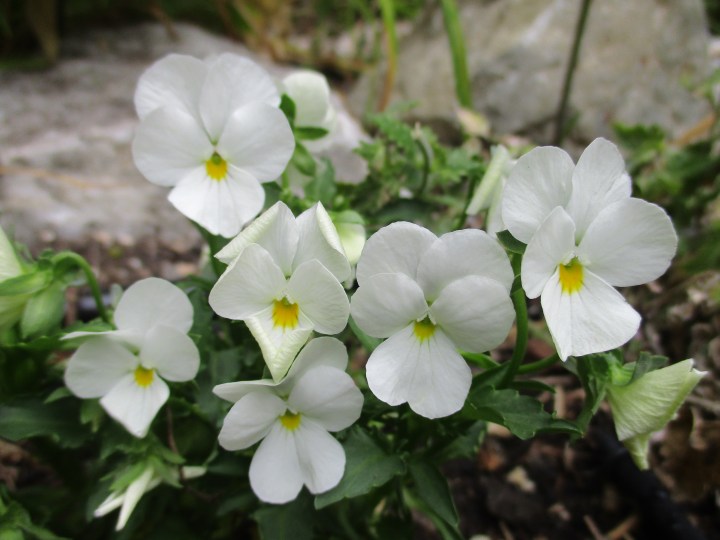
3. Viola is one of the cool season annuals that does not do well through summer here. Some survived from last spring, but they were not happy about it. A few of the many might survive and regenerate if we cut them back, but it is easier to plant something new. These white violas, as well as some comparable yellow ones, got planted early to replace prematurely fading petunias.P90831++

4. Petunia is a warm season annual that did well through most of the summer, but is now fading a bit early. Some have already been replaced with violas. Others probably should be. These are still mostly presentable, so can remain for now. If possible, it is better to not replace them with violas too early. Violas that grow too much before autumn can get floppy through winter.P90831+++

5. Phlox was not planted. A single plant grew in an already crowded bed of flashy annuals and perennials two springs ago. There were a few more last year, and even more this year. They all land in good situations, where they unobtrusively grow through spring, bloom in summer, and die back through autumn. They are warm season annuals, but are expected back next spring.P90831++++

6. Geranium, which are really pelargonium, are perennial here, rather than annual like they are in climates with cooler winters. They can be damaged or even killed by frost where they are more exposed, but this particular geranium is sheltered by an eave and trees. They will probably get cut back at the end of next winter, just to stimulate fresh new growth to replace the old.P90831+++++

This is the link for Six on Saturday, for anyone else who would like to participate:

https://thepropagatorblog.wordpress.com/2017/09/18/six-on-saturday-a-participant-guide/

Paris Daisy

60831If you’re going to San Francisco, be sure to wear some flowers in your hair. In the 1960s and 1970s, such accessorizing with Paris daisy, Argyranthemum frutescens (which was at the time, Chrysanthemum frutescens), was a fad. The white flowers with yellow centers were about two or three inches wide. Modern cultivars have smaller flowers that might be light pink or pastel yellow.
Bloom continues in phases from spring through autumn. Light shearing as each bloom phase fades promotes fuller bloom of the subsequent phase. However, if conditions are right, bloom may be nearly continuous, without much pause between phases. Unlike the tougher yellow euryops daisy, Paris daisy wants rich soil, regular watering and maybe a bit of fertilizer for best performance.

Individual plants can get three feet tall and twice as broad, but live only a few years. Lower stems that develop roots where they touch the ground can be left to grow as new plants when an original plant dies. If they do not get roots on their own, lower stems can be pressed into the soil and held down with rocks (with their leafy tips exposed) to grow roots before the parent plant deteriorates.

Horridculture – True Colors

P90821Bearded iris can bloom in almost any color. It is expected of them. There is not much they can do to surprise us.
Dahlias exhibit a remarkable range of both color and floral form. Only a few colors are beyond their range.

Roses, gladiolus, freesias, tulips, hyacinths, petunias, pansies, primroses and several of the most prolific bloomers are expected to provide many choices of color.

Other flowers are not so diverse. Forsythia blooms only in bright yellow, or perhaps a lighter hue of yellow. Mock orange blooms only in white, either single or double. Until recently, before purple was invented, the common species of lily-of-the-Nile were either blue or white. We tend to appreciate such flowers for their simplicity, and do not expect anything more from them.

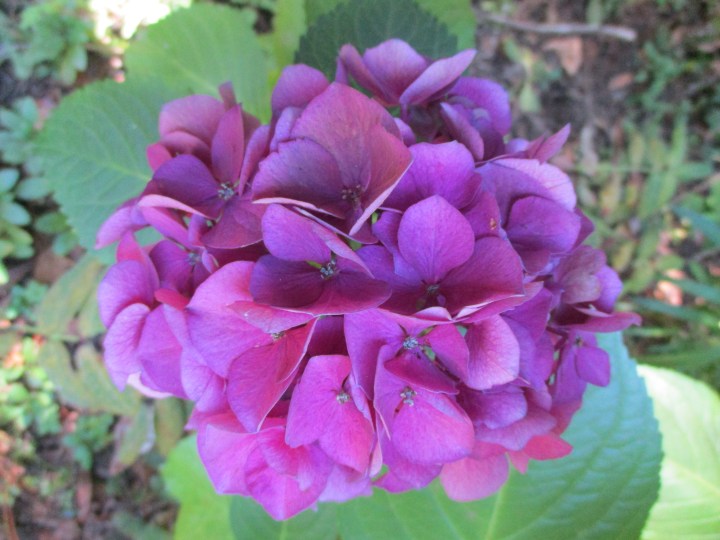
Decades ago, hydrangeas were either white or pink or blue. I say ‘either’ because what seems to be three choices is actually only two. White hydrangeas were always white. Pink or blue hydrangeas were the same, but were pink in alkaline soil, or blue in acidic soil. Blue hydrangeas planted into alkaline soil turned pink. Conversely, pink hydrangeas turned blue in acidic soil.

In the slightly alkaline soil of the Santa Clara Valley, pink hydrangeas were common. Blue hydrangeas were fertilized regularly with aluminum sulfate or some sort of acidifying fertilizer.

In the more acidic soil of the West Coast of Washington, pink hydrangeas would have been blue without lime.

Some more recently bred cultivars of hydrangea excel at either pink or blue. It does not take much to convince them to exhibit their preferred color in less than conducive conditions. These cultivars made it easier to grow blue hydrangeas in the Santa Clara Valley, or pink hydrangeas on the West Coast of Washington.

Then breeding got ridiculous. Hydrangeas were bred to bloom reliably in rich shades of purple, red, or dark blue, with minimal sensitivity to the pH of the soil. They are appealing to those who like these unnaturally rich colors; but to those of us who expect hydrangeas to bloom in white or traditionally soft hues of pink or blue, they are just too weird.

Fasciated Lily-of-the-Nile

P90817K

Floral fasciation is a rare developmental disfigurement of a bloom, supposedly caused by the fusion of two or more blooms. Many fasciated blooms really do look like two blooms stuck together, like double daisies. Alternatively, fasciation can cause distention of a single flower of many on a foral spike of foxglove.

Fasciation of lily-of-the-Nile bloom is typically expressed merely as a few stray florets on the otherwise bare stalk below the main floral truss. A smaller subordinate stalk may seem to be fused to the main stalk below the stray florets.

The specimen in the picture above is exceptional. It really does look like a double bloom, with one stacked on top of the other. The atypically short and stout stem looks like a tightly fused bundle of several smaller stems. Those who do not know better might find the more billowy and more colorful fasciated bloom to be more appealing than the normal bloom pictured below.

The first picture of my ‘Six on Saturday‘ post this morning shows that this is not the only fasciated bloom here. There is another similar fasciated bloom right next to it. This suggests that the fasciation is likely caused by a genetic mutation that was shared with each of two rhizomes that split from the original.

If the mutation is sufficiently stable, and not likely to soon revert, more copies could be propagated later by division. The rhizomes split after bloom; so if one split into two last year, the two that are here now could split into four next year. If genetically stable, all four should bloom with the same fasciation next year.

To monitor their genetic stability, I should probably relocate these two odd rhizomes, to separate them from the others for observation. I suspect that they will eventually revert anyway.

P90817++