Six on Saturday: Vanity


These are five of the pictures of camellias from Nuccio’s Nursery in Altadena that I said last week I would share this week. I will share five more immediately afterward in a second ‘Six on Saturday’ post. I am not certain if there is a rule against doing so, but no one seemed to mind when I did the same to share an over abundance of autumn foliar color last autumn. You can find the second post here: https://tonytomeo.com/2019/03/30/six-on-saturday-vanity-ii/

Brent Green, my colleague who I sometimes mention within the context of my articles, typically in a rather unflattering manner, took these pictures nearly two weeks ago. He lives and works nearby, in the Los Angeles region.

Brent takes horrible pictures. He always has. He was wasting my film on bad pictures such as these in 1986. I told him just before he took these pictures that I really wanted GOOD pictures. These are what I got.

Also, Brent is VERY vain. Back in 1986, when we were roommates in Fremont Hall at Cal Poly in San Luis Obispo, he often had me go get the car to meet him at the bottom of the stairs because he was in that much of a hurry to do whatever he happened to be doing at the time. It might have been getting close to a week since he last got his Grace Jones flat top do done. Perhaps his clothes were getting close to three months old, so he needed a new batch. It was always a rush. The problem was that there was a mirror in our dorm room. I would wait in the red zone at the bottom of the stairs with the engine running for several minutes before going back up to the top floor and most of the way down the long hall to our room to find him staring at himself in that mirror. When I told him that we needed to leave NOW before the car got ticketed, he would still need to add some more Sta-Sof-Fro to his do . . . and stare some more. He had hair back then.

Yes, this is relevant here. Anyway, these are the camellias:

1. Chandleri Elegans or Francine – What do they see off to the right? Why is one cowering behind the other? This picture should have been centered, and wider than tall, or horizontal rather than vertical.P90330
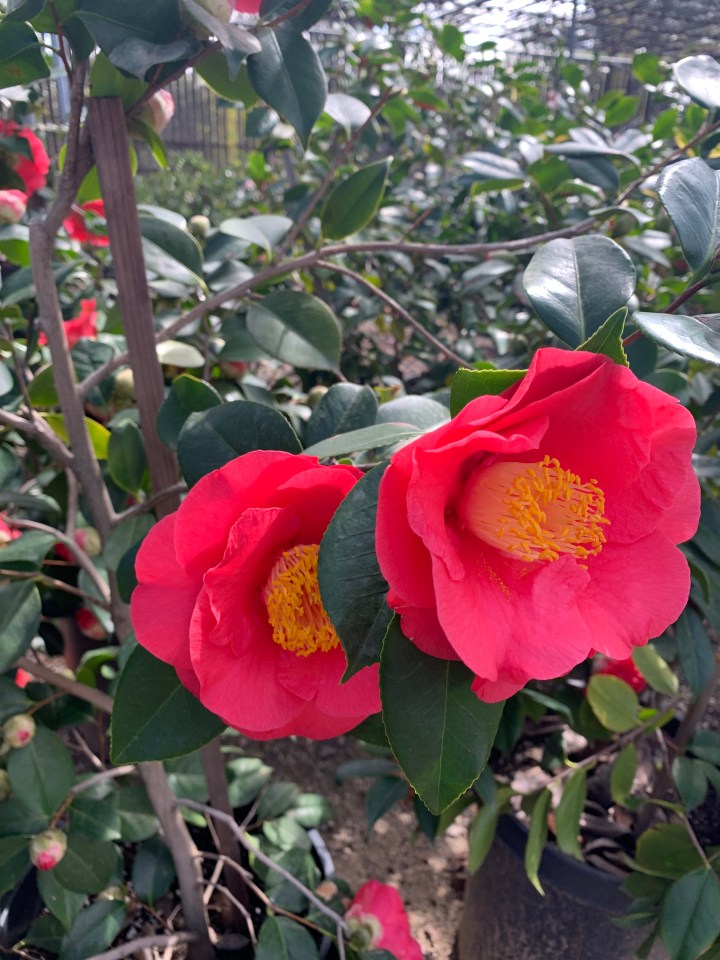
2. Rosette – What is so interesting off to the left that the flower can not look at the camera? Is this supposed to be a picture of the flower low in the picture, or the gravel beyond it?P90330+

3. Red Devil – There are a lot of distracted flowers here. What is this one looking at on the ground? Is the gravel that interesting? Perhaps the vinyl cans are. This one should be centered too.P90330++

4. Demure – This one looks like an album cover from the 1970s; pale, distracted, and off center against an industrial background. It could be a bad picture, or it could be artistic.P90330+++
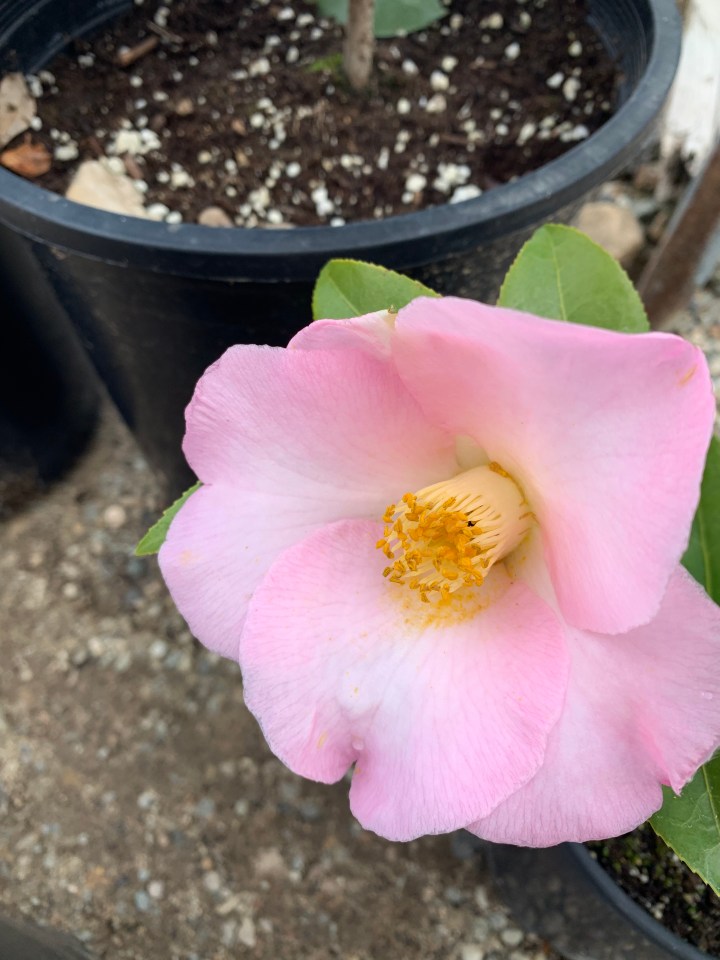
5. Tata – This one looks like a teenager with bad acne looking down before jumping off the high dive.P90330++++

6. Brent Green – The only good picture of the bunch.P90330+++++

Now . . . how did Brent take such bad pictures of flowers that he could so easily aim the camera at properly, AND take such a perfect selfie without being able to see the picture as he took it? Could it be VANITY?!?

This is the link for Six on Saturday, for anyone else who would like to participate:

https://thepropagatorblog.wordpress.com/2017/09/18/six-on-saturday-a-participant-guide/
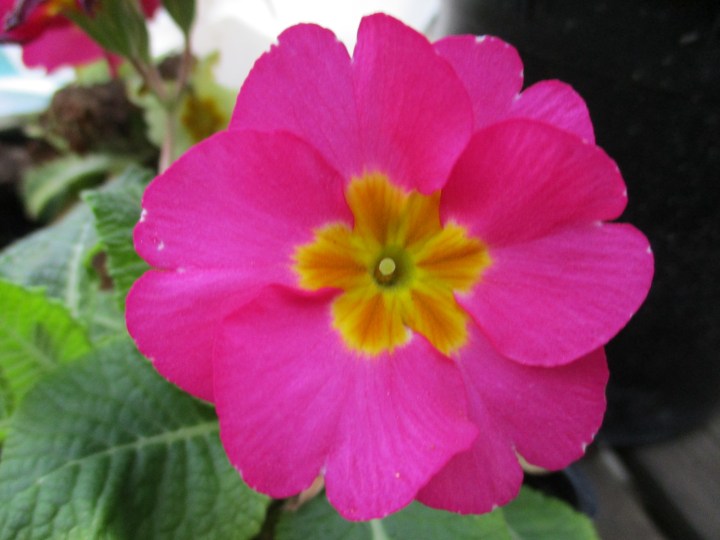
Annuals Should Match The Weather

P80317Pulling out cool season annuals that are still somewhat colorful is never easy, even if they are already deteriorating. There is always the desire to stretch their season as late as possible until they succumb to warmer weather. Only a few can perform all year, or get cut back to hide below other taller plants until the weather gets cool enough in autumn for them to regenerate and bloom again.
Regardless of all the resistance, removing the annuals of a previous season relinquishes space for annuals that are appropriate to the next season, whether cool to warm season, or warm to cool season. Even if new annuals are initially wimpy relative to the older annuals that were removed, they should proliferate and bloom better than lingering unseasonable annuals would if not removed.

Timing is somewhat important. There is no point in removing cool season annuals too early if the weather is still too cool for warm season annuals. However, there is no point in planting too late either. Delayed planting only delays growth and bloom. Some warm season annuals, especially those grown from seed sown late in winter, prefer to get established while the weather is still cool.

French marigold is probably the most traditional warm season annual for bright yellow, orange and bronze. Lobelia contrasts excellently with rich blue and purple, and can also be purplish rose or white. Petunia can do even more with brighter and more variable colors. Cosmos provides pastel pinks and white on taller plants. Cockscomb colors rival those of marigold, and can also be red.

Pincushion flower, annual statice and zinnia are popularly enjoyed as bedding plants, and also work well individually, behind lower bedding plants, or in planters of mixed annuals or perennials. Verbena and moss rose cascade nicely from such mixed planters. Sadly, brightly colored and formerly popular busy Lizzie (impatiens) are either rare or unavailable because of a mold disease.

Nasturtium and alyssum are warm season annuals that are often grown through winter as well. Where they are allowed to naturalize and bloom throughout the year, deteriorating old plants might need to be groomed out as they get replaced by self sown plants. New nasturtium should be sown as seed, instead of planted as seedlings from cell packs. Alyssum grows well by either means.

Six on Saturday: Right Here – Right Now


There are certainly more impressive flowers at work. I suppose I should have gotten pictures of them. Instead, I just took these six pictures within minimal proximity to a where I happened to be working on Wednesday. I thought they would be more interesting than they are. I wanted to get a picture of the laurustinus #4 because others have been posting pictures of the same as if it is something important. Flowering quince #6 is my favorite here, and the only one that was not planted into the landscape. It grew from the roots of an old specimen that was in front of an old home that was demolished to redevelop the site. Because of it’s resiliency, we want to pull up some of the layered stems (that rooted where they lay on the soil) to plant in elsewhere.

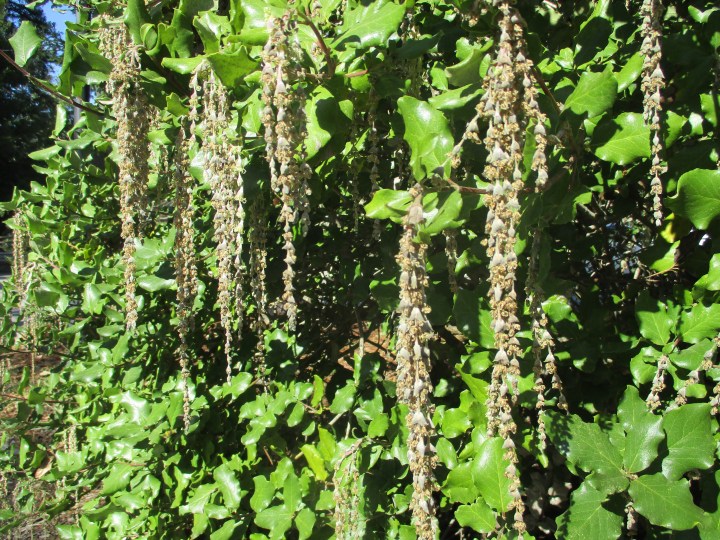
1. Garrya elliptica – silktassel bloomed with very pendulous light beige blooms quite some time ago. These lasted longer than others in partial shade, but are now turning tan and getting dry. Silktassel is native here.P90202

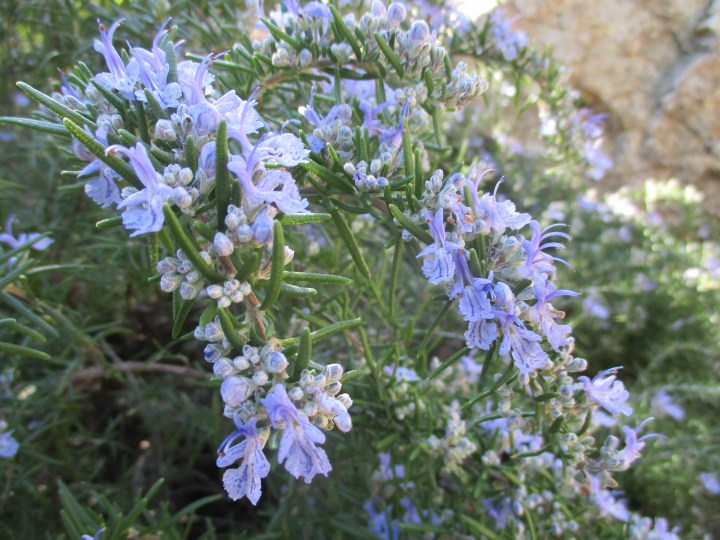
2. Rosmarinus officinalis ‘Prostratus’ – trailing rosemary seems to bloom continually. I do not remember it without bloom here. Bees, which are active in all but the coolest of weather, like how it always here for them.P90202+

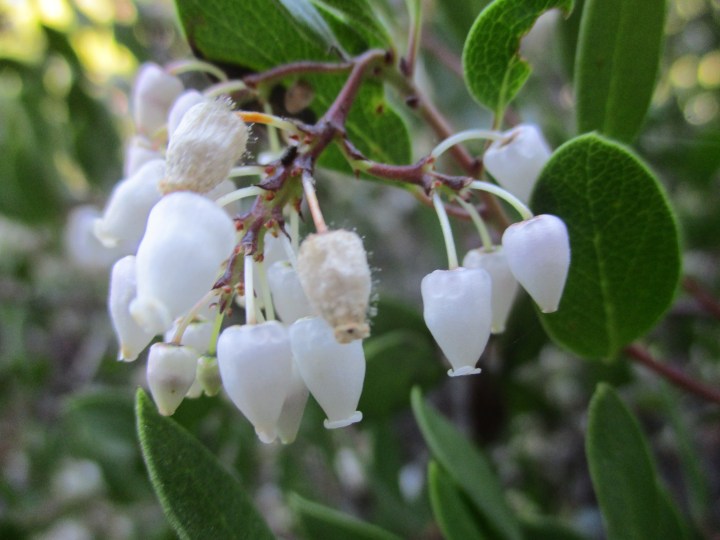
3. Arctostaphylos densiflora ‘Howard McMinn’ – Howard McMinn manzanita is a garden variety or cultivar of a species that is native not far north of here. I sort of think these waxy white flowers are too tiny to impress.P90202++

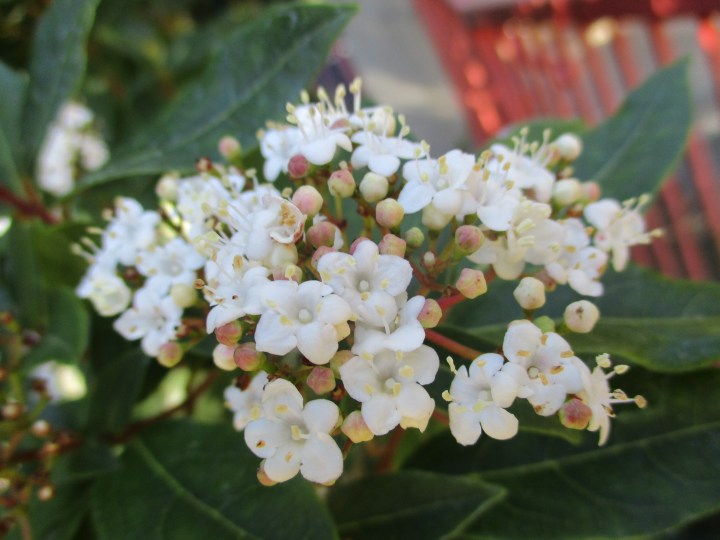
4. Vibrunum tinus ‘Spring Bouquet’ – laurustinus is actually blooming later here than where winters are colder. It naturalizes here. I suppose that those that grow from seed would not be of the same cultivar as the originals.P90202+++

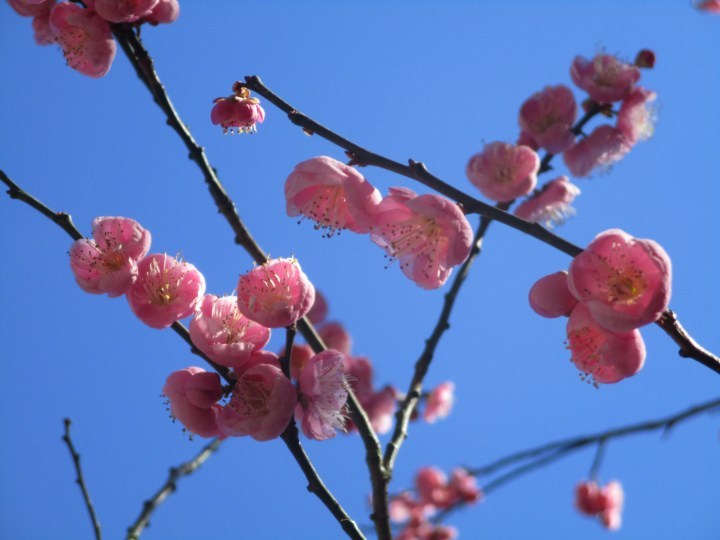
5. Prunus cerasifera – flowering plum is rather sparse here because of the partial shade of larger trees. I do not know what cultivar this one is. I am not even sure if it is Prunus cerasifera. It does not look familiar to me.P90202++++

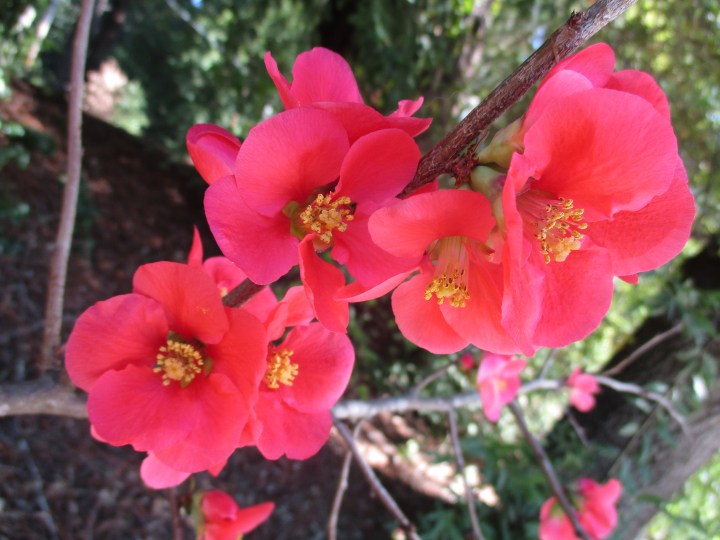
6. Chaenomeles speciosa – flowering quince is another one that I can not identify, although it seems to be the most common sort that I see about town.. I guessed the species, but will not even bother to guess a cultivar.P90202+++++

This is the link for Six on Saturday, for anyone else who would like to participate:

https://thepropagatorblog.wordpress.com/2017/09/18/six-on-saturday-a-participant-guide/

African Daisy

81212It seems like not so long ago when the only African daisy that was commonly available was the trailing African daisy that makes such a nice relaxed ground cover for small spaces. The simple white flowers have navy blue centers, and are occasionally joined by mutant light purple flowers. The cultivar that blooms only in light purple was not as popular. Things have certainly changed!

African daisies, Osteospermum, have been bred and hybridized so extensively that most of the modern cultivars are not categorized by specie, so are known by their cultivar names. Most are likely related to Osteospermum ecklonis, which was the first of the shrubby specie to become popular. Although often grown as cool season annuals, African daisies are short term perennials.

Flowers can be various pastel hues of purple, pink, orange, yellow or white. Bloom can be profuse in random phases, and sporadic bloom is almost continuous between early spring and late autumn. It is only postponed by the coolest winter weather and the warmest summer weather. Mature plants can get a bit more than two feet high and wide. They want full sun and regular watering.

African Marigold

81107French Marigold might have been a more appropriate choice. It is the official flower of Dia de los Muertos on November 2. Some might say that the bigger and bolder African marigold, Tagetes erecta, is just as official. Both are Mexican, but as the names imply, most varieties of French marigold were developed in France, and most varieties of African marigold were developed in Africa.
Both African and French marigolds are warm season or autumn annuals that exhibit a similar range of floral colors that contrast nicely against their rich green aromatic foliage, but they are not much more similar than that. African marigold can get almost three feet high and two feet wide. Its bigger pom pom flowers tend to be solid colors rather than mixed; and vanilla white, although unpopular, is not rare. Bright yellow and bright orange are the most familiar. Rusty red is the third most popular color.

African marigold wants rich and well drained soil in sunny exposures. It gets lanky, blooms less, and is more likely to mildew where partly shaded. It should be watered regularly and early in the day. Flowers can mold if they stay damp for too long. Deadheading, which is the removal of deteriorating flowers, promotes continued bloom. Occasional application of fertilizer might also help.

Vahz, Vawz or Voz

P81020‘V-A-S-E ‘ is probably how it is spelled, just like that which is pronounced exactly as it looks, or ‘vays’. ‘Vahz’, ‘vawz’ or ‘voz’ just sounds fancier, . . . or bigger.
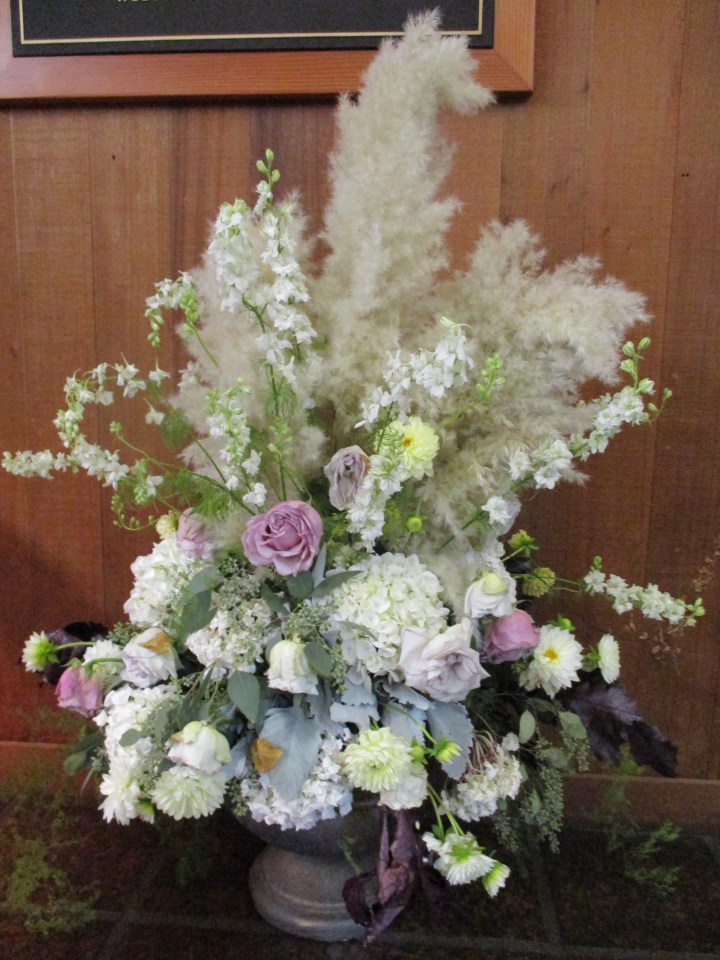
That is how I learned it. ‘Vays’ is the smaller version that is designed to contain one or only a few flowers and maybe some foliage. ‘Vahz’, ‘vawz’ or ‘voz’ is the much larger version that is designed to contain entire bouquets or ‘floral arrangements’. Those that contain only dried flowers and foliage do not even need to hold water.

I learned this from those who were experts on the subject. My Aunt Betsy and her best friend Cathy were ‘flower children’. They rented an apartment in a hip and trendy neighborhood in western San Jose back in the early 1970s. The neighborhood was so trendy and hip that the neighbors were known as ‘hippies’. Aunt Betsy and Cathy outfitted their apartment accordingly, with wicker, shaggy rugs, and a big spider plant hanging from beaded macrame.

Of course, there was also a rather big ‘vahz’, ‘vawz’ or ‘voz’. It was cheap molded plaster painted glossy chocolaty brown. It contained a billowy abundance of only two species of dried cut flowers, cattails and pampas grass, that had been sprayed with hair spray to prevent them from sharing their seed. It was as gloriously hideous as it sounds, and more than adequately expressed impeccable cultural refinement and a keen appreciation for the remarkably distinctive and exquisitely tacky style of home decor that was so prevalent at the time.

The cattails might have been collected on the side of Highway 80 in Auburn, near the home of Aunt Betsy’s Great Aunt Mamie. The pampas grass might have been found in Vasona Lake County Park in Los Gatos.

Chrysanthemum

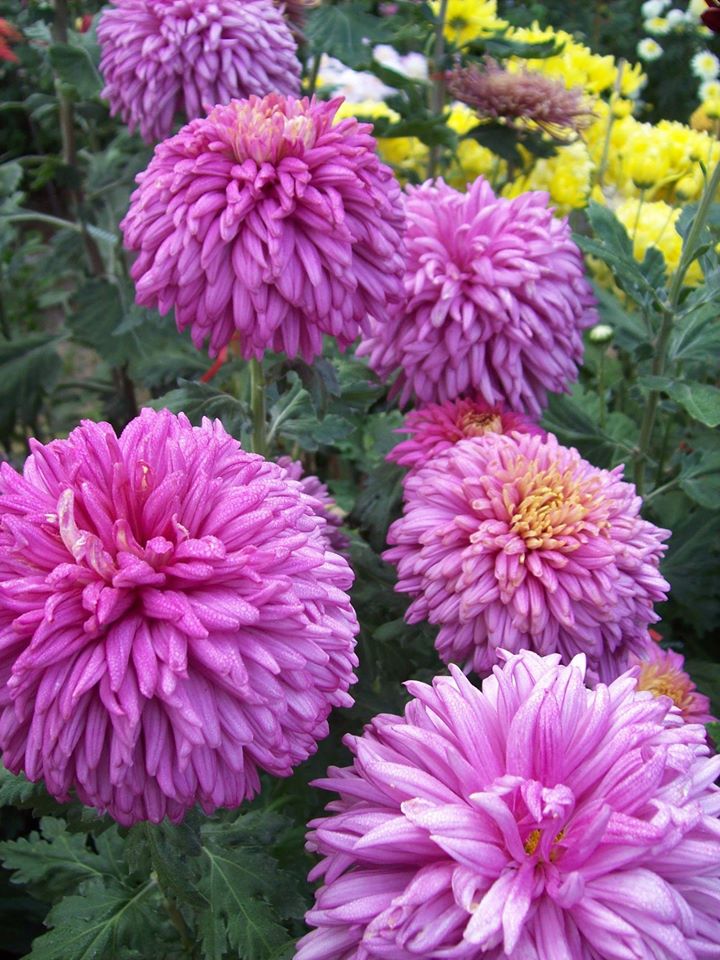
51021thumbIt is impossible to fit enough information about chrysanthemums into just a few sentences. Centuries of breeding have produced too many cultivars to document. Flower color ranges through many shades and hues of yellow, orange, red, pink, bronze, cream, lavender and almost purple, as well as white. (True purple is purportedly lacking.) Many have yellow centers. The deeply lobed leaves are strongly aromatic.
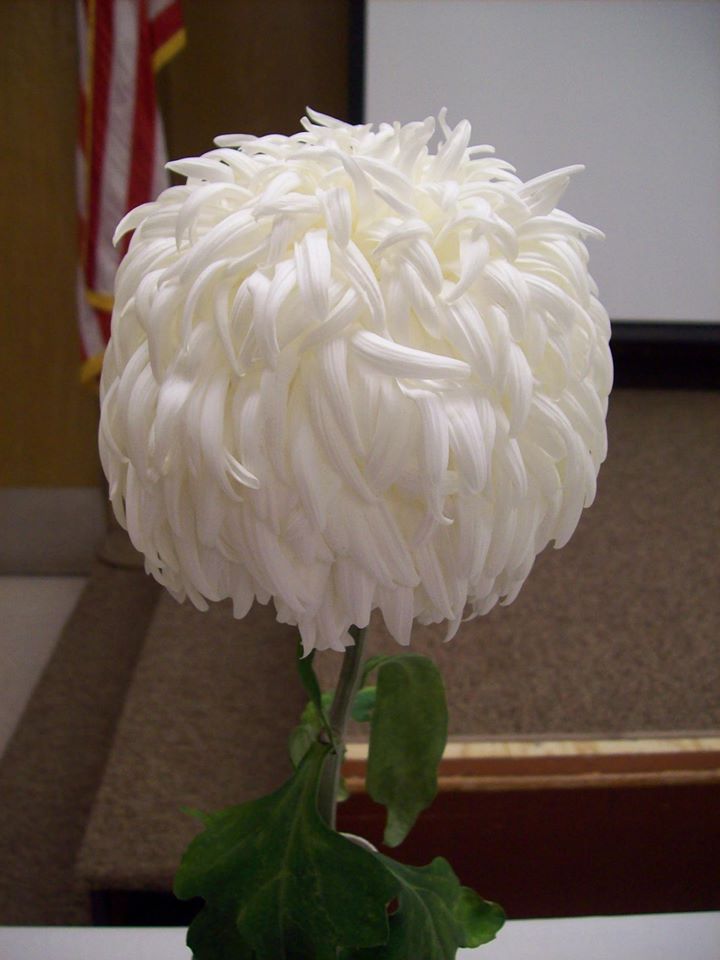
Flower form is as variable as color is. Some are small domed buttons that bloom in sprays of many blooms. Others are round pom-poms. There are all sorts of daisy types. Spider mums have weirdly elongated ‘petals’, (which are actually ‘ray’ florets). Those that bloom singly are bigger than those in sprays. Some of biggest and most billowy seem to be too heavy for their own stems!

If they get what they want, chrysanthemums can be surprisingly reliable and easy to grow. They do want regular watering, regular application of fertilizer, and richly organic media, such as potting soil. In fact, they are popularly grown in pots because they prefer potting media to garden soil. Potted plants can be brought in while blooming, and then retired to the garden between bloom phases.

Chrysanthe-Mum Is The Word

51021Only a few decades ago, when horticulture was taken more seriously, potted blooming plants like chrysanthemums, orchids, azaleas, hydrangeas, lilies and even poinsettias, got the respect that they really deserve. Now they are more commonly purchased in full bloom, enjoyed only as long as their bloom lasts, and then discarded as their blooms deteriorate.
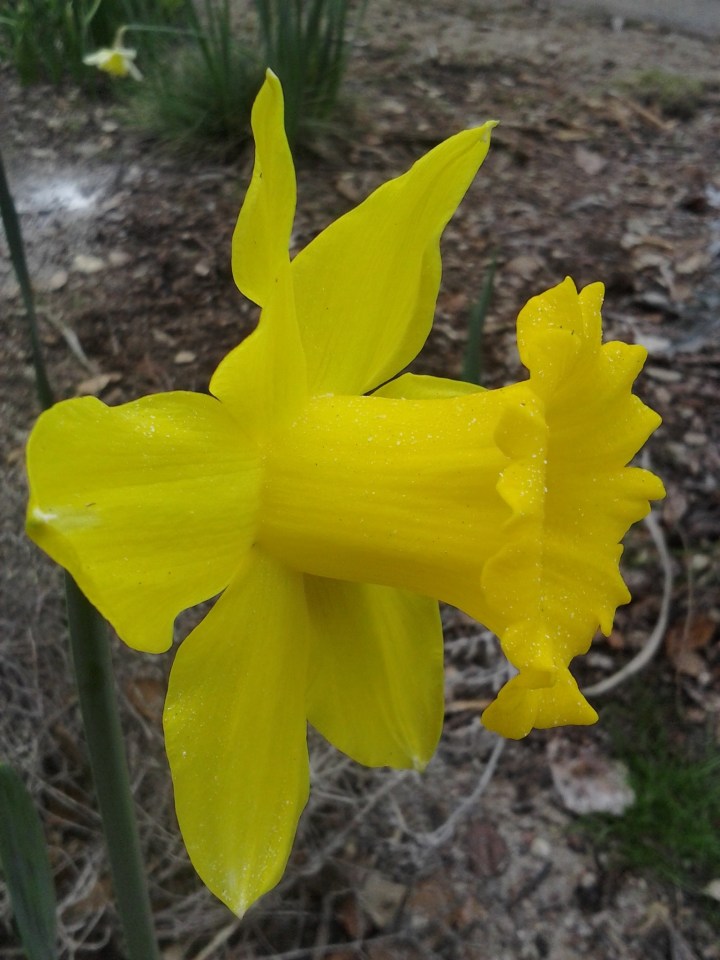
Some get put outside, but often die before they actually get repotted or planted into the garden. Many of those that do get planted, die when their sensitive greenhouse-grown foliage gets scorched by real sun exposure. Others succumb to desiccation before they can disperse their roots. Only orchids want to stay in their original pots for a while, but they rarely get the attention and regular watering that they crave.

Chrysanthemums happen to be in season now, both as potted plants for the interior of the home, and as autumn annuals in the garden. Yet, they are quite sustainable as perennials that can live for quite a few years. They only need to be groomed accordingly so that they can bloom in season, and new stems can replace the old. When they get planted into the garden, multiple plants in a single pot should be separated.

Many chrysanthemums get tall enough to require staking. If left to perform naturally, they bloom profusely. Hobbyists who want to grow larger flowers remove axillary flower buds (sideshoots) to concentrate resources into single terminal (top) flowers that most effectively display their distinctive colors, textures and forms. Sadly, many of the most impressive chrysanthemums have become rare as more profuse bloomers have become more popular.

The Chrysanthemum Society, which can be found on Facebook, is one of the most reliable resources for anyone wanting to grow some of the rare but really fancy exhibition types of Chrysanthemums. The internet makes it possible to get involved with regional chapters well beyond their designated regions. Chrysanthemum fanatics are more than happy to show off and talk about their favorite flowers.

Fall For Spring Bulbs Now

61019thumbThey are certainly not much to look at now. They are even less interesting once buried out of sight in the garden. The big and colorful pictures on the boxes that they arrive in are probably a bit more spectacular than the flowers expected early next spring will actually be. Nonetheless, it will be amazing to see such flashy bloom emerge from seemingly lifeless bulbs that get planted now.
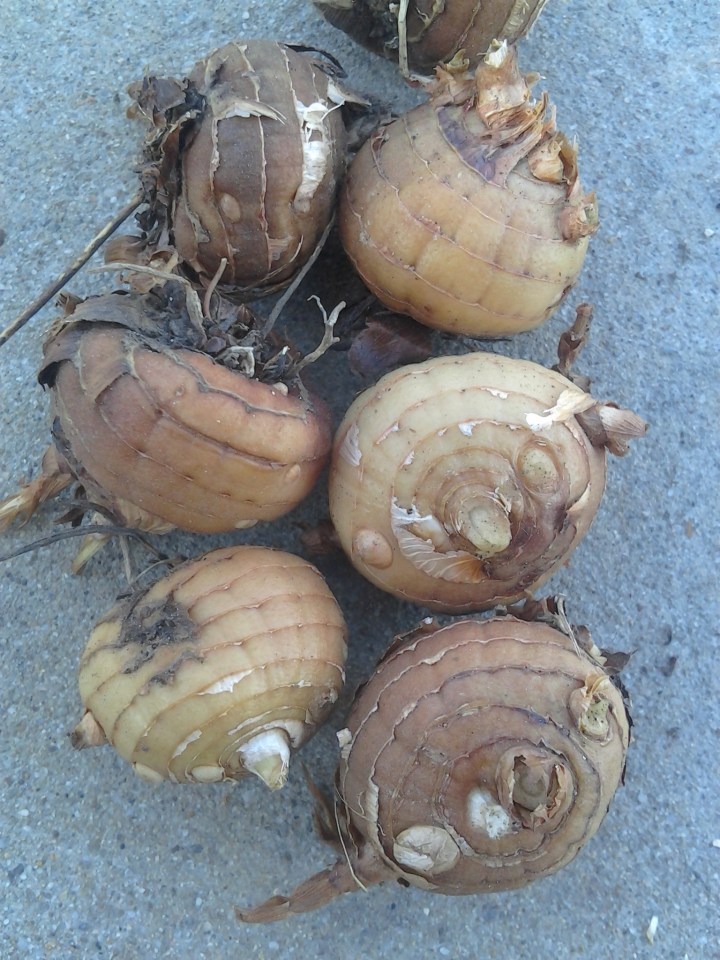
Dormant bulbs are so easy to plants precisely because they are dormant, and therefore lacking any foliage, bloom or roots that can be damaged in the process of planting. They only want to be planted at the right depth, and preferably in the correct orientation (with their tops up and their bottoms down). They like to be planted now, so that they can slowly chill through cool winter weather.

Chill through winter is important to convince dormant bulbs that it really is winter. In such a mild climate, some plants might wonder about that. Cool winter weather either initiates the development of blooms within dormant bulbs, or stimulates bloom as weather subsequently warms. Many tulip, hyacinth, anemone and ranunculus might not get enough chill here to bloom after their first year.

Daffodil, narcissus, grape hyacinth and some iris are not so discriminating. They are likely to bloom even better in their second spring, and can naturalize in good soil with occasional watering. Freesia and crocus might also naturalize, but want more water. Crocosmia and montbretia can actually be invasive. Dahlia and gladiola are summer bulbs, so will be available for planting later.

All bulbs, as well as the corms, rhizomes, tubers and tuberous roots that are commonly known as bulbs, become available in nurseries when it is time for them to be planted, for obvious reasons. Some will be available for quite a while, so can be planted in phases every two week or so, like vegetable plants. Each subsequent phase starts to bloom as each previous phase finishes bloom.

Phasing only works for certain bulbs that are on a tight schedule, and only for the first season. By the second year, they will be synchronized. Iris, anemone and ranunculus tend to bloom together, when the weather is right, regardless of when they were phased. Plants with aggressive roots might not bother bulbs in their first season, but can smother bulbs that might otherwise naturalize.

The Right Bulbs Save Energy

51014thumbAfter working so hard to bloom so impressively in spring or summer, bulbs redirect their efforts into saving up their energy for winter dormancy. That is why their fading foliage lingers after faded flowers get pruned away. The foliage eventually dries and deteriorates, leaving plumped dormant bulbs to overwinter underground. It is all their natural life cycle.

However, to bloom well the following spring, many bulbs need to be chilled while dormant. Such bulbs are from cooler climates. The chill convinces them that it really is winter, and that it will be safe to bloom when weather gets warmer in spring. They can get rather confused without adequate chill. Some may never bloom as well as they did their first spring.

Tulip, hyacinth, lily, anemone and ranunculus are probably the best examples of the worst perennial bulbs. Technically, they are perennials. Where winters are cooler, they may naturalize and bloom every spring. Here, winters are just too mild. They bloom very impressively in their first spring, but rarely bloom as well the second spring, and only if pampered.

Narcissus, daffodil, grape hyacinth and bearded iris are much more reliable. Crocus and freesia are a bit more demanding, but can be reliable if they get what they want. Montbretia and crocosmia are reliable enough to become invasive. Gladiola and dahlia, which are not quite as reliable as crocus, are summer bulbs, so get planted a bit later.

Of course not all bulbs are true bulbs. Some are corms, rhizomes, tubers or tuberous roots. Some get planted deeply. Bearded iris and a few others get planted shallowly. A few others do best in pots. In their first year, some bulbs can be planted in phases so that they bloom in phases the following spring. However, all bulbs of each type will synchronize by their second year.

Anemone, ranunculus and bearded iris bloom too synchronously to be phased. No matter when they get planted, each type blooms at the same time. However, some bearded iris bloom as early as the earliest of daffodil, and others bloom late. Some even bloom twice!