It is not actually from Boston. The first Boston fern, Nephrolepis exaltata ‘Bostoniensis’ was merely discovered in Boston, as a mutant in a shipment of otherwise normal ferns. Unlike the more upright parent plants, Boston fern has softly arching fronds that can hang vertically at the ends.
The fronds are typically about a foot and a half long, and can be a few feet long in humid and partly shady environments. Each frond is comprised of many pinnae that are neatly arranged on both sides of a wiry rachis (leaf stalk). Each leaflet is an inch or two long or longer. Delicate aerial roots sometimes dangle below the foliage.
Through the 1970’s, Boston fern was one of the most popular houseplants. Yet, it really prefers more humidity than it gets inside. It is actually happier on porches or in atriums where it is sheltered from frost and harsh sun exposure. It prefers partial shade outside, but likes abundant ambient sunlight as a houseplant.
Without color or fragrance of flowers, ferns provide some of the most distinctive foliage in the garden. They do not turn color in autumn. Only a few tree ferns develop sculptural branch structure. Yet, they do their job well, and many are happy to do so in spots that are a bit too shady for other plants.
Almost all ferns are low perennials that produce foliage that arches outward from the center. Some can get quite broad. A few tree ferns grow upward on trunks (although the trunks are merely tough roots that grow through decomposing stems). Australian tree ferns can get quite tall and broad where sheltered from wind.
The staghorn fern is a weird epiphyte that naturally clings to tree trunks or rock outcroppings where it collects organic debris that falls from trees above. In home gardens, it is popularly grown on wooden plaques or as a hanging plant. Hanging plants do not necessarily need pots, or sometimes engulf their pots as they grow.
Leaves of ferns are known as ‘fronds’, and with few exceptions, are intricately lobed or divided into smaller leaflets known as ‘pinnae’, which are arranged on opposite sides of leafstalks known as ‘rachi’ (or singularly as ‘rachis’). The staghorn fern has unusually branched but otherwise unlobed fronds. The bird’s next fern has has distinctively simple fronds without any lobes or pinnae.
Most of the popular ferns are naturally understory plants that grow below larger plants. Even most tree ferns grow amongst larger trees. This is why so many ferns tolerate shade so well. In fact, many prefer partial shade, and will actually fade or scorch if too exposed. However, it is also why so many ferns prefer rich soil with an abundance of organic matter.
Maidenhair, rabbit’s foot, bird’s nest, holly, Boston and a few other ferns are popular as houseplants. Because home interiors are a somewhat arid for them (lacking humidity), some ferns like to be misted daily. Ferns respond well to regular but light application of fertilizer. Too much fertilizer can roast foliage.
Because ferns are not expected to bloom, nitrogen (which can inhibit bloom for some plants) is not a problem. Ferns that are out in the garden can therefore get fish emulsion or a bit of the same sort of nitrogen fertilizers that keep lawns green.
Foliage needs sunlight for photosynthesis. Foliage needs air for respiration. Roots need moisture to sustain foliage. Houseplants can technically get all of what they need from the confinement of their pots within the interiors of homes and other buildings. They only require sufficient moisture to be delivered to them, and sufficient sunlight from windows. The air is the same that we all utilize.
However, there is no substitute for nature. While hydroponics and synthetic light facilitate yet more deprivation of what is natural, the plants involved would appreciate more consideration. Without exception, domesticated plants are descendants of plants that grew wild somewhere. Those that dislike local weather would be pleased with the weather of their respective ancestral homelands.
Most of the popular houseplants that are grown for their lush foliage originated from tropical forests. Many were understory plants that prefer the shade of larger trees. That is how they tolerate the relatively shaded interiors of buildings. Now that they are here as houseplants, they appreciate shelter from frost. They probably miss rain, humidity, sporadic breezes and tropical warmth though.
Rinsing tropical foliage plants in the shower eliminates some of the dust that they accumulate where air stagnates. Rinsing them out in the garden is even better because it does not make such a mess in the shower. What is even better than both of these options is allowing a gentle rain to rinse the foliage. Plants only need to be moved to a windless spot prior to an expected rain shower.
The weather was much too cool earlier in winter. There will be no rain later in summer. This time of year, and again next autumn, the weather is safely mild; and eventually, a few showers are likely. Timing is critical. Plants should be brought out just prior to rain, and brought in before the weather gets sunny. Foliage that has always been sheltered is very sensitive to scald from direct sunlight.
Saucers and pots can be cleaned while outside. Crowded plant can be repotted.
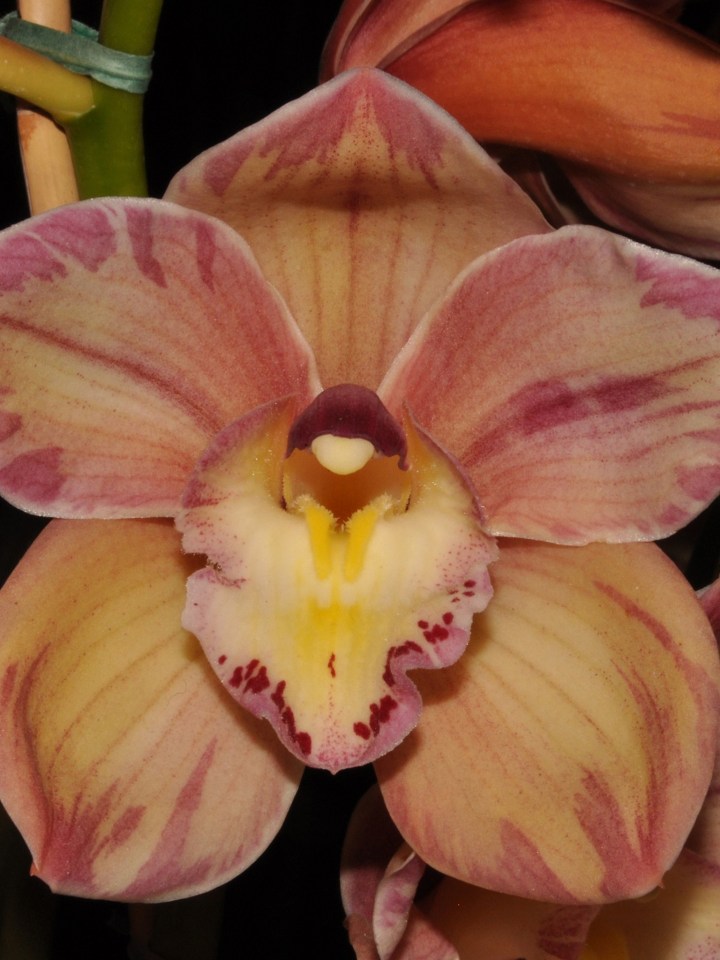
It is funny how so many different plants get here from all over the world, and then become so popular so far from their natural homes that they seem to have always been here. It is now hard to imagine that some of the more popular cymbidium orchids actually came from tropical and subtropical Asia and northern Australia. Other orchids are from tropical Africa or South America.
As the Nineteenth Century turned to the Twentieth, orchids were popularized by those who profited from industry in the east, and then moved west to escape harsh winters. They arrived in the Mediterranean climate of the Santa Barbara region with resources to spend on outfitting luxury homes with comparably luxurious gardens and exotic plants. Orchids were a natural choice.
At homes in Montecito and Hope Ranch, cymbidium orchids were grown is mass plantings, and maintained by professional horticulturists. The popularity of orchids continued for decades. As the extensive orchid collections of England were threatened by the bombing and fuel shortages of World War II, collectors and horticulturists in California brought them here to be safe and warm.
Many of these refugee orchids were bred extensively by Californian horticulturists to produce many of the countless varieties that are now available. Production of blooming potted orchid plants and cut orchid flowers have become major horticultural industries in California. To this day, the Santa Barbara region produces more orchids than any other region in America. Modern tissue culture cloning technology has made it possible to propagate and grow more orchid plants at a faster rate than ever before. This makes them more affordable.
Even though mass plantings of cymbidium orchids are now rare, orchids are probably as popular as they ever have been, simply because they are so available to more people who can enjoy them. They are not limited to fancy gardens of luxury homes. Cymbidiums are still popular potted plants for sheltered porches. Small but flashy moth orchids are among the most popular of blooming potted plants for homes and offices.
The red, orange, yellow, purple, white or almost black fruit of ornamental pepper that naturally develops in summer can be seen at any time of year because the plants are grown in artificial greenhouse environments. The peppers are usually small and narrow, and stand upright above their glossy rich green foliage. Some are narrower. Others are a plumper. Technically, the fruit is edible, but it is not as flavorful as peppers grown for culinary purposes.
Because the plants are sensitive to frost, they are more often grown as houseplants than out in the garden. In the garden, they need shelter to survive as perennials. As houseplants, they need warm and sunny exposure in order to bloom and develop fruit. They should be watered regularly, but only as their potting soil is starting to get dry.
Landscaping and growing houseplants really is no way to bring nature closer to home. If it were up to nature, most of our gardens would be relatively bare. Most of the few native trees are less than ideal for home gardens. The few native annuals and perennials with colorful flowers bloom only briefly. Almost all native shrubbery is scrubby and not conducive to pruning. After all, most of us live in what would naturally be coastal chaparral.
This is why home gardens contain so many exotic plants from so many different climates and regions all over the world. These plants get pruned, shorn and mown in all sorts of unnatural ways. Most do better if watered unnaturally through naturally dry summer weather. Many crave unnatural fertilizer. Houseplants and a few others are confined to pots so that roots can not disperse like they want to.
Potted plants that are forced into bloom to decorate home interiors are the most unnatural of all. They are among the most extensively bred of plants. They are grown in contrived environments that coerce them to bloom whenever their blooms are needed. Poinsettias, lilies, azaleas, hydrangeas, kalanchoes, callas, miniature roses, chrysanthemums and some orchids are the more familiar of these sorts of plants.
They are certainly colorful by the time they leave the greenhouses they were grown in. By the time they come home, they are in the middle of full bloom. There is no work to get them to bloom. The work is in keeping blooms as healthy and as colorful as possible, for as long as possible. Most of these plants only want to be watered regularly, and are happy to keep their color for quite a while.
By the time they want fertilizer, blooming potted plants will have finished blooming. Sadly, at that time, most get discarded instead. Realistically though, such systematically abused plants can be rather ugly as they replace their greenhouse foliage with foliage that is better adapted to the garden. The process of forcing them into bloom is just too unnatural and difficult to recover from easily.
Yet, with enough patience and pampering, most blooming potted plants should eventually recover and adapt to a garden lifestyle. Lilies, callas and other bulb-like plants should be put aside in the garden while their foliage fades and eventually separates from the bulbs. The dormant bulbs can then be planted and allowed to grow into their new environments.
Of all the tender perennials, polka dot plant, Hypoestes phyllostachya, is one of the lesser likely to survive winter outside, even if sheltered from the cold. Yet, it is actually becoming more popular as a warm season folliage plant for pots of small mixed perennials. It is a delightful small houseplant, either alone or as an understory plant to larger houseplants like ficus. As an understory plant, It is easier to work with if grown separately in small pots that can get nestled into moss on top of the soil of the larger plants. If it has a problem, it can easily be replaced or removed.
The foliage typically has so many pink spots that less than half of the foliar surface area is green. Some have white or darker reddish pink spots. The bloom is not as interesting as the foliage, and is not often seen. Roots like rich and evenly moist potting soil. The biggest plants are not much more than a foot high. Most stay less than half as tall. New plants are easy to propagate from cuttings. When things get warmer in spring, plants that have more stems than foliage can be cut back to regenerate.
‘Tis the season for seasonal potted plants. These are not well established houseplant or potted plants that live out on porches and patios through the year. Seasonal potted plants are those that are purchased at their prime, allowed to live in our homes and offices while they continue to bloom or maintain their foliage, and then most likely get discarded when no longer visually appealing.
Poinsettia epitomizes winter seasonal potted plants. Florists’ cyclamen, azalea, holly, amaryllis, Christmas cactus and small living Christmas trees are other overly popular choices. All are grown in very synthetic environments designed to force optimal performance, with no regard to survival afterward. They are like cut flowers that are not yet dead. They are true aberrations of horticulture.
Technically, any of them can survive as potted plants, or out in the garden after they serve their purpose as appealing seasonal potted plants. Their main difficulty is that it is not so easy for them to recover from their prior cultivation, and adapt to more realistic environmental conditions. For now, it is best to enjoy them at their best, and try to maintain them at their best for as long as possible.
Eventually, they all experience a phase in which their original growth deteriorates to some extent, while they start to generate new growth that is adapted to the situation that they are in at the time. Christmas cactus are probably the most proficient at adapting, and becoming delightful houseplants. They are even likely to bloom occasionally, although not on any particular schedule for winter.
Holly, azalea and cyclamen can eventually get planted out in the garden. Most hollies grow into large evergreen shrubbery, but do not produce as many berries as they originally did. Azaleas are cultivars that were developed to be seasonal potted plants, so are a bit more finicky than those developed more for landscapes. Cyclamen can be added to pots of mixed annuals and perennials.
Living Christmas trees are not so easy to accommodate. Most are pines that need their space.
It is unfortunate that, like Easter lilies and poinsettias, most kalanches, Kalanchoe blossfeldiana, are enjoyed while actively blooming, and then discarded as their blooms fade. It is so easy to simply snip out the deteriorating flowers, and grow the small perennials plants for their appealing succulent foliage until they bloom again. They do not get much more than half a foot tall, so can stay in small pots indefinitely. They seem to prefer the porosity of clay pots. Because they can rot, they should be watered when the surface of the soil seems to be getting dry, and their drainage saucers should not be allowed to hold water too long. Kalanchoes like bright but indirect sunlight. They can be acclimated to direct sun exposure, but might seem to be somewhat stunted. If brought in before frost, they can be happy out on a patio. The clustered small flowers can be white, pink, red or bright or pastel shades of orange or yellow.
Just like potted chyrsanthemums, azaleas, hydrangeas and poinsettias, potted specimens of Guzmania magnifica are popularly purchased while beginning to bloom, enjoyed as house plants through a long bloom cycle, but then discarded as bloom eventually deteriorates. They are rarely allowed to produce new pups that can be divided and grown into fresh new plants to bloom later.
The bright yellow, orange, red or pink bloom stalks, as well as their rich green basal foliage, are so glossy that they seem to be plastic. The colorful parts of the blooms are pointy strap shaped bracts that arch outward from upright stalks. The leaves below have the same shape, but are longer, and more densely arranged in neat rosettes. Tiny flowers are mostly obscured by the bracts.
Guzmania magnifica, likes bright ambient sunlight without direct sun exposure, and can tolerate significant shade, especially if grown for only a few months while blooming. They seem to like misting, but probably do not not need it. They should be watered only weekly to every two weeks, when the surface of the soil seems to be getting dry. Too much fertilizer might scorch the foliage.




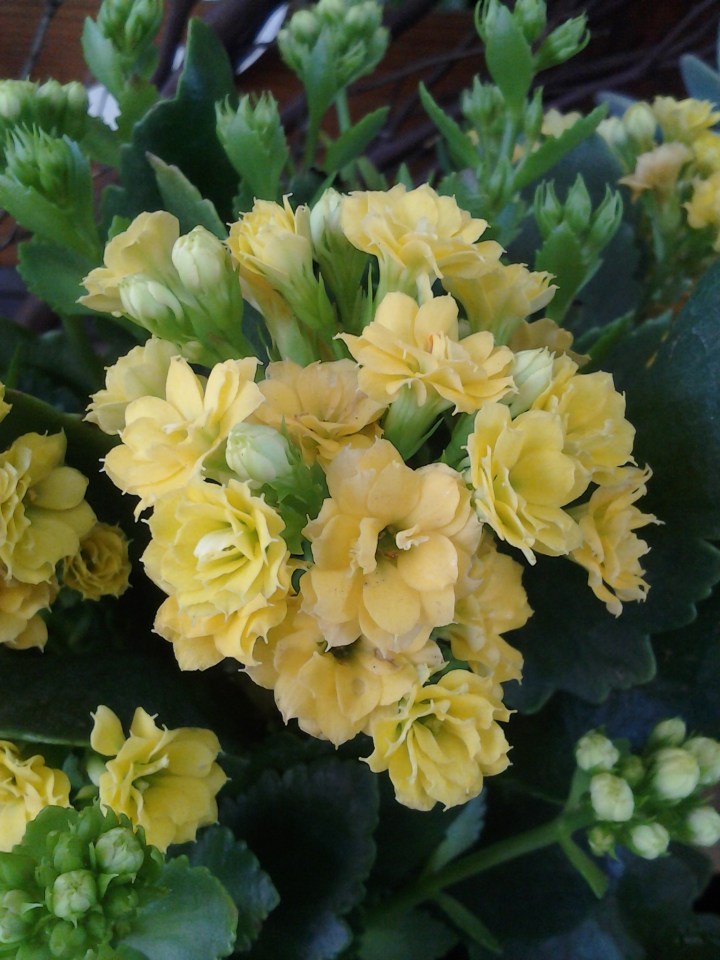 It is unfortunate that, like Easter lilies and poinsettias, most kalanches, Kalanchoe blossfeldiana, are enjoyed while actively blooming, and then discarded as their blooms fade. It is so easy to simply snip out the deteriorating flowers, and grow the small perennials plants for their appealing succulent foliage until they bloom again. They do not get much more than half a foot tall, so can stay in small pots indefinitely. They seem to prefer the porosity of clay pots. Because they can rot, they should be watered when the surface of the soil seems to be getting dry, and their drainage saucers should not be allowed to hold water too long. Kalanchoes like bright but indirect sunlight. They can be acclimated to direct sun exposure, but might seem to be somewhat stunted. If brought in before frost, they can be happy out on a patio. The clustered small flowers can be white, pink, red or bright or pastel shades of orange or yellow.
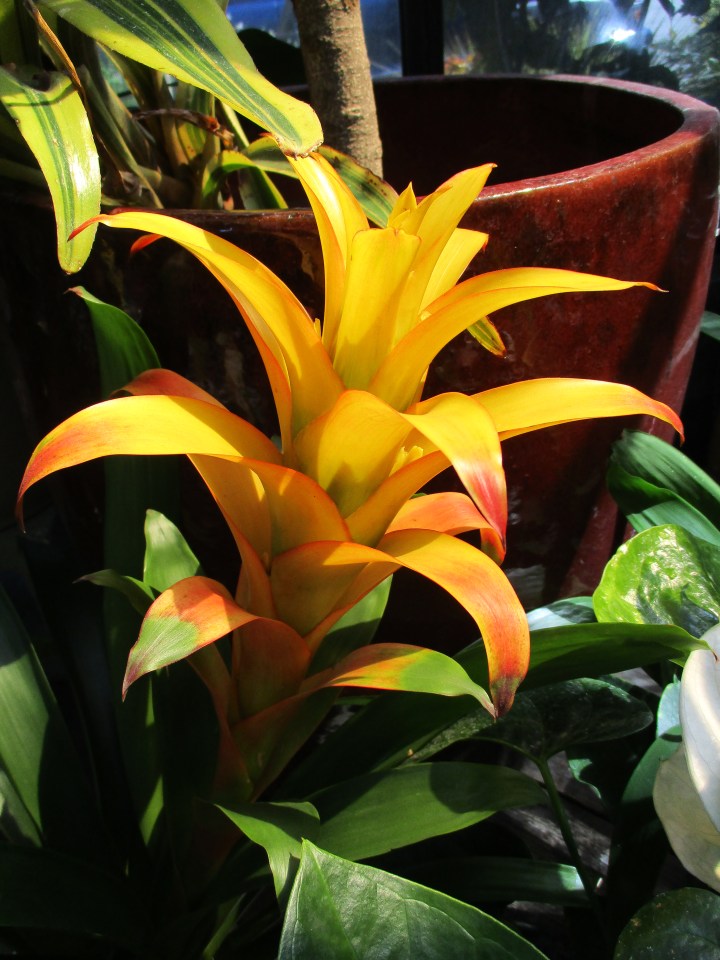 Just like potted chyrsanthemums, azaleas, hydrangeas and poinsettias, potted specimens of Guzmania magnifica are popularly purchased while beginning to bloom, enjoyed as house plants through a long bloom cycle, but then discarded as bloom eventually deteriorates. They are rarely allowed to produce new pups that can be divided and grown into fresh new plants to bloom later.
