Six on Saturday: Vanity II


As I mentioned in the immediately previous post, this is the sequel to that same previous post, and the second ‘Six on Saturday’ for today. These five bad pictures of good camellias, and the sixth . . . picture, would make sense only after reading the previous post: https://tonytomeo.com/2019/03/30/six-on-saturday-vanity/

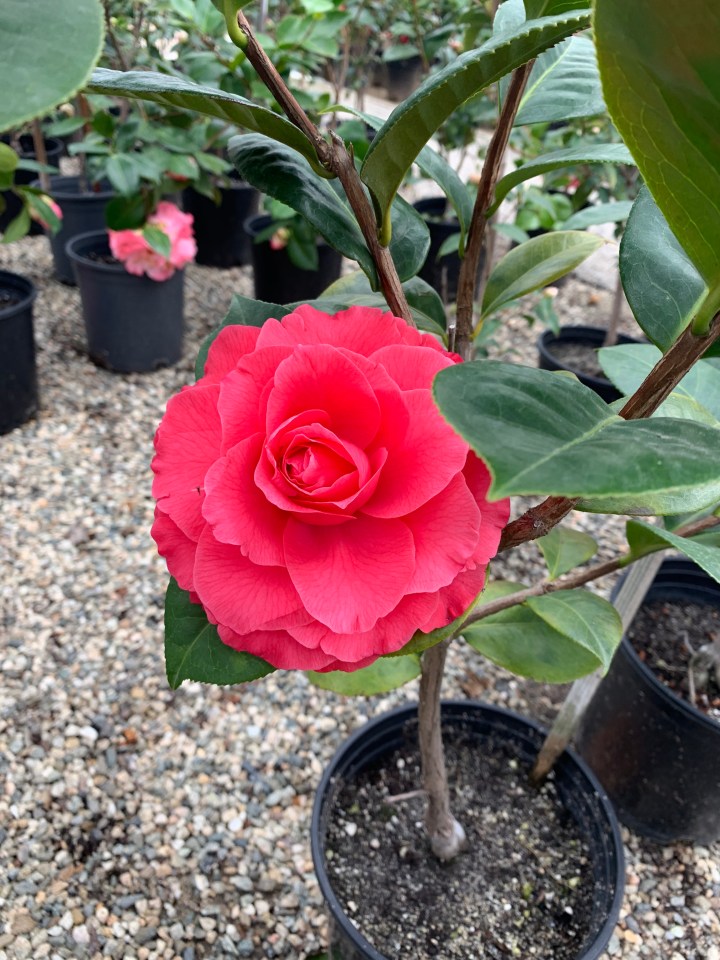
These pictures are somewhat better than the previous six, . . . although black vinyl nursery cans and the gravel on the ground below are a bit too prominent in the first four. The flowers are centered better within the pictures, . . . although the first three are not facing the camera.

1. R. L. WheelerP90330K

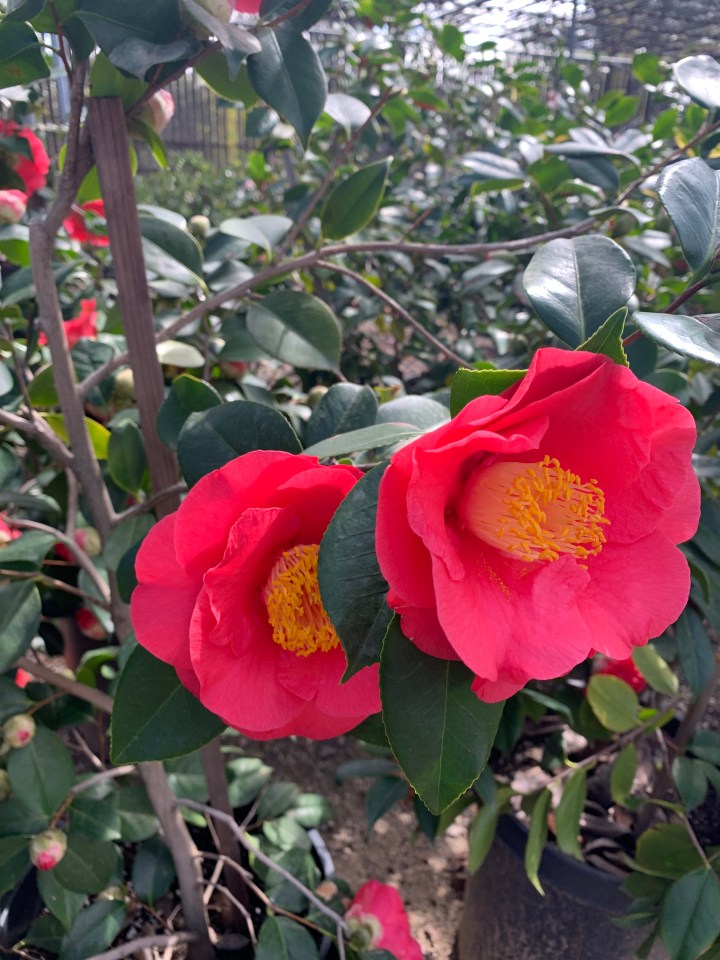
2. Variegated Guilio NuccioP90330K+

3. Nuccio’s GemP90330K++

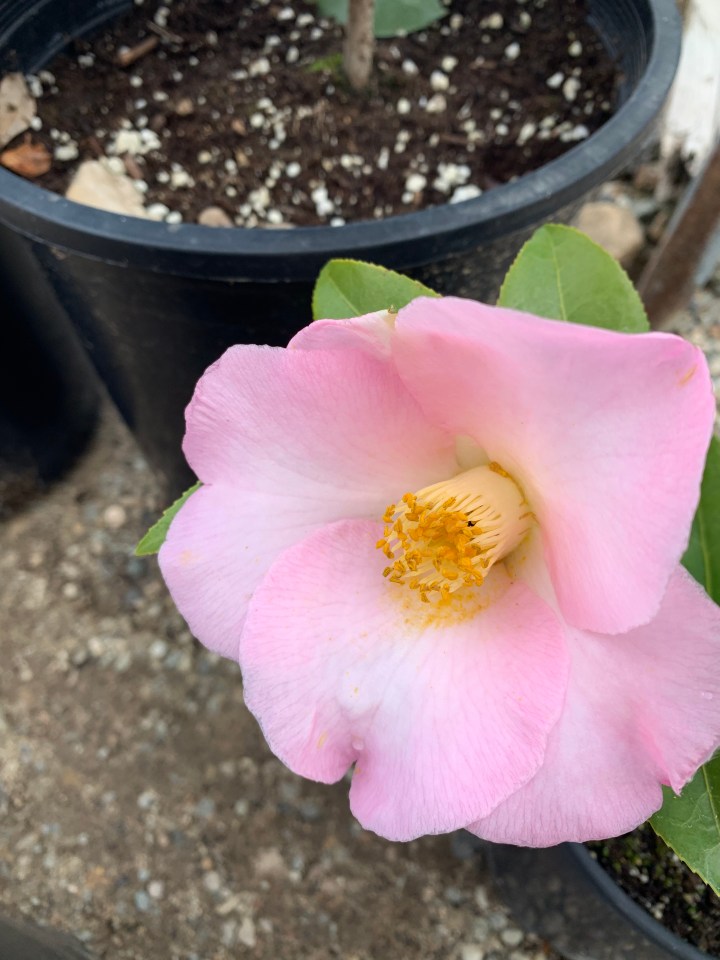
4. Valentine’s DayP90330K+++

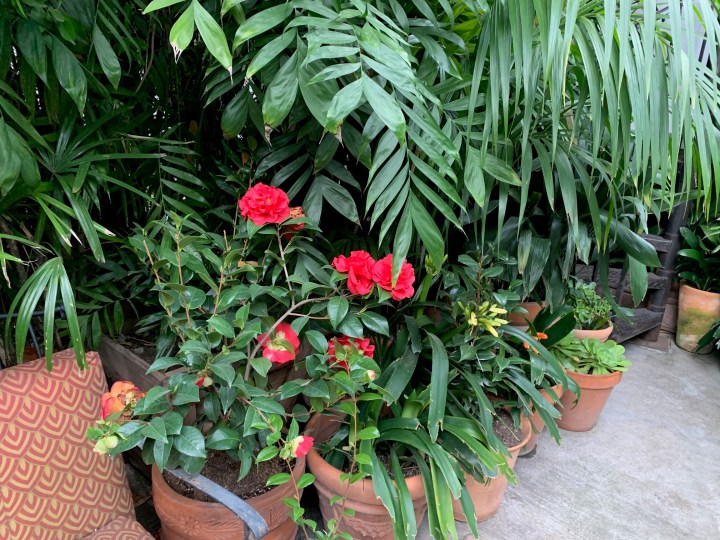
5. Unidentified camellia in the home gardenP90330K++++

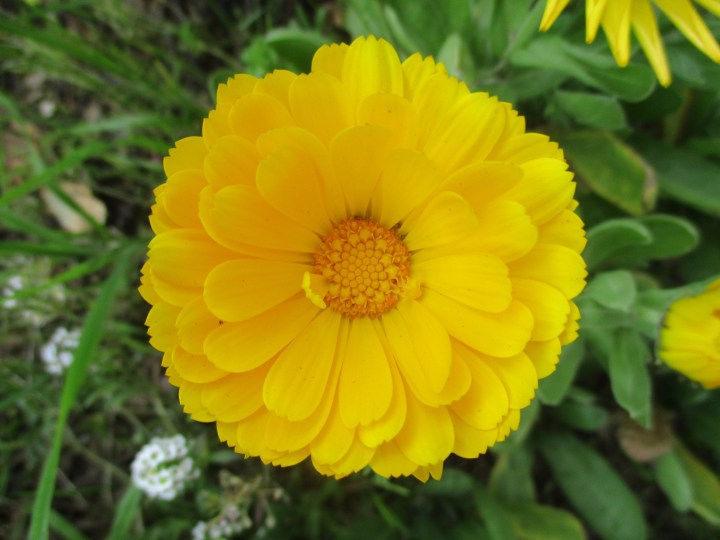
6. ME! As mentioned above, the previous post makes a bit more sense about these pictures.P90330K+++++

Now, in case you do not read the previous post or know who Brent is, I will explain briefly that he is a renowned but extremely vain landscape designer in the Los Angeles region, and has been my colleague since we were college roommates in 1986. I posted my selfie here for comparison with Brent’s selfie in the previous post. Together they demonstrate that, although I am not nearly as proficient with taking good selfies as Brent is, I look much better in my selfies. Ironically, Brent Green, the renowned landscape designer, got his selfie in a nursery; and I am a nurseryman, but got my selfie in a landscape.

There are some more pictures of Brent’s home garden that I will likely share next week. They are much more interesting than the sorts of landscapes that I work in.

This is the link for Six on Saturday, for anyone else who would like to participate:

https://thepropagatorblog.wordpress.com/2017/09/18/six-on-saturday-a-participant-guide/

Six on Saturday: Vanity


These are five of the pictures of camellias from Nuccio’s Nursery in Altadena that I said last week I would share this week. I will share five more immediately afterward in a second ‘Six on Saturday’ post. I am not certain if there is a rule against doing so, but no one seemed to mind when I did the same to share an over abundance of autumn foliar color last autumn. You can find the second post here: https://tonytomeo.com/2019/03/30/six-on-saturday-vanity-ii/

Brent Green, my colleague who I sometimes mention within the context of my articles, typically in a rather unflattering manner, took these pictures nearly two weeks ago. He lives and works nearby, in the Los Angeles region.

Brent takes horrible pictures. He always has. He was wasting my film on bad pictures such as these in 1986. I told him just before he took these pictures that I really wanted GOOD pictures. These are what I got.

Also, Brent is VERY vain. Back in 1986, when we were roommates in Fremont Hall at Cal Poly in San Luis Obispo, he often had me go get the car to meet him at the bottom of the stairs because he was in that much of a hurry to do whatever he happened to be doing at the time. It might have been getting close to a week since he last got his Grace Jones flat top do done. Perhaps his clothes were getting close to three months old, so he needed a new batch. It was always a rush. The problem was that there was a mirror in our dorm room. I would wait in the red zone at the bottom of the stairs with the engine running for several minutes before going back up to the top floor and most of the way down the long hall to our room to find him staring at himself in that mirror. When I told him that we needed to leave NOW before the car got ticketed, he would still need to add some more Sta-Sof-Fro to his do . . . and stare some more. He had hair back then.

Yes, this is relevant here. Anyway, these are the camellias:

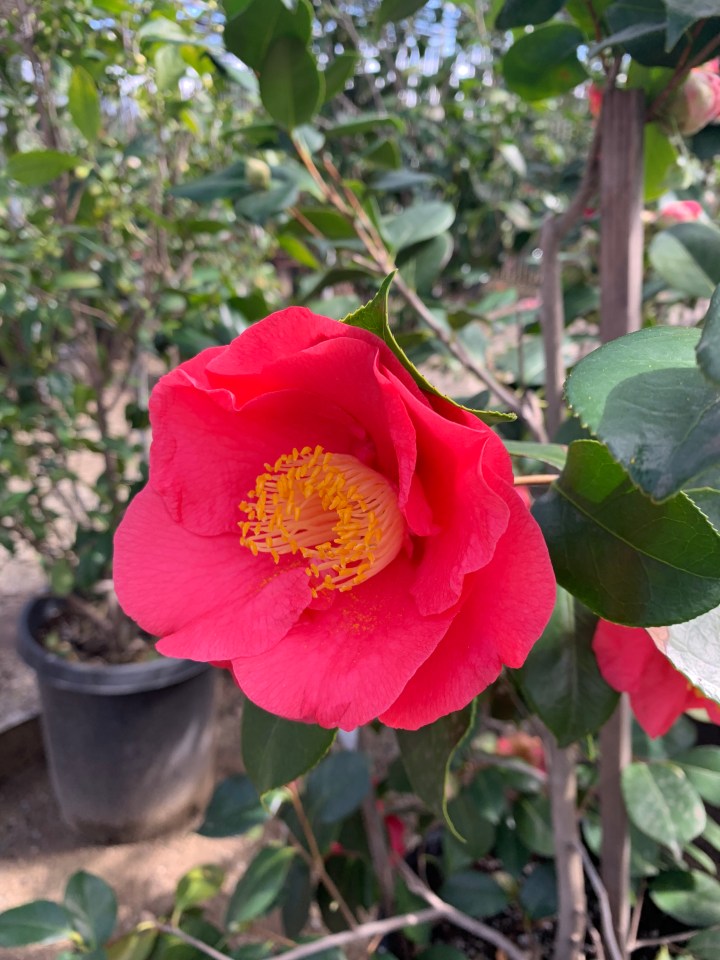
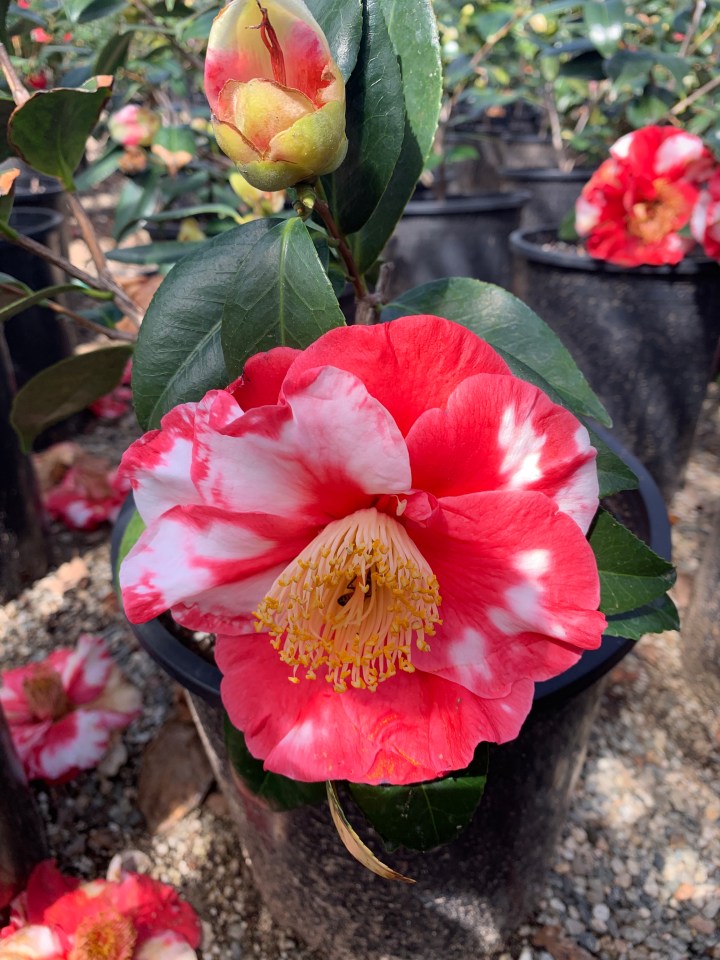
1. Chandleri Elegans or Francine – What do they see off to the right? Why is one cowering behind the other? This picture should have been centered, and wider than tall, or horizontal rather than vertical.P90330

2. Rosette – What is so interesting off to the left that the flower can not look at the camera? Is this supposed to be a picture of the flower low in the picture, or the gravel beyond it?P90330+

3. Red Devil – There are a lot of distracted flowers here. What is this one looking at on the ground? Is the gravel that interesting? Perhaps the vinyl cans are. This one should be centered too.P90330++

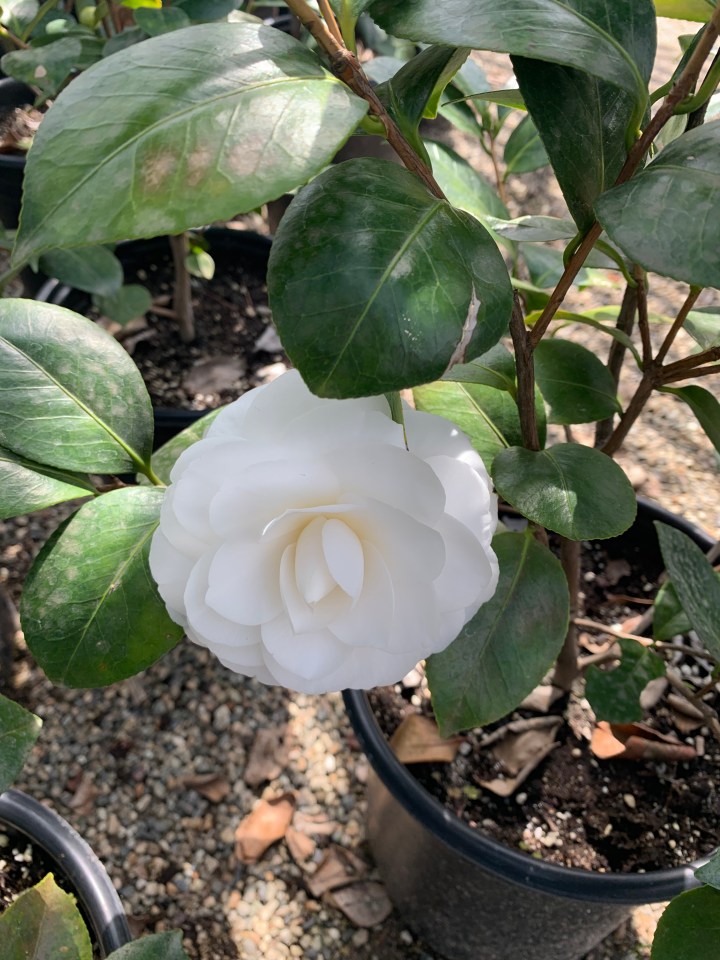
4. Demure – This one looks like an album cover from the 1970s; pale, distracted, and off center against an industrial background. It could be a bad picture, or it could be artistic.P90330+++

5. Tata – This one looks like a teenager with bad acne looking down before jumping off the high dive.P90330++++

6. Brent Green – The only good picture of the bunch.P90330+++++

Now . . . how did Brent take such bad pictures of flowers that he could so easily aim the camera at properly, AND take such a perfect selfie without being able to see the picture as he took it? Could it be VANITY?!?

This is the link for Six on Saturday, for anyone else who would like to participate:

https://thepropagatorblog.wordpress.com/2017/09/18/six-on-saturday-a-participant-guide/

Six on Saturday: Presbyterian Horticulture


Subjects for more than just a few of my illustrations are found in the simple landscape of Felton Presbyterian Church. Until the last year or so, I had been able to participate in more of the seasonal work days, when we do most of the maintenance of the landscape, as well as a few other chores. No one seems to mind that I am Catholic.

The biggest and best trees, including the big coast live oak, Quercus agrifolia, out front (which I should have gotten a picture of) are native, and were there before the site was developed. Smaller trees of the same species have appeared since then. Also, a nice big catalpa, Catalpa speciosa, appeared right out front, just to the south of the big coast live oak. Otherwise, most of the landscape is an odd mix of what various parishioners contribute to it.

1. Naked lady, Amaryllis belladonna, bloomed late last summer, just before the foliage started to develop in autumn. They are blooming again! Now I know where fake roses come from.P90323

2. Breath of Heaven, Coleonema pulchrum, has a name that is more appropriate to a Church than ‘naked lady’. The flowers are tiny, and not very impressive, but are pretty against the very finely textured foliage.P90323+

3. Pot marigold, Calendula officinalis, has been modestly naturalized here for years. There are just enough to be pretty, without being invasive. Goodness! Naked ladies and pot!P90323++

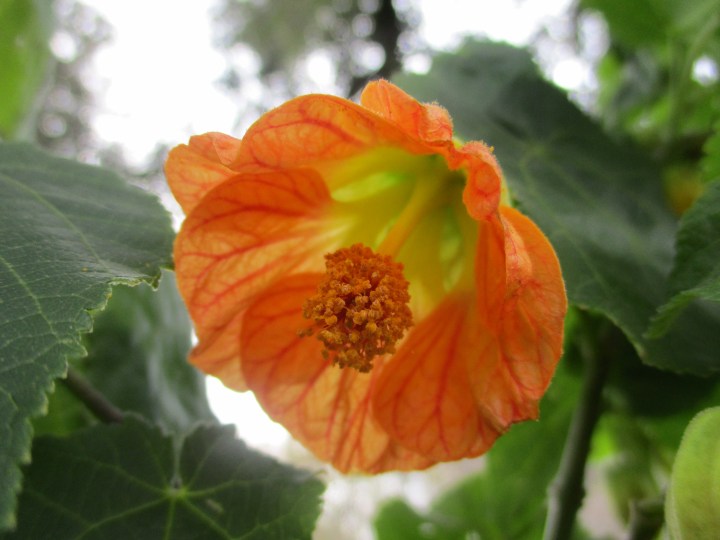
4. Flowering maple, Abutilon spp., was contributed by a parishioner who has many growing wild and blooming in a variety of colors at here home in the same neighborhood where I work. She gave us many of the same.P90323+++

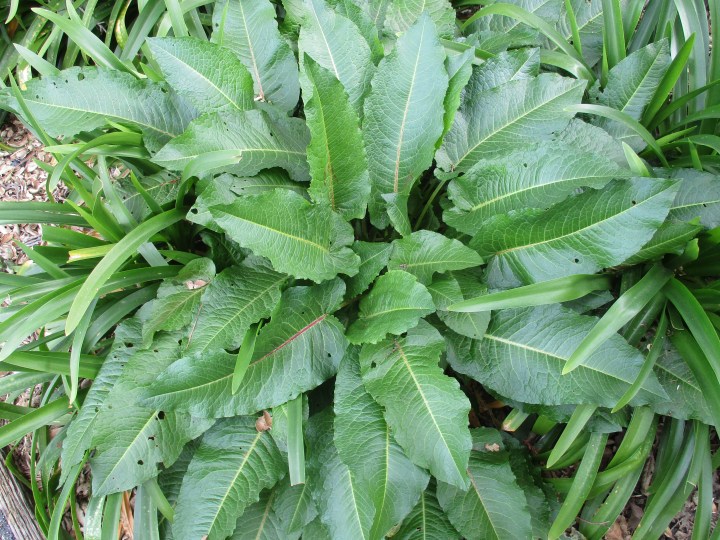
5. Dock, Rumex crispus, has a cool name, but is really just a weed. I have been trying to kill this one for years! It will not die. The root is mixed with tree roots. Now, it looks so fat and happy that I sort of want to leave it.P90323++++

6. Lichen (which I can not identify with a Latin name) on the limbs of the crape myrtle featured last week got noticed enough for it to get a close up picture this week. I don’t understand the allure. I’m not lichen this one.P90323+++++

Since I did not use any of the pictures of camellias from Nuccios’ Nursery in Altadena that Brent sent to me (that I mentioned last week), I will try to share them next week, even though they finished blooming already.

This is the link for Six on Saturday, for anyone else who would like to participate:

https://thepropagatorblog.wordpress.com/2017/09/18/six-on-saturday-a-participant-guide/

Horridculture – B & B

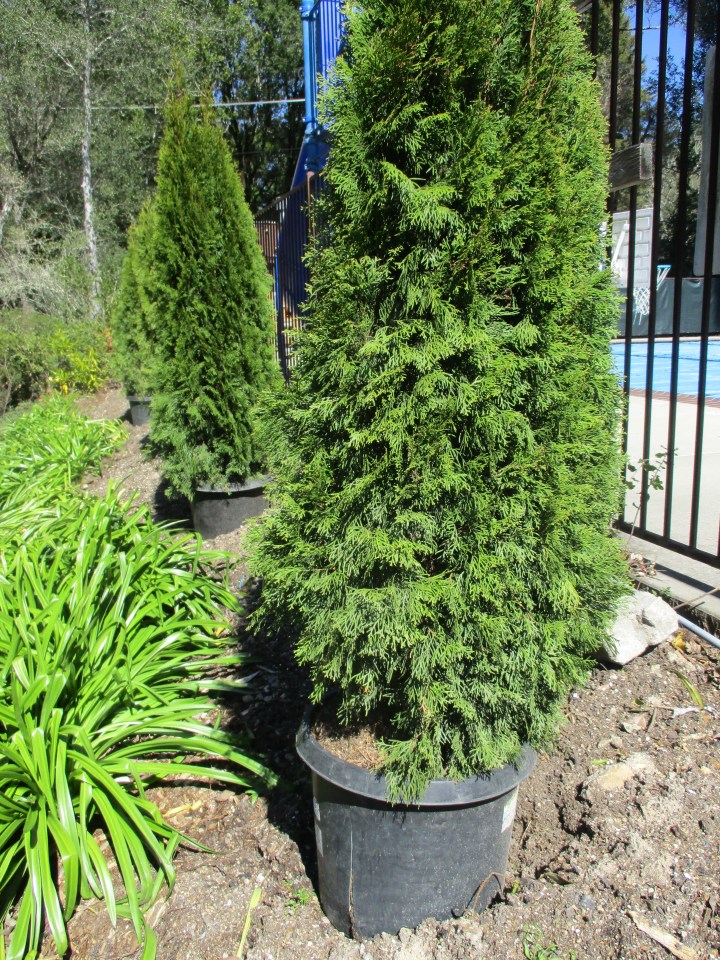
P90320B & B, formally known as ‘balled and burlapped’ nursery stock, was expected to be the next big ‘thing’ in nursery commodities here in California back in the late 1980s. As those outside of California know, it is field grown plant material that gets dug and marketed with its roots wrapped in burlap. It was more common in other regions, so was expected to become more common here as more nursery stock was to be imported from Oregon.
However, growers in Oregon started growing more of their stock in cans like we do in California, and then did not send as much of their B & B stock to California as predicted. Only certain slow growing commodities and large items are still field grown, and then dug and ‘balled and burlapped’ for export. Of these, arborvitaes, rhododendrons and various deciduous shade trees are the more commonly available locally.
B & B stock from Oregon is typically of exceptional quality. Horticulture is taken more seriously there.
Because B & B is still a foreign concept in California, it is typically canned to be more familiar to local consumers. It does not take long for it to root into the little bit of extra potting medium and fill out the cans. There is no need for the roots to be unwrapped, since the burlap decays as fast as the root disperse and expand. The now canned but formerly B & B arborvitaes in the picture above are exemplary.
Yet, they are not perfect. The problem with B & B stock here is that there are not many horticultural professionals here who know how to work with it, or even care to do so properly.
The picture below shows how shallow the B & B root systems of the arborvitaes are relative to the squat #15 (15 gallon) cans that they were purchased in. They obviously did not get enough time to root into their potting medium after they were canned. This is not due to a lack of horticultural expertise. This is either (and hopefully) a mistake in scheduling, or merely a lack of concern. But hey, no bother. They are still excellent specimens.P90320+
At least they seemed to be. A potentially serious problem was revealed when they were installed and the loose potting medium fell away from the burlap.
Many years ago, the burlap containing the balled root systems of B & B stock was bound with biodegradable jute twine. It rotted away before it could do any damage. Since then, nylon twine became more commonly used. Those who are familiar with B & B know to simply cut and remove the nylon twine before planting.
Whomever processed and canned these arborvitaes are either (and hopefully) not familiar with B & B, or just do not care. The nylon twine was still tightly bound and tied. If these arborvitaes had rooted into their potting medium and held it intact, this twine would not have been visible. Because it is wrapped a few times around the main trunks as well as wadded up burlap, it could have girdled the main trunks as they grew and expanded!
In a way, it was fortuitous that the potting medium fell away to expose the nylon twine, which was cut to allow for expansion of the main trunks. These exemplary B & B arborvitaes from Oregon should live happily ever after.P90320++

Six on Saturday: Picture Dump


No topic. No excuse. I just have these few pictures that I have no other use for. Some are sort of interesting, depending on perspective. Some are weird. #5 is just plain unsightly.

I considered sharing six pictures of camellias from Nuccios’ Nursery in Altadena that Brent sent to me, but I did not want to totally dismiss these pictures. Besides, Brent takes really lame pictures. I might share them next week just so we all can see how lame they are. I believe that most are different from the camellias at work that I shared pictures of last year, but I really do not know.

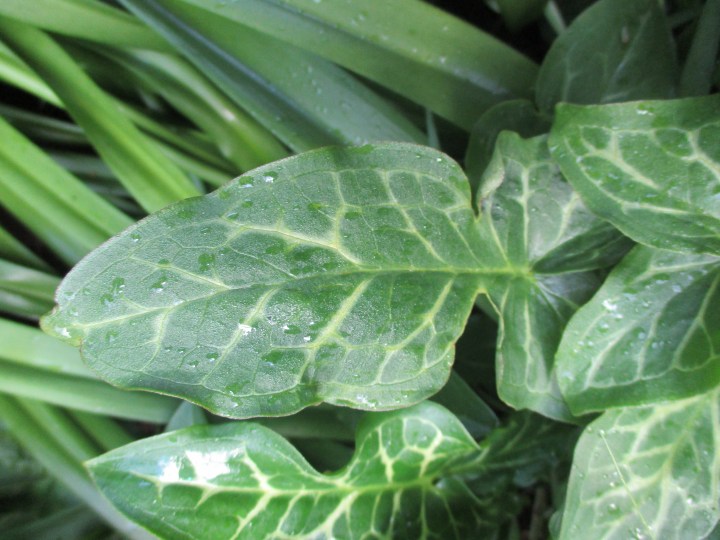
1. Arum italicum, which is also known simply as Italian arum, is something that I had always dismissed as a naturalized and sometimes invasive exotic species. In other words, I thought of it merely as a weed. Then, I noticed others using the foliage with cut flowers. It never occurred to me how pretty it is. I am not sure if this is the real deal, but it is what grows here. Some of the garden varieties that others have shared pictures of are more intensely variegated. It seems to me that another species that is not variegated might live here too, but I can not remember where I saw it.P90316
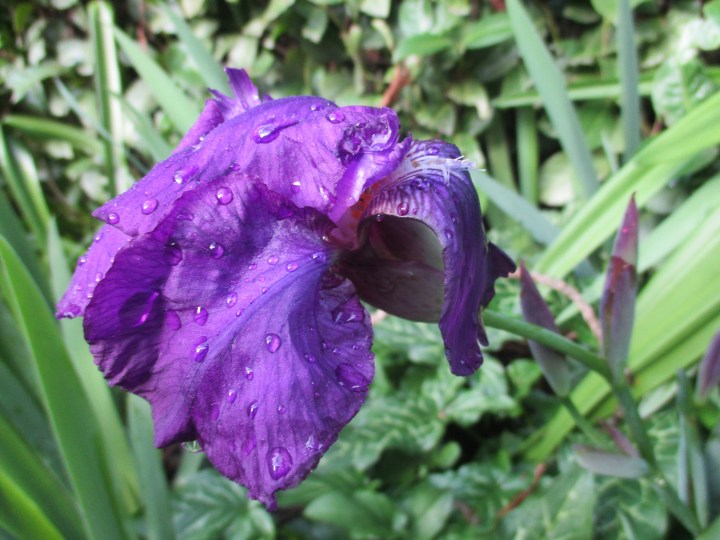
2. It never rains in Southern California. This is not Southern California. Besides, contrary to popular belief, it really ‘does’ rain in Southern California. Anyway, the incessant and abundant rain has been damaging a few of the spring blooming flowers, although most are doing quite well. This odd bearded iris bloom seems to be melting. Those that bloomed immediately afterward are doing just fine. The stems seem to me to be unusually slim for bearded iris, but I am no expert.P90316+
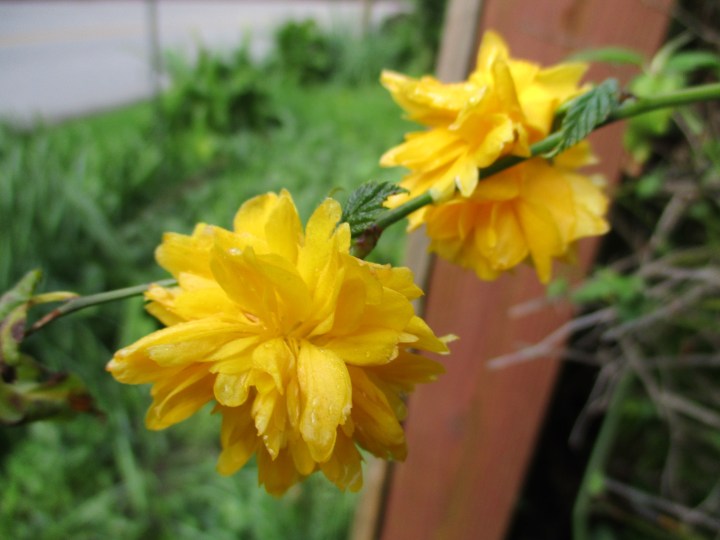
3. WHAT IS THIS?!? I believe it to be Kerria japonica, which is also known simply as Japanese kerria. . . . sort of like Arum italicum, which is also known simply as Italian arum. I thought it was something completely different until it bloomed. I will not say what I though it was, because my assumption was about as lame as Brent’s camellia pictures, and we can’t have that.P90316++
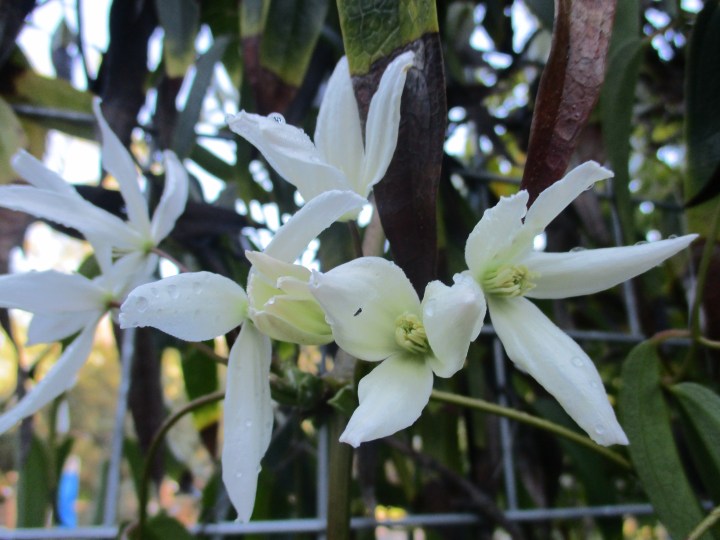
4. Clematis armandii, which is also known simply as Armand clematis (I bet you didn’t see that one coming.) is more popularly know here as evergreen clematis. It grows like the weed that it is, and climbs into the lemon tree that it is next too. It always seems to be very vigorous and healthy, but many of the leaves have crispy tips. Those at the top of the picture are about half dead! The vine does not get any fertilizer, although it probably reaches where other plants are fertilized. The damage is attributed to the water.P90316+++
5. Lagerstroemia indica, which is NOT also known simply as Indian lagerstroemia, is the familiar crape myrtle. Some might disdainfully spell it without the first ‘e’. I am none to keen on it either. Actually, I am none too keen on its overuse! It is everywhere, and very often in situations that it does not belong in. This one is under larger trees, so does not get enough sunlight to bloom well. Prior to pruning, it was more disfigured than it is now. Since it can not grow as tall as it would like to be, it should be pollarded annually. As it matures and develops knuckles, some of the superfluous stems can be removed. As much as I dislike crape myrtle in bad situations, I want this tree to be pollarded properly. ‘Crape murder’ is unacceptable! There are MANY in the region that are indiscriminately hacked by so-called ‘gardeners’, who leave nasty stubs and unsightly stubble.P90316++++

6. Eureka lemon originated as a ‘sport’, or mutant growth, of Lisbon lemon. The only difference between the two is that Lisbon lemon produces all fruit within a limited season, while Eureka lemon produces a bit less within the same season, and then continues to produce a few additional fruit sporadically throughout the year. Lisbon lemon works well for orchards that produce lemons for lemon products. Eureka lemon is better for home gardens, where it is always happy to provide lemons whenever they are desired. I got this picture of a single ripening fruit because there are not many others on the tree right now. That means the tree is doing its job; and people who work here are using the lemons.P90316+++++

This is the link for Six on Saturday, for anyone else who would like to participate:

https://thepropagatorblog.wordpress.com/2017/09/18/six-on-saturday-a-participant-guide/
Horridculture – Fads

P90313This is why I do not grow hellebores in my own garden. The specimen in the pictures above and below are about as good as they get here. Most are quite a bit worse. Some put out only one or two flowers. Some do not survive their first year in the garden.
No one seems to know why they don’t do well here. It might be the lack of chill in winter, although they do better in even milder climates. It might be the minimal humidity, although they generally do no better in the damp redwood forests where the specimen in these pictures lives. Those that might get too much sunlight do no better or worse than those that get too much shade. They are simply not happy here.
My solution to this ‘problem’ is to not grow them in my own garden. I do not particularly like them anyway. Even those that look ‘good’ look like huge African violets dipped in paraffin. Those in the landscapes that I work with now are the colors of worn vinyl upholstery of 1970s Chryslers. Yup, I will pass on hellebores. ‘Problem’ solved before it happened.
That ‘solution’ does not work for everyone.
Some landscapers get what they can from the few growers who will grow them here, and plant them in all sorts of landscapes that they just do not belong in. Some will do it because they read somewhere that hellebores do well in shade, which is technically true, but only in regions where other environmental conditions are appropriate. Some do it because they saw pretty pictures of them, and read a nice article about them in some gardening magazine that features such articles about what does well where the respective magazines are published.
Sadly, many do it because hellebores are a fad here, and something that many landscapers with something to prove like to brag about. They are like dawn redwood and unusual varieties of Japanese maple that are so often installed into inappropriate situations just so the landscaper can add pictures of them to their portfolios. Fortunately, hellebores merely struggle or die without causing any other damage to the landscape.
There are a few kinds of fads, and some of them actually make sense, but good landscape designers should use fads responsibly and with discretion.P90313+

Six on Saturday: Mudslide


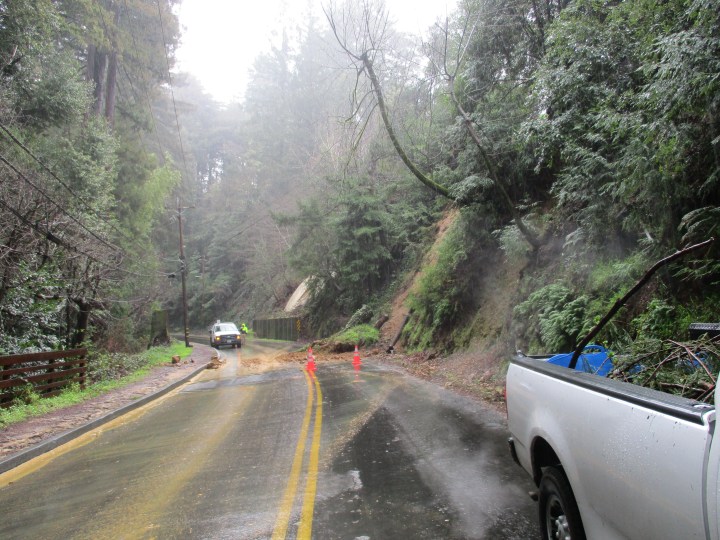
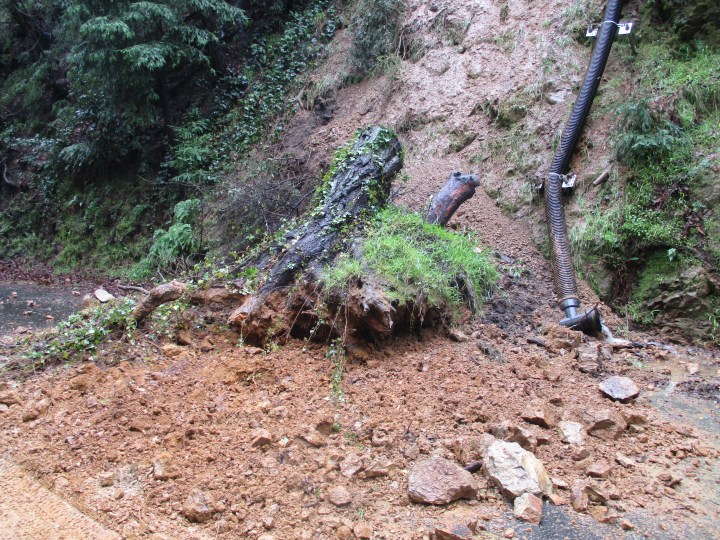
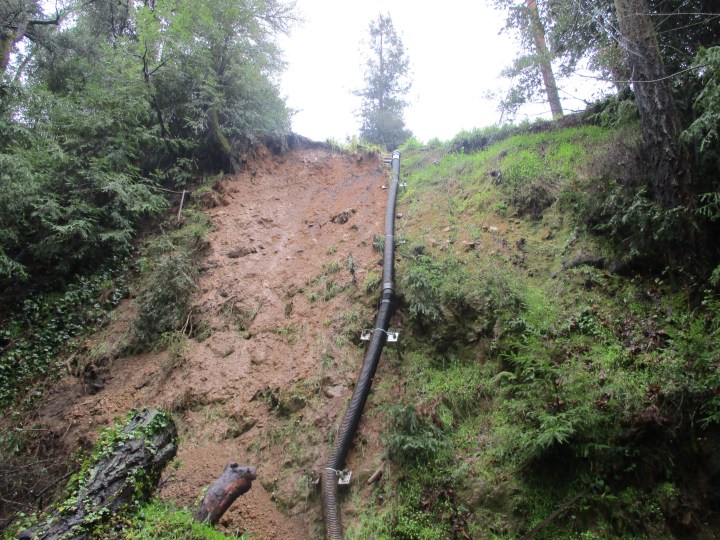
With all the rain, it was no surprise. Mudslides are somewhat common here, and they sometimes close roads. In fact, we were sort of expecting a small mudslide almost in this particular spot right when we got the call about it. The only slight surprise was that it was right next to where we expected it to be. The cliff that we expected to make this sort of mess was still intact under the tarps put over it to deflect some of the rain.

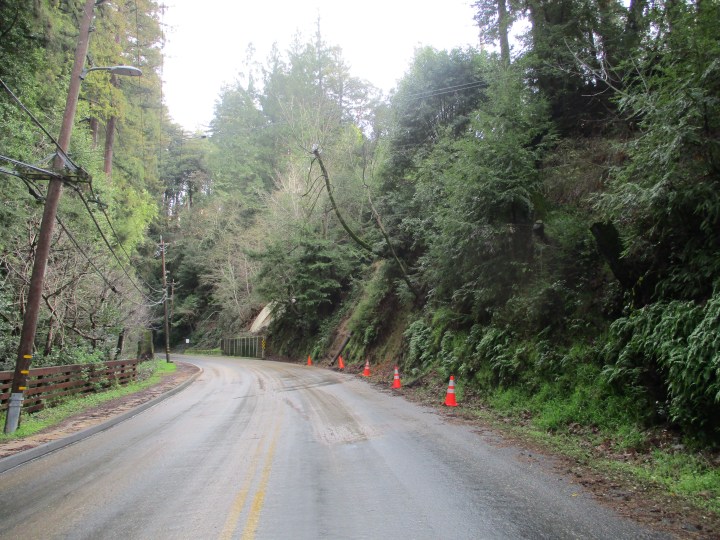
Fortunately, it was a small mudslide that blocked only one lane. We were able to direct traffic through the other lane while the blocked lane was cleared of debris by a small bulldozer.

The top of the cliff slid to the bottom along with a stump of a Douglas fir that was cut down many years ago. The Douglas fir was cut down so that it would not destabilize the soil that it was rooted into as it moved in the wind. However, The soil was destabilized as the Douglas fir roots that held it together decayed. This is actually a common dilemma, since trees sometimes need to be cut down before they cause such problems, but the death and decay of the roots of such trees ultimately cause the same problems.

The sorts of trees that could be coppiced do not do so well in the dry soil on top of cliffs. Otherwise, we could plants willows, cottonwoods or something of the sort, and cut them down as they get too big, without killing the roots. They would be happy to regenerate and continue the process. The sorts of plants that prevent surface erosion do not do much to stabilize the soil. Otherwise, we could put something as simple as freeway iceplant (Carpobrotus chilensis) on top, and let it cascade downward over the unstable area.

1. It was nothing too serious, but just enough to block the inbound lane. Tarps over the cliff that we expected to make this sort of mess are visible above the retaining wall just beyond. My work pickup in the lower right corner of the picture blocked the inbound lane with its headlights and hazard flashers on. I directed incoming traffic around it into the clear outbound lane as it was available. The young man off in the distance moved his pickup out of the outbound lane, and also directed traffic accordingly. When necessary, he stopped traffic while incoming traffic used the outbound lane. We communicated by radio and hand signals.P90309

2. This is the stump of the Douglas fir that was cut down so that it would not dislodge the soil and cause a mudslide. A decayed stump of a smaller madrone tree is to the right. Their rotting roots and the English ivy were insufficient to stabilize the top of the cliff.P90309+

3. These significant mudstone boulders on the far side of the road could have done some serious damage to a car if one had gotten in their way.P90309++

4. That is where the Douglas fir stump came from, just to the left of the drainage pipe. It did not get very far. That is it at the lower left corner.P90309+++

5. We arrived about ten. By noon, there was not much evidence of what had happened. We left the cones because the road was slippery with mud.P90309++++

6. This is supposed to be a gardening blog, so here is an unidentified fern that witnessed the whole ordeal from a stable portion of the same cliff. There is slightly more flora to this story than two dead stumps and a bit of ivy.P90309+++++

This is the link for Six on Saturday, for anyone else who would like to participate:

https://thepropagatorblog.wordpress.com/2017/09/18/six-on-saturday-a-participant-guide/
Six on Saturday: Another Day At The Office


There is no rush to leave the office and shop when the weather is cold and rainy. We have been getting quite a few of the inside chores done. When we do go out in the rain, I do not like to take the camera out from under my rain gear; so I do not take many pictures. Besides, since most of my work involves pruning right now, I have not been working much around what is blooming or other interesting subjects.

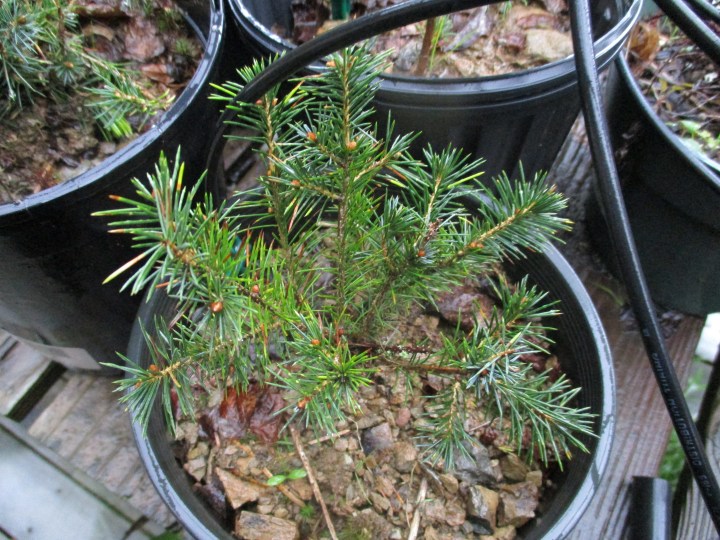
1. Sitka spruce brought back from near Smith River within their native range are now happily canned in the recovery nursery at our shop. They look as if they were grown here, or are on a bench in a production nursery. They will eventually go out into the landscapes.P90302

2. Staghorn fern that the same colleague with the Sitka spruce brought back from his grandparents’ home in Orange County are not so happy. They were desiccated on arrival. Now that they are getting much more rain then then need, they are just rotting. The specimen that is still attached to the plywood on the left is probably beyond salvage. The specimen that broke its wire and fell onto the deck to the right is only partially viable. The viable portion will probably be separated from most of the rotting necrotic portion when it is attached to a new slab.P90302+

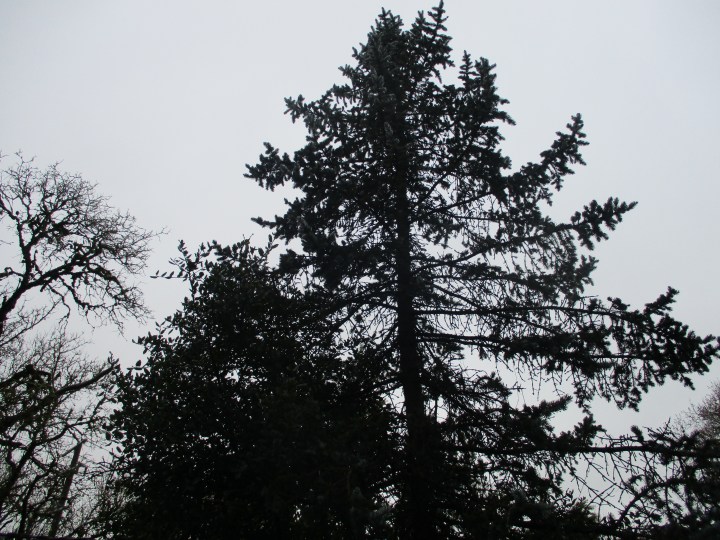
3. Colorado blue spruce and a young coast live oak are adjacent to the deck where the Sitka spruce and staghorn fern reside. This is not a good picture, but shows how the young oak to the left is crowding the older spruce to the right. Their main trunks are only about two feet apart at grade. The spruce was planted back in the middle of the 1980s, and would be a more desirable tree, but is very distressed, and is not likely worthy of salvage. The native oak grew from seed within only the past several years, and is not particularly remarkable, but happens to be quite healthy and well structured. It is not easy to decide which tree to cut down. I sort of suspect that the oak will win, and the spruce will need to go. Those are cruddy box elders in the background.P90302++

4. Bucket of rain water is impressively full next to the spruce and oak . . . and other spruces and staghorn ferns. There is an open recycle bin nearby that is also full. It must have been somewhat dark rather early in the morning for the flash to operate when I took this picture. I do not know if it ruined my selfie or just made it more artistic.P90302+++

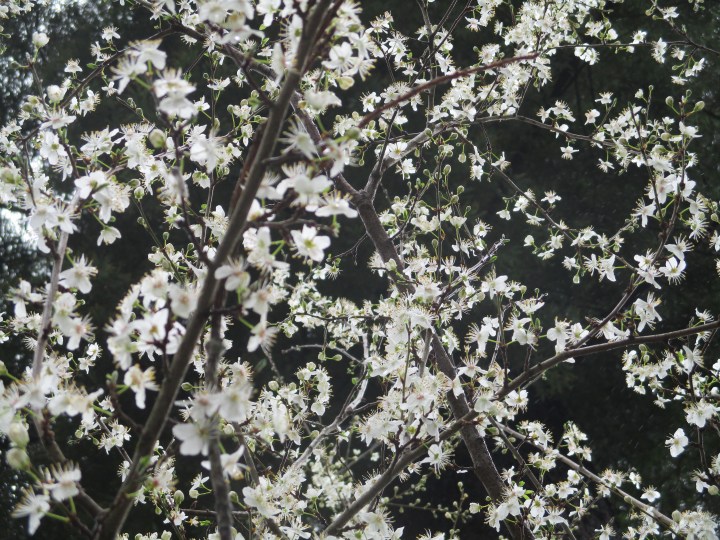
5. Wild plum is still blooming in some spots. These survived all the rain rather well by delaying their bloom somehow. It will be raining again by the time you see this after midnight on Saturday morning, so this bloom will not last long. There may be others that bloom even later though, and with one exception, the flowering cherries have not started their bloom yet. That darkness in the background is the trunk of a big redwood tree.P90302++++

6. Wild plum close up shows the detail of the blossoms, and the unfocused silhouette of the redwood trunk in the background.P90302+++++

This is the link for Six on Saturday, for anyone else who would like to participate:

https://thepropagatorblog.wordpress.com/2017/09/18/six-on-saturday-a-participant-guide/
Six on Saturday: Above and Below


All that rain was excellent! Now it is cold. There was snow in Malibu in Southern California. It has not been this cold in quite a while. Nonetheless, the weather is grand, and not so cold in the middle of the day. The first three of these six pictures prove it.

1. This was just about sunrise on the first day in a while that did not start with rain. It was cold, and the sky was clear. The trees to the left are Douglas fir. The tree just to the right of center is a ponderosa pine. The tree in the right corner is a coast live oak. This is in one of those spots where different ecosystems collide. The firs merge into redwoods to the left. Ponderosa pines mixed with a few coast live oaks continue to the right, with more pines farther back. All are native.P90223

2. Now it is raining again. I would not say it was real rain, but merely a brief rain shower, with really big and soggy raindrops. Since it lasted only a few minutes, I would still classify this as a sunny day. Unfortunately, the raindrops are not visible in the picture; but the light duty clouds in an otherwise clear sky are. It was sunny when this picture was taken, which means that from some other vantage, this spot was at the end of a rainbow. Those trees are native (coastal) redwoods.P90223+

3. While looking up, I noticed that the exotic (nonnative) sweetgum is mostly defoliated. Rain tends to dislodge the colorful foliage in winter. The two leaning redwood trunks in the middle of the picture are a concern because, although they (and palms) are the most stable trees that I work with, redwoods do not accommodate structural deficiency very well. The asymmetrical distribution of the weight of the trunks above the curves exerts lateral tension on the trunk.P90223++

4. Below all these tall trees, we have a pile of nice madrone firewood that is ready to be split for next year. The native madrone is notorious for instability. Big trees often blow over, or just fall over because they are really bored. The tree that produced all this firewood was cut down because the lower trunk was so very rotten. Yet, as you can see, the firewood from upper limbs is in good condition. Madrone firewood is quite desirable, so this wood is expected to be gone soon.P90223+++

5. The shade under redwood forests is so dark that even these shade tolerant (exotic) gold dust plant want more sunlight. I should have just cut these down, but instead tried to give them a second chance. I pruned out all the dead material, and then pruned out some of the deteriorating stems, hoping that the process would stimulate new grown. That was almost a year ago. Not only has there been no growth or improvement, but the foliage looks even more distressed than it did before!P90223++++

6. Out in a sunnier spot, and after most others have finished, these (exotic) daffodils are still blooming. Actually, they have been blooming for a while. Since there are two different varieties blooming now, I suspect that those that bloomed here earlier were a different variety, or varieties. There is a bit of (exotic) tulip foliage mixed in with them. No bulbs were intentionally planted here on the riverbank, so were likely dumped here in soil that came from a planter or a landscape somewhere.P90223+++++

This is the link for Six on Saturday, for anyone else who would like to participate:

https://thepropagatorblog.wordpress.com/2017/09/18/six-on-saturday-a-participant-guide/
Six on Saturday: After The Storm


Contrary to popular belief, we do get a bit of wintry weather here. It is neither as cold nor as snowy as weather is in most other regions, but it gets sufficiently cool and rainy to let us know it is winter. In fact, here on the western slopes of the Santa Cruz Mountains, we get the little bit of extra weather that does not quite get over the Summit into the Santa Clara Valley. Clouds must unload slightly in order to gain sufficient altitude.

There have been more storms so far this winter than there normally are, and this last week was particularly stormy. It is both a lot of fun, and a lot of work. Storms are innately wet, as well as messy. By the time we catch up from one storm, another arrives. The first few storms are something to be celebrated. The last few start to be rather bothersome.

1. Do you see the well kept shop buildings on the left and right? Neither do I. This is what I found when I got to work on Thursday morning after the electricity was put out by a wicked storm. The lights in the middle are those of a car out on the road. I managed to set up the coffee ‘machine’ to make coffee for the crew when the electricity came back on. I also put the leftover coffee that someone made late the previous night into a pitcher, so that if the electricity did not come back on in time for the crew to make fresh coffee, the first few to arrive could warm up the leftover coffee in the . . . . . . microwave. Okay, perhaps that was not such a good idea. The coffee was just swell cold.P90216

2. Many trees fell during the last few storms. Many more trees lost significant limbs. This unfortunate coast live oak is not as bad as it looks. Once the stub of the fractured limb is removed, it should be just fine. We try to identify potentially hazardous trees, and either work with them to make them less hazardous, or remove them completely. It is nonetheless impossible to predict all hazards. I would have not considered this particular subject to be hazardous prior to the damage seen here.P90216+

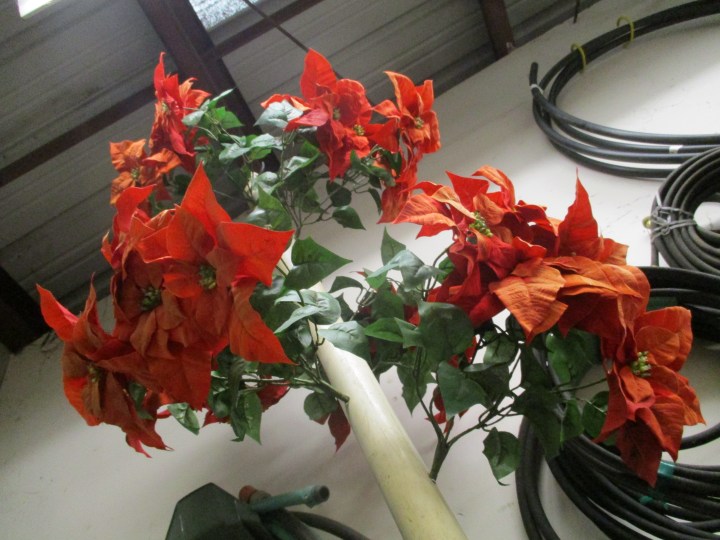
3. Artificial poinsettias were removed about a month after Christmas. https://tonytomeo.com/2019/01/26/pseudodendron-falsifolia/ They are no longer seasonal. Besides, this is the stormy season here, when these artificial poinsettias would be likely to get blown about the neighborhood if left out. If they were to survive the storms, they would fade in sunnier weather of spring. But hey; why must I justify their removal? They are tacky! They will stay hanging in the barn until after next Thanksgiving.P90216++

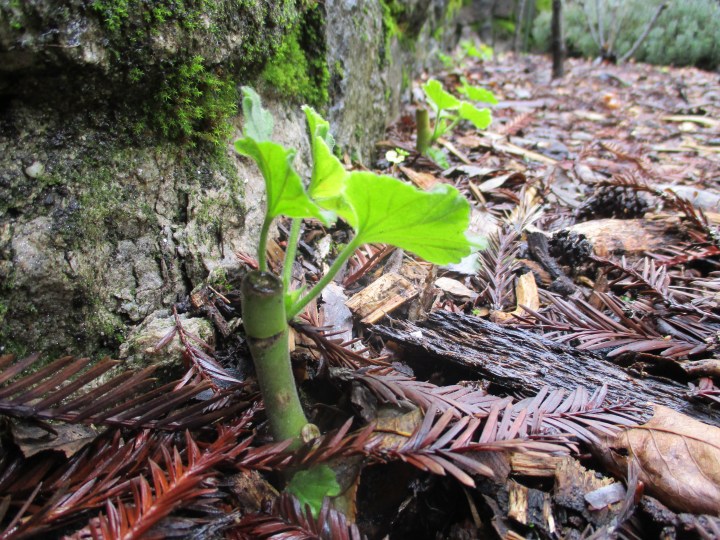
4. Pruning scraps from zonal geraniums that needed to be pruned back earlier in winter were just too tempting. Rather than discard them, I processed them into cuttings. I tried to give most of them away, but ultimately needed to plug some back into the landscape. They get plugged this time of year so that they get soaked by the rain as they disperse roots. Many went into situations where they will be without automated irrigation. If planted too late, they would just desiccate when the rain stops. These are in a neat row along the base of a stone wall separating a few roses from the roadway, so they will get a bit of water from the roses. So far, they ALL are doing well. Propagation can be such a bad habit.P90216+++

5. This was NOT my idea. I am none too keen on Japanese maples. Yet, this one works very nicely for the particular landscape it is in. I am impressed by the vibrant red color because this particular tree is somewhat sheltered and partly shaded. (Exposure to sunlight and cool wintry weather enhances color.) It looks great among the redwoods.P90216++++

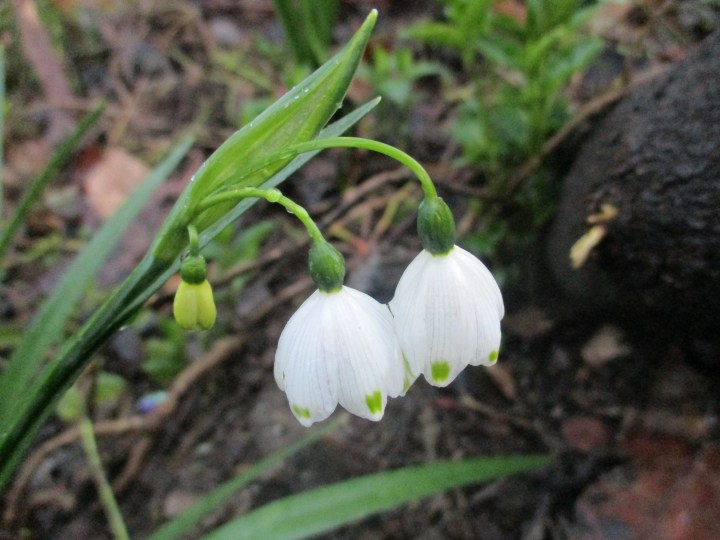
6. No, I do NOT grow ANY of the snowdrops, Galanthus nivalis, or any of the hybrids. ‘Snowflakes’, Leucojum vernum, are only here because they naturalized on the riverbank, likely from seed or bulbs that washed in from a garden upriver. They are spreading quite nicely, and are pleased to bloom in this unirrigated spot after soaked by a few storms. I could have gotten a picture with more flowers in it, but most are already deteriorating. I got these as a closeup instead. I know they are not really snowdrops, but I can brag about them anyway.P90216+++++

This is the link for Six on Saturday, for anyone else who would like to participate:

https://thepropagatorblog.wordpress.com/2017/09/18/six-on-saturday-a-participant-guide/