Clearance can get one into some interesting situations. Yes, with the necessary clearance, one can get into penitentiaries, protected military facilities, sensitive areas of the White House, or even Area 51.
The sort of clearance that I was concerned with this past week and the week prior was not so interesting. Now that roofs and gutters of the buildings at work are in the process of being cleaned before wintry weather, trees must also be pruned for clearance. As they grew through summer, some got detrimentally close to the roofs and gutters that are getting cleaned, as well as chimneys, windows, outdoor lighting and walkways. Such clearance is a concern throughout the year, but becomes more of a priority as we get ready for winter. No one wants to go back onto the roofs any more than necessary.
1. Before. The redwoods must be pruned for adequate clearance from the roof, chimney, lamppost, and even the umbrella on the patio that can not be opened without pushing a bit of foliage aside.
2. After.
3. Soot on the tip of one of the redwood limbs demonstrates why clearance from chimneys is so important. Foliage that gets too close to chimneys can ignite and fall back onto the roof below, where it has the potential to ignite any foliar debris that might have accumulated behind the chimney since last year.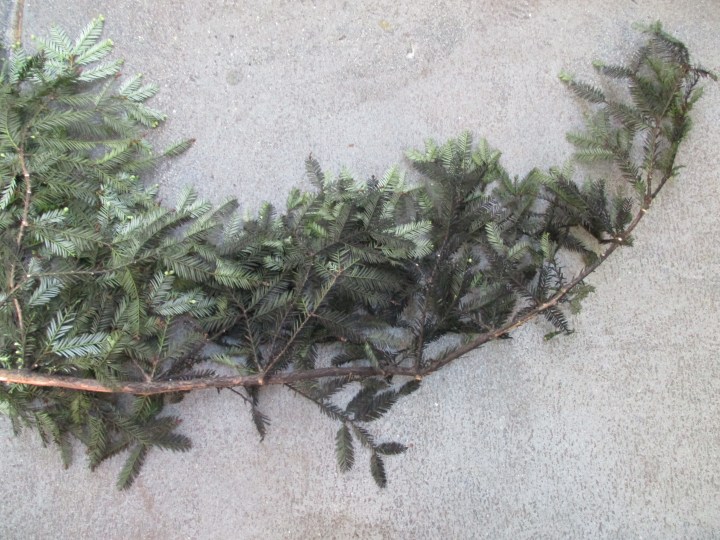
4. The belfry of the chapel next door really bothered me. Clearance was barely adequate. Although I am not worried about the shingles or painted surfaced getting damaged as wind starts to blow during winter, I think that the chapel would look better with more clearance from the encroaching redwood limbs. The problem was that I could not reach the limbs. Because this clearance was not a priority, the pruning here was postponed. A colleague who is not as plump as I am suggested that I get onto the roof through that gap between the top of the louvered sides of the belfry, and the underside of the roof above. Now, even if I could somehow get through that little gap, where would I go on the outside?! Let Quasimodo do it!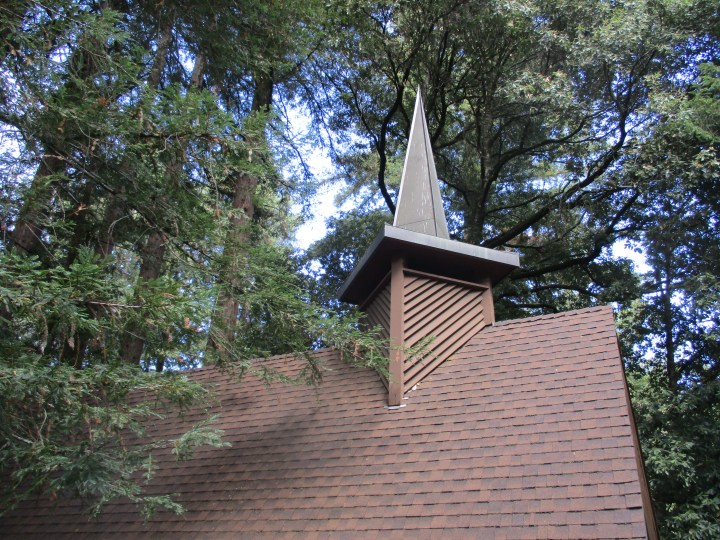
5. The chapel was built among the redwoods, very literally. Expanding trunks are beginning to displace the foundation and utilities. I can not prune for the sort of clearance that is needed here. Because the chapel is such an important building, and the redwoods are such important trees, it would be feasible to move the chapel over onto a new foundation. The problem with that idea is that the redwood trunks are pressing up against the building on three sides! There is no place to move the building without cutting something out!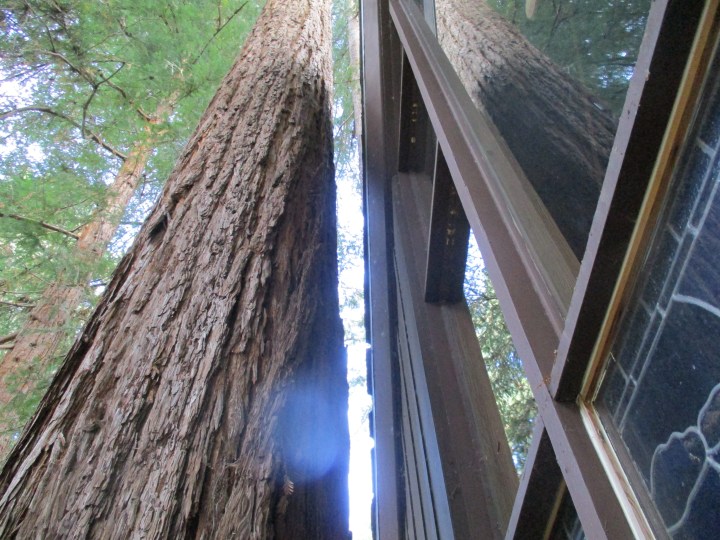
6. Phytophthora ramorum, which is commonly known as Sudden Oak Death Syndrome, or SODS, continues to kill tanoaks, (Notho)lithocarpus densiflorus, and coast live oaks, Quercus agrifolia. These trees do not need to be pruned for clearance, but must be removed before they start to deteriorate and drop limbs onto adjacent buildings or whatever happens to be below.
This is the link for Six on Saturday, for anyone else who would like to participate:
https://thepropagatorblog.wordpress.com/2017/09/18/six-on-saturday-a-participant-guide/





 It wasn’t even two days. The article about the ‘Illegal Planting’ of the Memorial Tree in Felton Covered Bridge Park posted at noon on Saturday, and then on Sunday night or early Monday morning, the Memorial Tree was vandalized. Fortunately, it is nothing serious. A small bag of trash was impaled onto the binding stake that is there to keep the trunk straight, which pushed the top of the small tree aside. It needed to be bound to a new stake anyway.




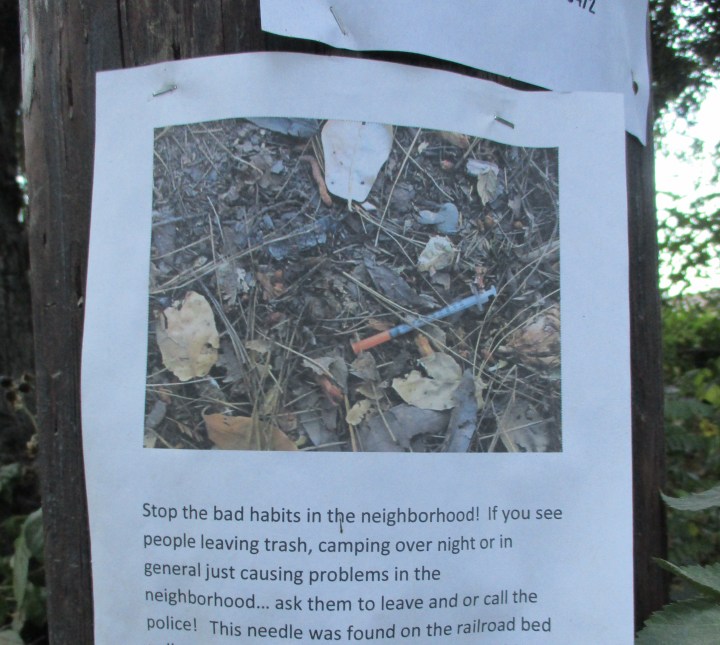 Throughout my career as a horticulturist, I have worked in more public landscapes than most. Some of these landscapes were in some of the most notorious neighborhoods of the San Francisco Bay Area and the Monterey Bay Area. Yes, I have found some rather strange items strewn about, including a few that necessitated telephone calls to local law enforcement. Yet, I have never once found a single used syringe.


 Straight out of college, I worked briefly for a wholesale nursery that grew landscape stock, which included boxed trees. We also recycled a few trees, particularly from the abandoned homes in the neighborhood around the nursery. (The neighborhood, including the nursery, were in the easement of the Norman Mineta Freeway, which in the process of being constructed at the time.) I had believed that the boxed and recycled trees were for ‘instant’ landscapes, the sort that were for clients who did not want to wait for things to grow. It made sense, particularly in our region where so few stay in the same home long enough for trees to mature.