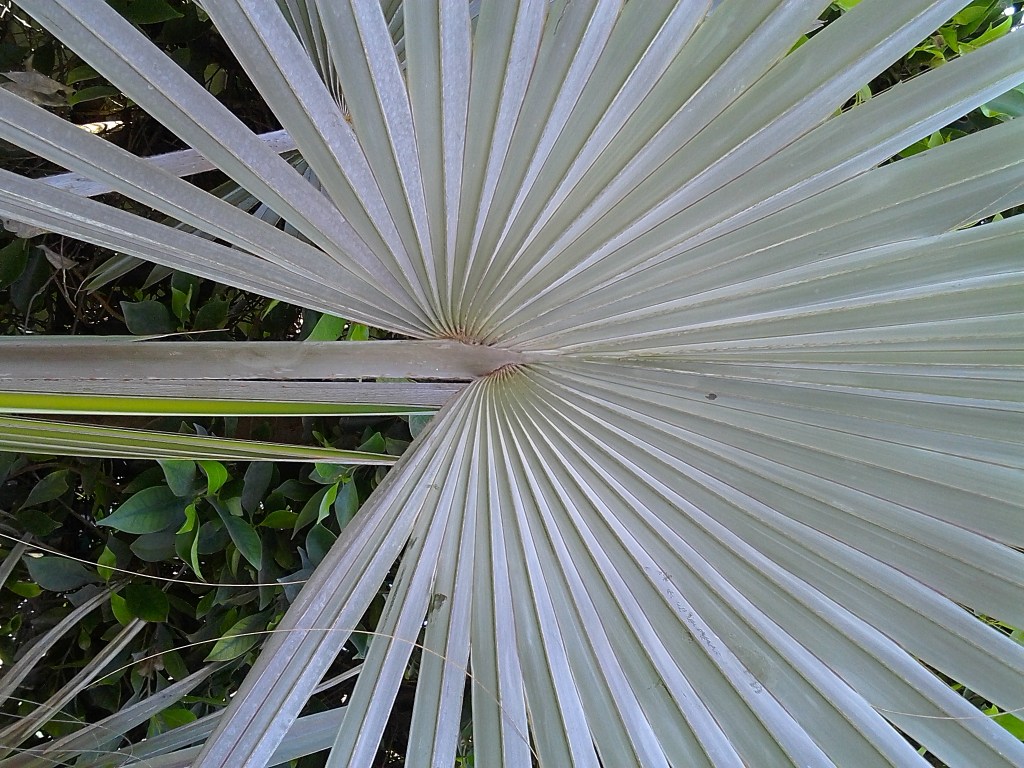
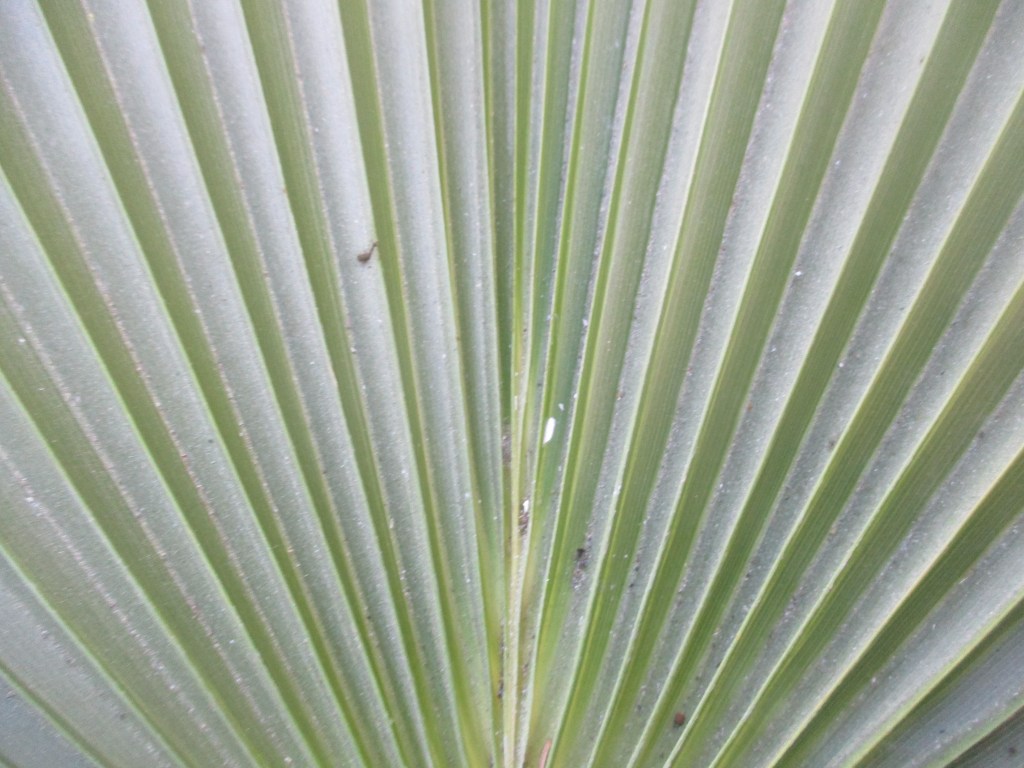
Silvery gray that is almost comparable to blue spruce is even more striking from a palm, like the Bismarck palm.
Most palm enthusiasts believe that the distinguished Bismarck palm, Bismarckia nobilis, is rare because it does not like local climates. It can be damaged by frost in winter, and prefers warmer weather in summer. Another concern is that they get too broad for compact urban gardens, since their shady foliar canopies can get more than twenty feet wide. However, a few seemingly happy specimens are sometimes seen about town.
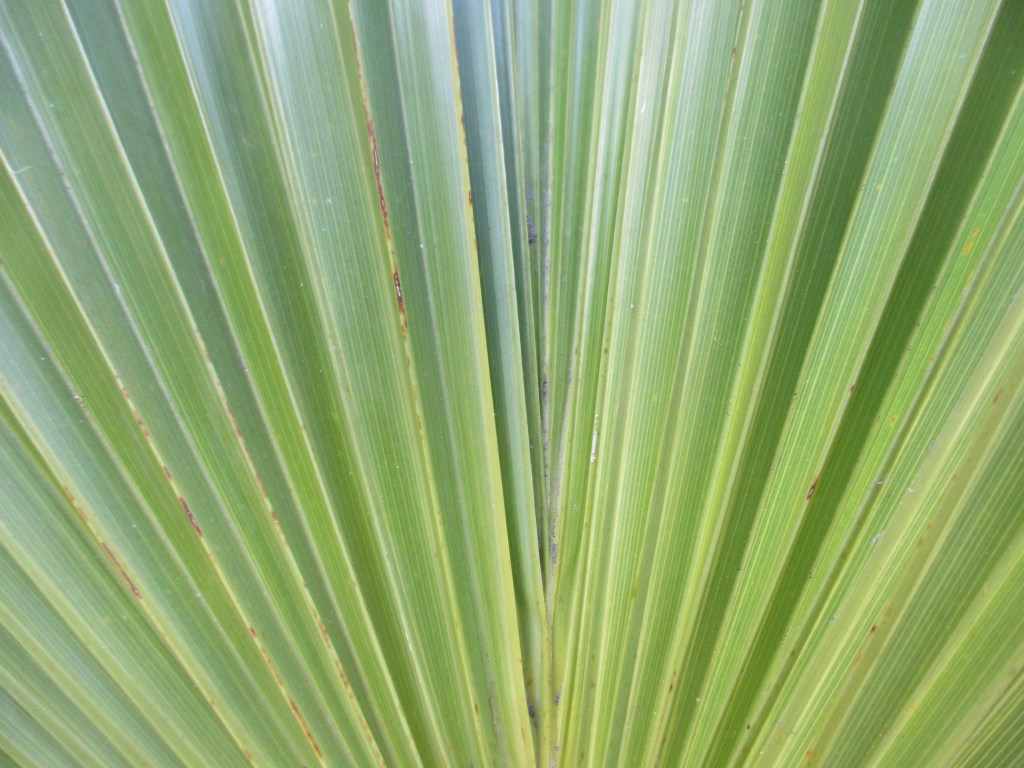
Foliage of this rare palm is strikingly silvery gray. Green Bismarck palms are even more scarce, both because they are less tolerant to frost, and because they are not so striking. The big and rather rounded leaves are more than six feet wide, and maybe up to eight feet wide, on petioles (stalks) about six to eight feet long!
It was a mistake to tell Brent to not send so many pointless pictures to my telephone. He now sends more than ever. My telephone gets too clogged with them to take ‘important’ messages, as if any are important. Brent gets annoyed if my telephone us unable to take more, or if I delete messages without opening them. Really though, I do not have time to see all of his pointless pictures and videos, and I should be able to accept messages from others also. If and when Brent actually sends something important, it is typically of such inferior quality that is is useless to me. #5 is an example of that. I should get some of my own pictures to share next week. I want to show off Rhody’s Roadie. Also, we ‘should’ be leaving for Washington on Wednesday.
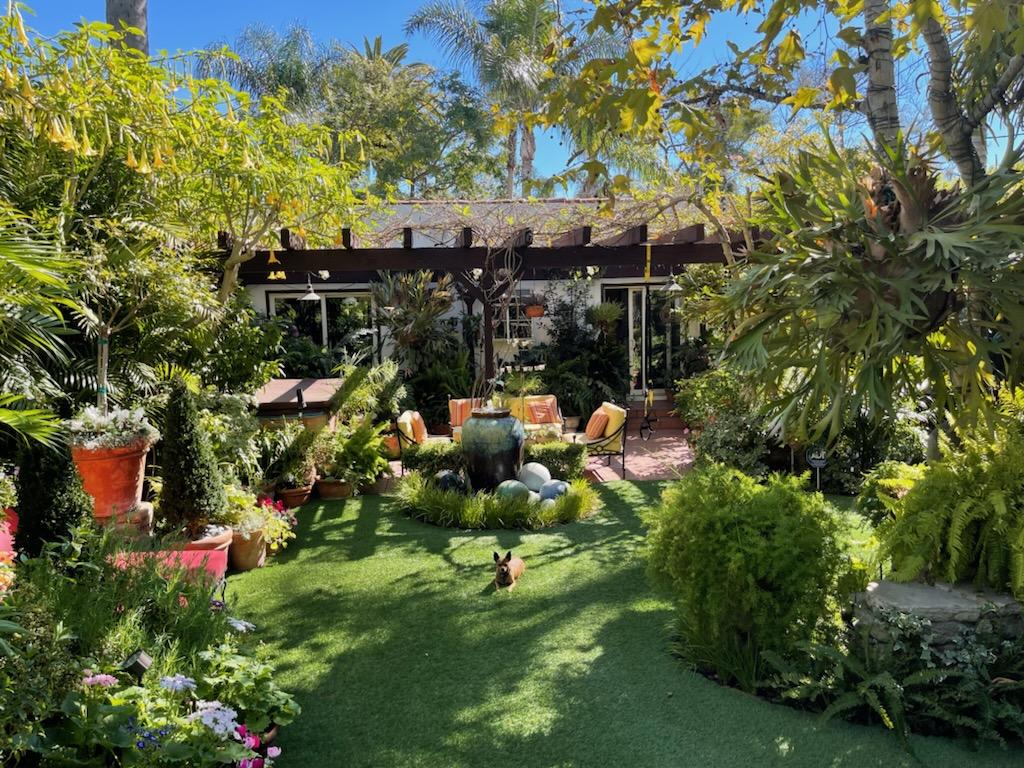
1. This is nothing new, although it is a more recent picture of Brent’s back garden. Brent does like to show it off. It looks like a garage sale with a tiny kangaroo in the middle of it.
2. Less clutter in this direction reveals the office with the roof deck above. That is where I camp out when I go to Southern California. That is some lush scenery to wake up with.
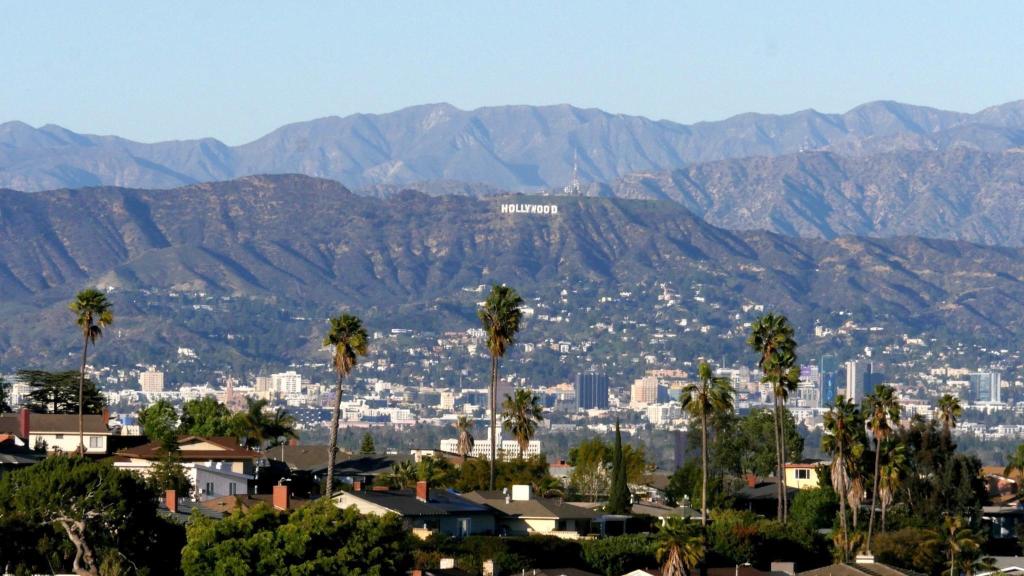
3. Three of seven queen palms live across the garden from my campsite on the roof. The famous ‘Hollywood’ sign is in the distance behind them. Four more queens are out front.
4. This is not the four queens out front. It is four canopies on two trees, elsewhere in the neighborhood. Branched palms are very rare. (Doum palm is not evident in the region.)
5. Goodness! This is the most significant of these Six, but is of such bad quality. Brent is an idiot! It is one of only a few surviving Olympic Oaks of the 1936 Olympics in Berlin. It was awarded to Cornelius Johnson, in conjunction with a Gold Medal, by Adolph Hitler, who would not acknowledge victory by anyone of African Descent. Brent was protecting the tree from developers who want it removed, but now wants to designate it as historic.
6. See if you can make sense of this one. It is no music video. The original was even a bit weirder. The Mexican fan palm is a Memorial Tree of Brent’s older brother Brian Green.
Esperanza and poinciana (pride of Barbados) from Crazy Green Thumbs will be delayed again. I still have not sown the seed, and when I do, I will likely delay posting pictures of them until I have exhausted all of these pointless pictures that Brent sends to me. There may be six more for next week after these six. Fortunately, the few that arrived since this purging began are not very interesting, so need not be shared. These six pictures arrived at various times through the past few months; and I did not document dates for them. It would be difficult to identify their chronology without inquiring with Brent, and without familiarity with potentially observable seasonal indicators of the particular climate. I am less than three hundred fifty miles away, but in an entirely different climate and region.
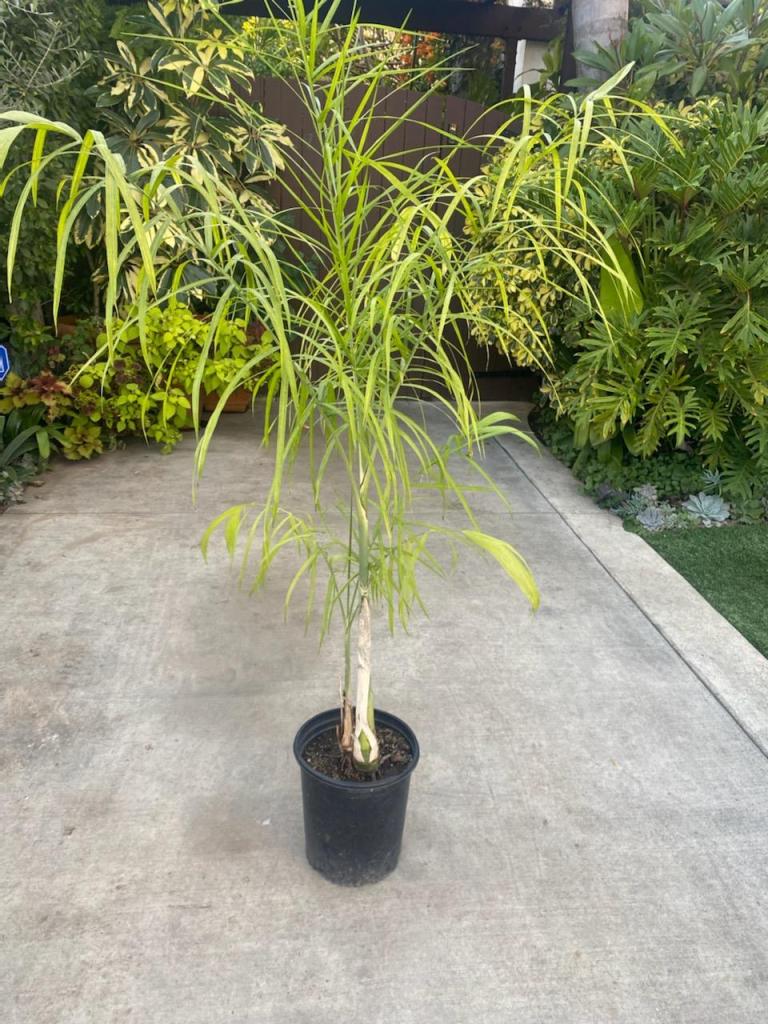
1. Baby queen palm, Chamaedorea plumosa, which is not princess palm, Dictyosperma album, is related to popular bamboo palm, Chamaedorea seifrizii. Brent got this for me.
2. Of all of Brent’s landscapes, this might be my favorite. The formality is rad. However, these illuminated Canary Island date palms, Phoenix canariensis, must be embarrassed.
3. Mexican fan palm, Washingtonia robusta, is a most common palm of the Los Angeles region. Although palms are popularly informal, some might be formal and symmetrical.
4. Mexican fan palm dominate the view. Kentia palm, Howea forsteriana, California fan palm, Washingtonia filifera, and queen palm, Arecastrum romanzoffianum, got in too.
5. Brent likes to show off his palms. They are more visible from next door than from the garden they inhabit. The Mexican fan palm is a Memorial Tree for Brent’s brother Brian.
6. Coons! The arborist who pruned this Mexican fan palm returned to finish shaving the trunk, but found that a pair of coons who inhabited the beard were not ready to relocate.
The small hesper palm that was taken from my garden last August has returned. A colleague directed me to it, at the home of one of his neighbors. I appropriated it without inquiring about its presence there. I suspect that it was taken as random ‘greenery’. However, if the neighbor actually wants a palm, I may provide one that is more appropriate to the particular situation. Since I got only a single picture of the recovered hesper palm though, my Six on Saturday for this week are completely random.
1. Hesper palm would not have been happy here in the shade of a redwood forest. It happened to be just across the driveway from where the kitties of ‘Cat Burglar’ live. It is back at home now.
2. Windmill palm is more impressive. It will be dug and canned for a former resident of the now abandoned house to the left. My date palm seedlings came from the compost pile at this home.
3. Dracaena palm (which is not actually a palm) was too big and tall for me to relocate from the now abandoned house, but not too large for gophers to relocate. They put it right onto the eave.
4. Deodar cedar was relocated three years ago, without the assistance of gophers. Most met a most unfortunate fate with a weed eater. This specimen got established slowly, but is happy now.
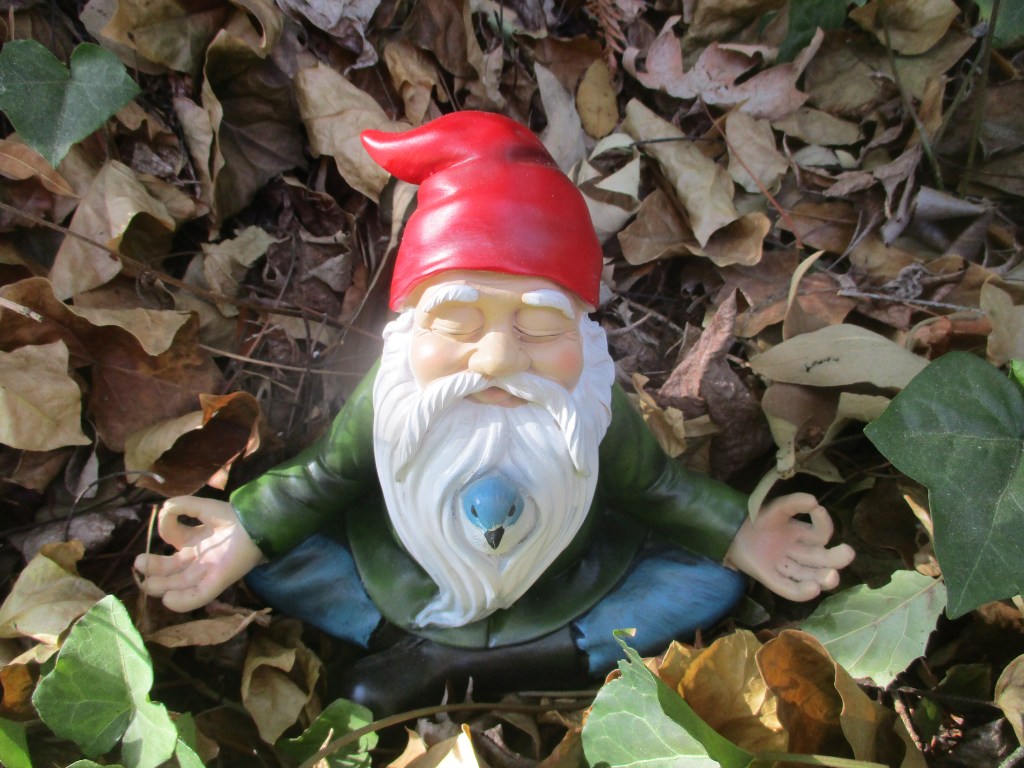
5. Gnomes annoy me! I do not know why this appeared in one of the landscapes, but it will go into the trash if not removed. My statue of Saint Francis, in my own garden, offended a neighbor.
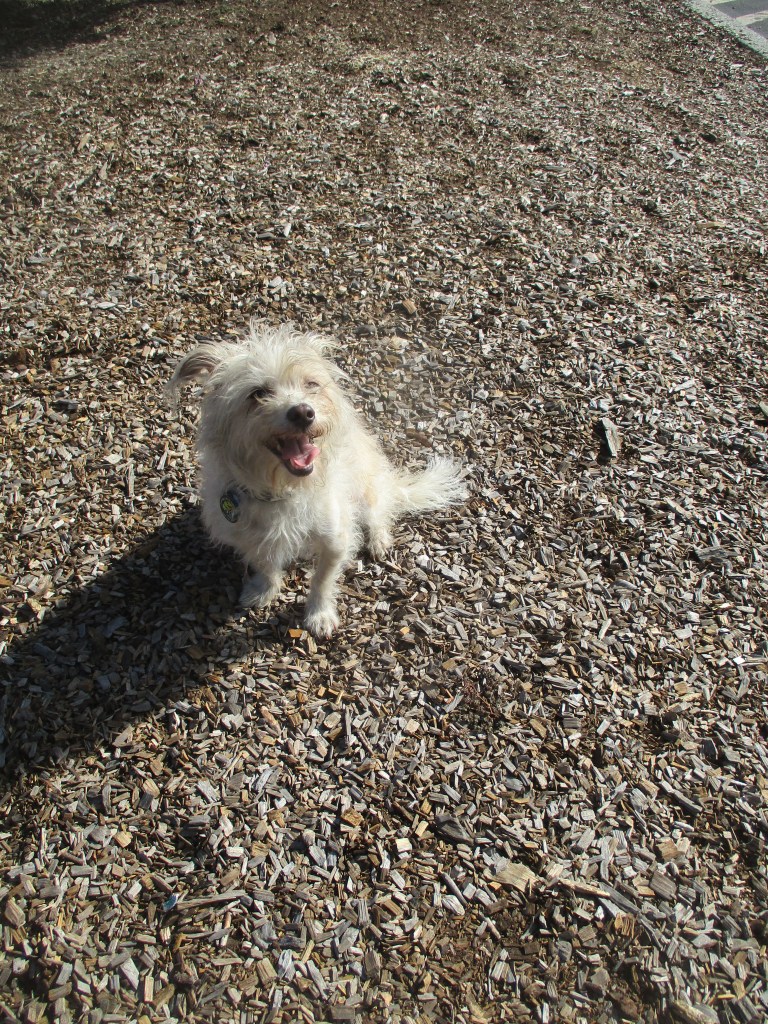
6. Rhody does not allow me to get too annoyed. He is posing with mulch because mulch was the topic of the gardening column when this and a few other formerly unused pictures were taken.
This is the link for Six on Saturday, for anyone else who would like to participate:
Palms are not as popular here as they are in Southern California. Furthermore, they are less popular in the Santa Cruz Mountains than they are in the Santa Clara Valley below. There are so many more refined landscapes in the Santa Clara Valley, and they contain many more exotic species. In the Santa Cruz Mountains, cutting trees down is more of a priority than adding more.
Besides, palms look silly with redwoods. Of these palms, which are mostly fan palms, only the Mexican fan palm will get planted as the winter rain starts. The others remain canned for now.
These palms are quite the Fan Club.
1. Arecastrum (Syagrus) romanzoffianum, queen palm – is not eligible for membership in this exclusive Fan Club. It is ‘feather palm’, rather than a ‘fan palm’. Therefore, no queens allowed.
2. Brahea armata, hesper palm – is a most distinguished fan palm. It is quite rare. Like the California fan palm, it prefers warm and dry summers, so can languish if irrigated too frequently.
3. Trachycarpus fortunei, windmill palm – is the opposite. It is quite common, and could be even more common, since it is not at all discriminating, and is proportionate to compact gardens.
4. Washingtonia robusta, Mexican fan palm – had the been the most common palm locally prior to the queen palm fad of the 1990s. Unfortunately, it gets very tall. Notice the lingering ash.
6. ‘A BIG STICK’ was the only ‘club’ I could find for this Fan Club. No one knows what it is, where it came from, . . . or anything about it. I think it is a wheelbarrow or post hole digger handle.
This is the link for Six on Saturday, for anyone else who would like to participate:
I believe that this is a young Chilean wine palm, although I am not certain.
Italian Americans, particularly Californians, are expected to be experts in regard to wine. I am not. I can not explain it. I dislike wine, especially the best of it. It smells and tastes like rotten grapes. When I learned that Chilean wine palms were, and might still be, decapitated for the collection of their sap, from which wine is made, I learned yet another reason to dislike wine.
This little Chilean wine palm, Jubaea chilensis, pictured above, lives just a block or so away from the bad date palm that I wrote about last Sunday. No one here will try to make wine from its sap. The utility cables that seem to be too close in the background actually pass with plenty of clearance to the right, so will not be a problem in the future. This young palm should be safe.
Although I have encountered too few of the species in my career to be completely certain that this little palm is a well bred Chilean wine palm, it is very convincing. I see no indication that it is a hybrid of another species. About half of the Chilean wine palms that I encounter are hybrids. Most of these are hybrids of queen palm. Others are hybrids of pindo palm. Both look weird.
Of course, well bred Chilean wine palms are not much better. The specimen pictured below demonstrates that, regardless of how bold and striking they are, they are still rather weird palms. That is probably why they are so rare now. They were rare even during the Victorian Period, when weird species were trendy. Yet to many, their distinctive weirdness is part of their allure.
I can not help but wonder where this Chilean wine palm came from. Someone must really appreciate it to put it here.
Date orchards that were displaced by the expansion of urban sprawl around Las Vegas in the 1990s were the source of the many recycled mature date palms that briefly became popular for large scale landscapes at the time. Most of the trees within the orchards were female, with only a few male pollinators. (Pollinators can live remotely, where they provide pollen for dusting.)
Male trees were undesirable anyway, at least in conjunction with female trees. They are taller and lankier, with less pendulous foliage, so are less visually appealing. More importantly, they pollinate female flowers so that they make fruit. Of course, in orchards, fruit is very important. In landscapes, it is just a mess. Without male pollinators, female trees produce no messy fruit.
Consequently, most male trees were not recycled. Some were installed singly, or in exclusively male colonies, in landscapes that were reasonably isolated from female trees. After decades of dutiful service, this is how they were retired, . . . or not.
During the brief date palm fad, a colony of exclusively female date palms at a mall near here produced a minor crop of dates during its second year after installation. It was not a major mess, but it was perplexing. Eventually, someone realized that a single relatively small male date palm lived just outside of the landscaped areas. It likely grew there from seed as a curb mongrel.
Even though the male tree was too remote to pollinate the female trees sufficiently for a major mess, it was removed. It was not much bigger than the short and clumping date palm pictured above. This tree seems to be a curb mongrel as well, since it was not likely planted there purposely. Furthermore, it will also likely need to be removed. It is too close to the building behind.
This is one of the several Canary Island date palms that Brent Green saved from poachers on the embankment of the Santa Monica Freeway.
Since I began posting my gardening column articles here, and supplementing with blog posts, I have deviated from horticultural topics only a few times. I will now do it again. I had earlier selected a horticultural topic for this post. It will wait for now.
Brent Green, my colleague down south, called me on the telephone to tell me to watch the news. I did so, but only briefly. It was just too crazy. So far, I have made a point of saying nothing about Coronavirus. I said nothing about those who protest the violation of their right to spread disease that will kill others. I mentioned nothing about the racist murderers in Minneapolis.
Now I see that people are senselessly rioting and looting in several cities in America.
The office building of the Canyon News, one of the newspapers that I write for, was clearly visible in the background as police helicopters showed looting of stores on the historic Rodeo Drive in Downtown Beverly Hills, in the region of Los Angeles. Police cars and palm trees were burning. From three hundred and fifty miles away, I can see it online.
This is not demonstration or protest. It is looting. It is mere opportunistic thievery. Those involved are not at all concerned about social justice, their own Communities, or that Black Lives Matter. They are exploiting an already bad situation to plunder what they can get away with.
This is happening in the Community where Brent Green has been planting his Birthday Trees (in quantities that corresponds to his age at the time) in public spaces for the past twenty two years. This is near where Brent Green saved several Canary Island date palms on the Santa Monica Freeway from poachers. This is a region that many people care about.
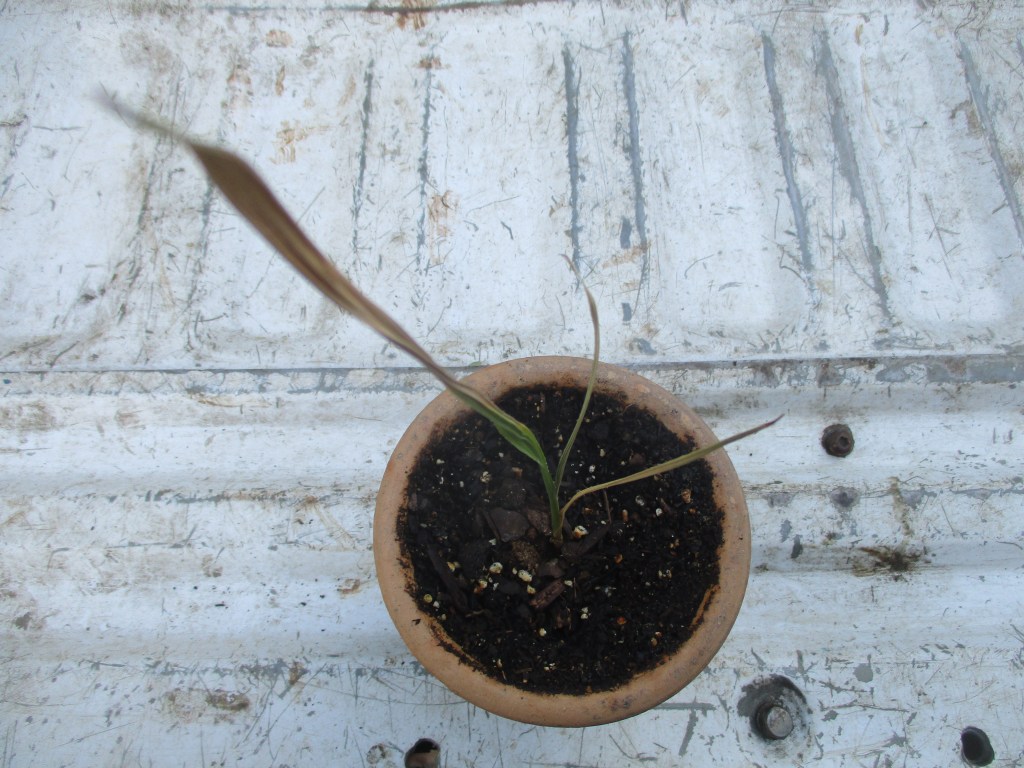
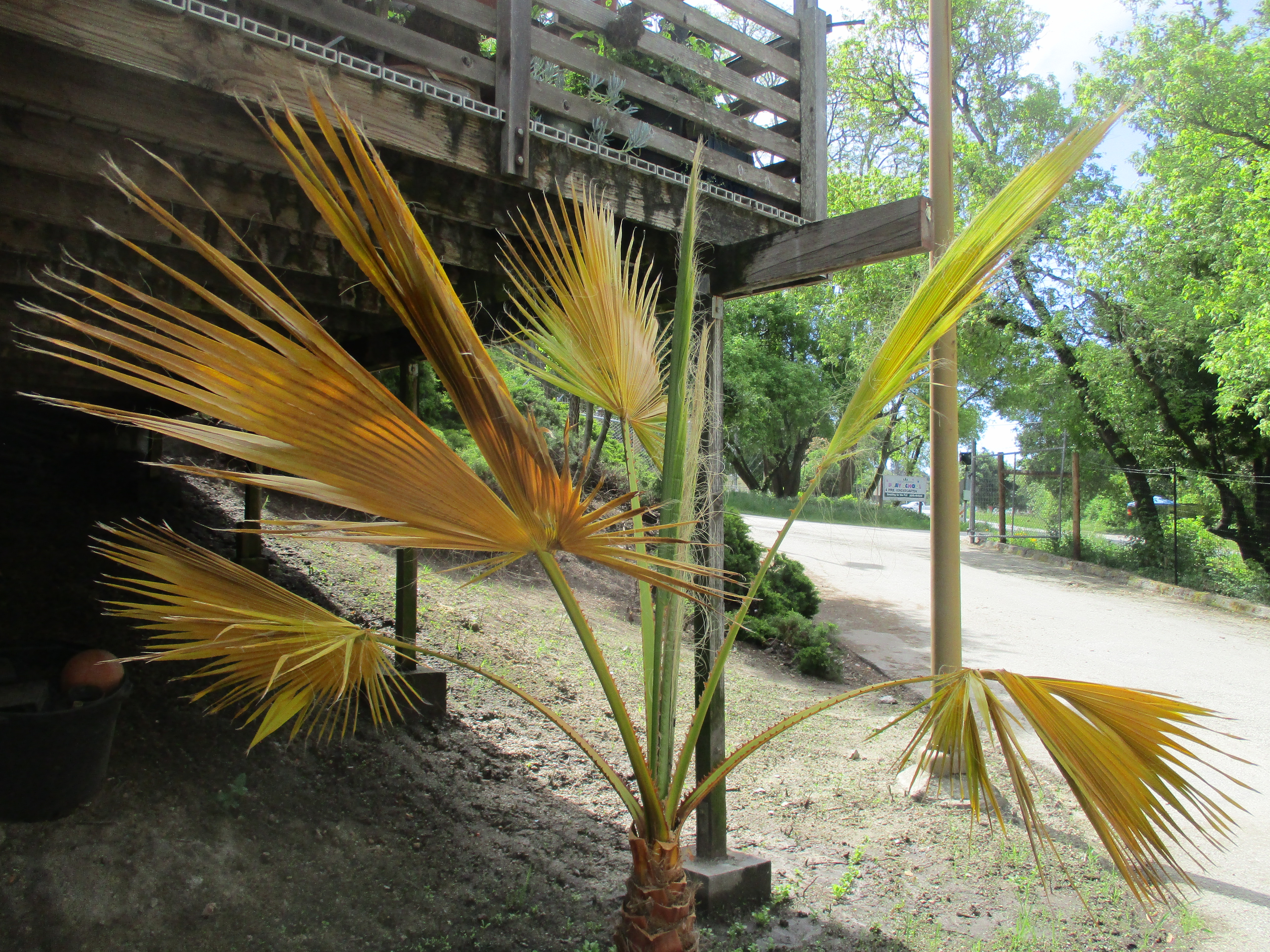
No, this is not wheat. It is the larger of the two Mexican fan palms that I dug and canned more than a week ago. ‘Wheat’ refers to the unpleasant phase that it is now going through. It is a long and awkward story about how it became known as the ‘wheat’ phase. All that anyone should know is that it refers to the color of the fading foliage. It fades from green to golden brown, just like ‘wheat’.
I say that the explanation is awkward because it involves an old skit by an offensive comedian on HBO in 1986, when the renowned landscape designer, Brent Green, was my college roommate.
Yes, we will just leave it at that.
Anyway, this is not at all unexpected. It is a normal process. I just wish it could be avoided. Every time I dig and can a palm, I hope that it will not happen; and I actually engage the associated palm as if it will somehow be different from the rest, and maintain all of its healthy green foliage. Some get through it more efficiently. Some start to produce new foliage before their old foliage dies off.
I actually relocated a mature windmill palm that somehow maintained the upper half of its canopy until it started to produce new foliage. That was all the fronds that were above a right angle to the trunk! I was impressed by that one. It was very different though. Most of the roots had already been damaged prior to relocation. Also, it was relocated in autumn, so had all winter to start recovery.
This unfortunate palm was dug not very long ago, just as the cool and rainy weather of winter was ending. Now that the weather is suddenly warming to around 80 degrees, the foliage is resuming vascular activity that the severed roots can not sustain. To compensate, it will shed this foliage that is now browning, while diverting resources into new foliage and roots. It knows what it is doing.
The new fronds that are still folded up in the middle are just fine. They will unfold into healthy new fronds as the palm recovers through summer. The first few fronds might be a bit stunted, but that is just part of the process. Newly relocated palms tend to accelerate foliar growth during such recovery, so, in just a few months, this cute little palm may look as good as it did when I canned it here.
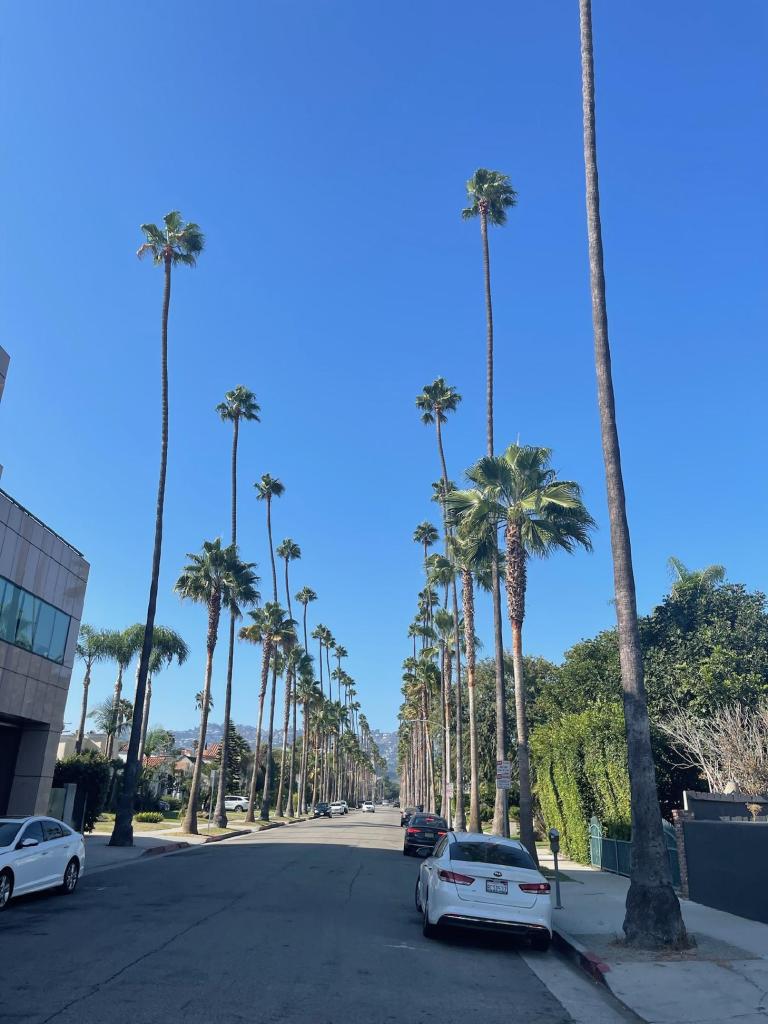
Palms are like ‘Red Delicious’ apples. It seems that most people dislike them; but they also seem to be very popular. Seriously, if only a few people like ‘Red Delicious’ apples, why are they so common in supermarkets? If most of us dislike palms, why are they so common in the San Jose Skyline?
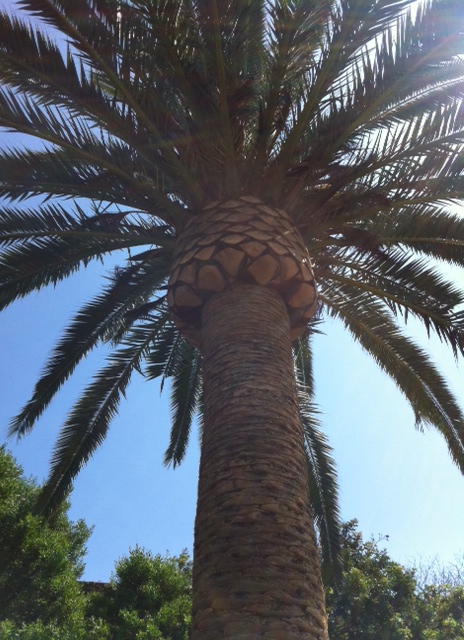
I suspect that palms really are as unpopular as they seem to be, but that they are also very conspicuous within their situations. Not only are they focal points of the landscapes in which they live, but most types eventually stand as tall as the tallest trees in the neighborhood, and some get significantly taller. They are innately the most prominent trees within their neighborhoods.
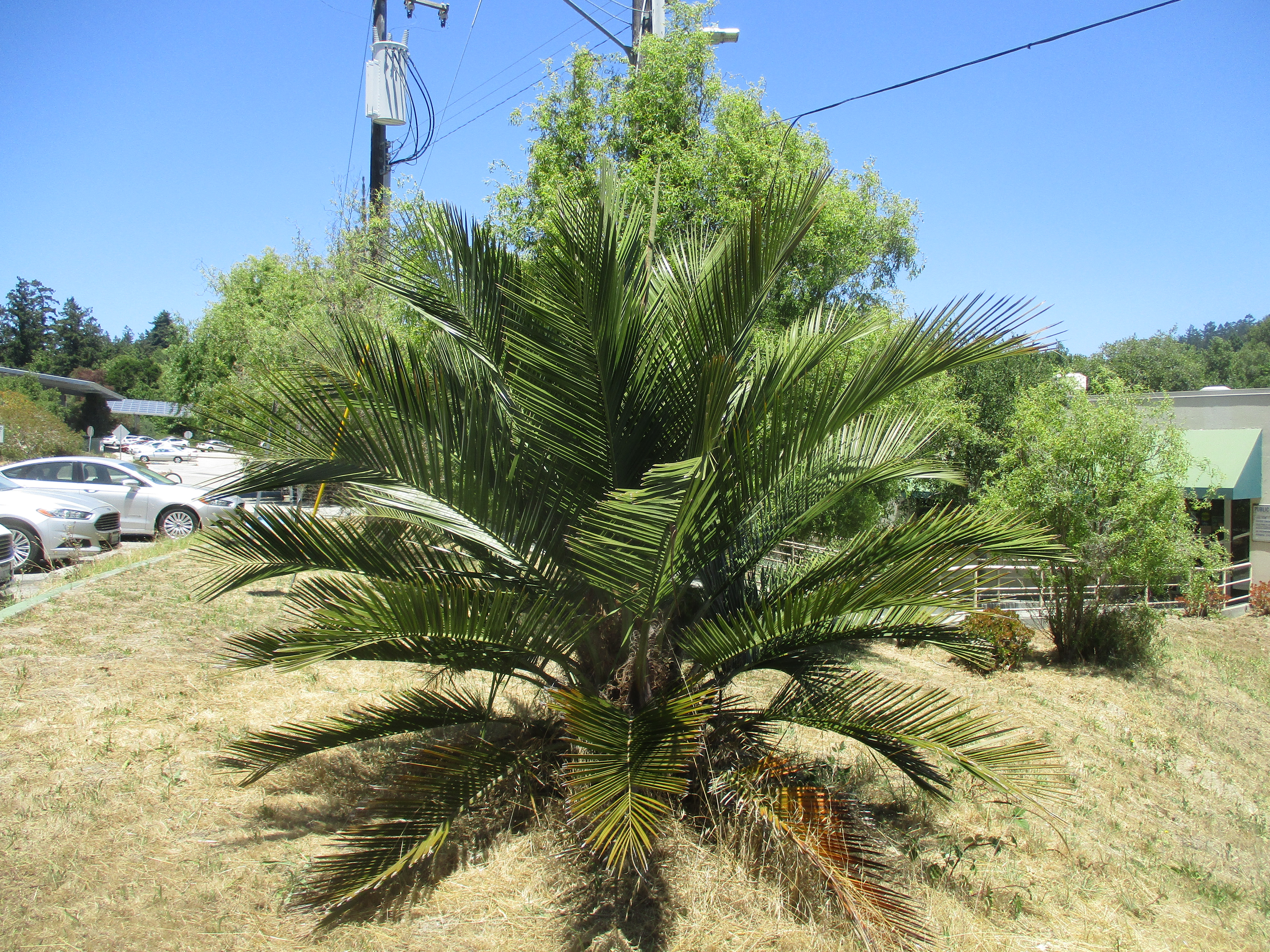
Palm are not like other trees though. Arborists may classify them as ‘herbaceous trees’. They are foliar plants while young, producing increasingly large leaves from terrestrial rosettes. They only ‘launch’ and start to develop their trunks after the formerly terrestrial rosettes have grown wide enough to do so.
Not only are their trunks no wider than their associated foliar rosettes, but they get no wider as they grow taller. The base of a trunk of a palm is as wide when the tree is only a few feet tall as it will be when the tree grows to forty feet tall. Mexican fan palms are only wider at their bases because they start out like that.
Palms with slender trunks can launch much sooner than those with wider trunks. It does not take long for their rosettes to get as wide as their trunks. Canary Island date palms have rather plump trunks, so may need to mature for many years before they launch.
Yuccas and dracaenas are not really palms. Their trunks expand and develop branches as they grow and mature.









 Palms are like ‘Red Delicious’ apples. It seems that most people dislike them; but they also seem to be very popular. Seriously, if only a few people like ‘Red Delicious’ apples, why are they so common in supermarkets? If most of us dislike palms, why are they so common in the San Jose Skyline?
