Six on Saturday: Tangly Cottage Gardening Journal


tanglycottage.wordpress.com is where you can find it. This is a blog about gardening, gardens, life, and of course, Skooter the kitty, in and around Ilwaco, in the very southwestern corner of Washington, where the Columbia River flows into the Pacific Ocean. Like so many blogs, it shares compelling insight about a culture and a region that might be very different from what one is accustomed to. Then again, it might be compellingly similar . . . or even unexpectedly familiar. You can decide for yourself.

I have been to Ilwaco only once, about twenty years ago. I spent the night in a campground there while driving from Silverdale, west of Seattle, to Saint Helens, north of Portland. It was certainly not a direct trip. That would have been a two and a half hour drive. I was on vacation, so drove around the Olympic Peninsula. I sort of intended on returning someday, but never did.

After all these years, it has been fascinating to read about the flora of the gardens of the region. When I was there, I was more interested in the native flora outside of town. Ilwaco still looks something like I remember it to look like, although I think that there is more landscaping downtown now.

A while back, I commented on Gladiolus papillio that was blooming in a planter box in downtown Ilwaco. I was impressed that it was such a reliable perennial species of gladiolus. I had been wanting to grow a species of gladiolus that was more perennial than than the common summer blooming bulbs that I am familiar with, but had not decided on which ones to try. Anyway, in response to my comment, the author of ‘Tangly Cottage Gardening Journal’ offered to send me a few of the bulbs! How could I refuse?

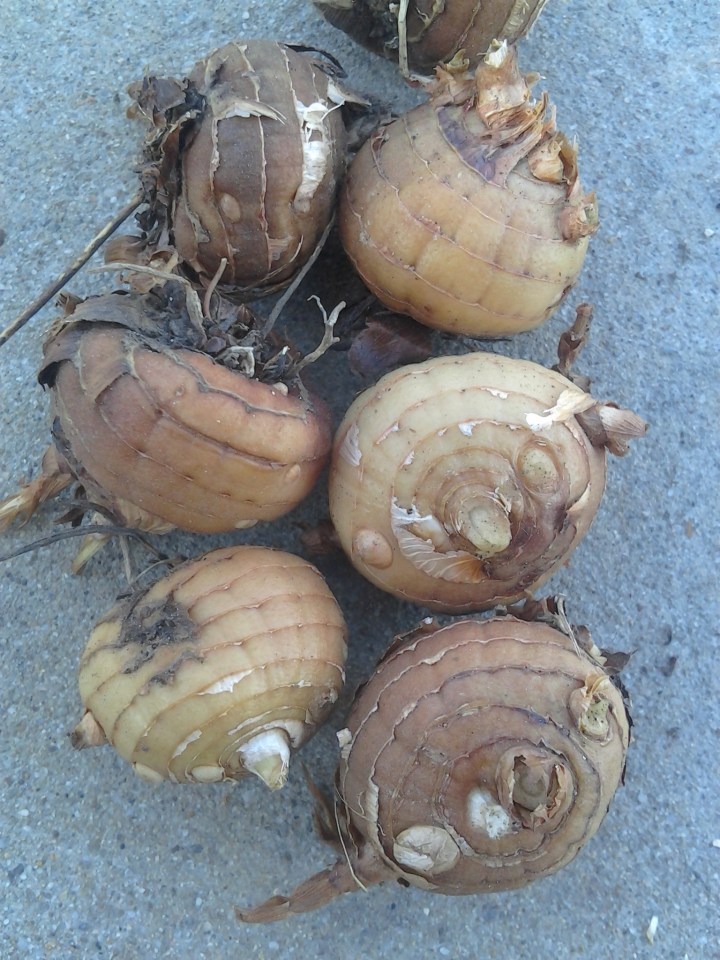
These six pictures are of those Gladiolus papillio bulbs that came from Ilwaco in Washington.

1. It is so excellent to get a package in the mail from such an exotic and far away place! It got here very fast. It was in my mail only two days after being postmarked on October 25.P81110

2. The contents of the package are even more excellent than the package itself! There were nearly fifty bulbs here! I planted them on the first of November, a bit more than a week ago.P81110+

3. The bulbs were planted in three groups of about a dozen, with two groups of about half a dozen between them. The first group is partly buried here because a bit of soil fell back into the hole before I got this picture.P81110++

4. This is how the same first group of bulbs looks completely buried. Aren’t they pretty? Never mind the calla. It is not vigorous enough to bother the Gladiolus papillio.P81110+++

5. This is the planting bed where the Gladiolus papillio bulbs were planted. They are up in back, in a row that extends from the left edge of the picture to the corner of the trellis with the espaliered camellia. The pinboard and mailbox in the top right corner of the picture are at the Post Office next door. I would have preferred to plant the bulbs in front of the Post Office, but there is no place to do so over there. I am pleased that these Gladiolus papillio were planted in a public space almost in front of the Post Office because that is where they originated in Ilwaco. As the proliferate, I intend to take a few to my downtown planter box in Los Gatos, and might even share a few with the lady who tends to the planter box next door to the Los Gatos Post Office.P81110++++
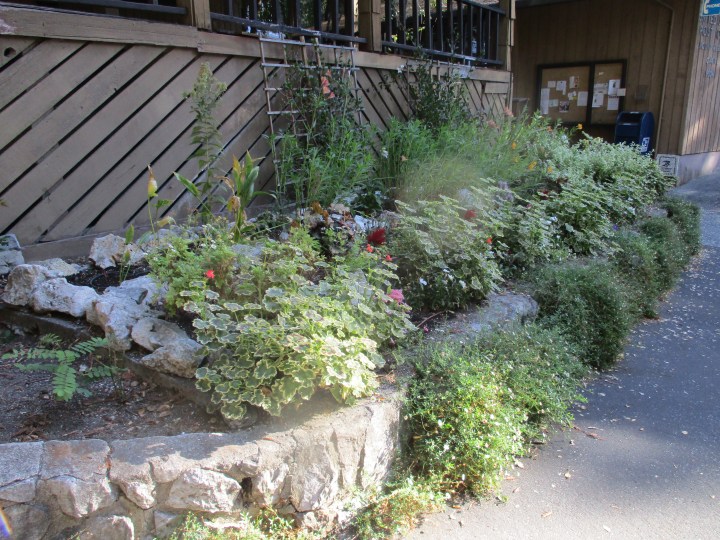
6. This is the Mount Hermon Post Office is next door.P81110+++++

This is the link for Six on Saturday, for anyone else who would like to participate:

https://thepropagatorblog.wordpress.com/2017/09/18/six-on-saturday-a-participant-guide/
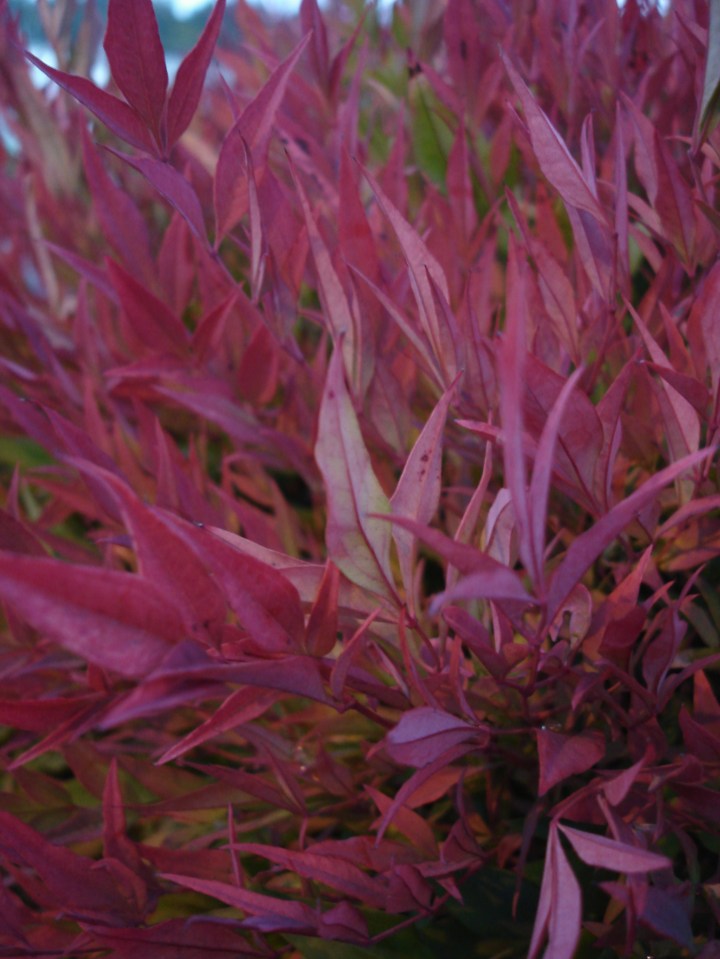
Heavenly Bamboo

51111Good old-fashioned Heavenly bamboo, Nandina domestica, which can almost reach the eaves, can be difficult to obtain nowadays. More compact modern cultivars do not get much more than six feet tall, and some stay less than three feet tall. Foliage is airier in partial shade, but more colorful where more exposed.
As it begins to emerge in spring, new foliage is pinkish or reddish before greening. It slowly bronzes by autumn. Some cultivars turn ruddy or orangish, or even burgundy. Individual leaves are actually quite large, but are divided into many small, diamond shaped leaflets. Some cultivars have very narrow leaflets. Tiny white flowers bloom through summer. Bright red berries ripen through autumn.

Although unrelated, Heavenly bamboo grows like bamboo, with vertical canes developing from creeping rhizomes. Overgrown or deteriorating canes should be cut to the ground as they get replaced by newer canes. Otherwise, they become top-heavy and inhibit development of new canes. Foliage should not be shorn, since it is not much to look at without its naturally intricate texture.

Chrysanthe-Mum Is The Word

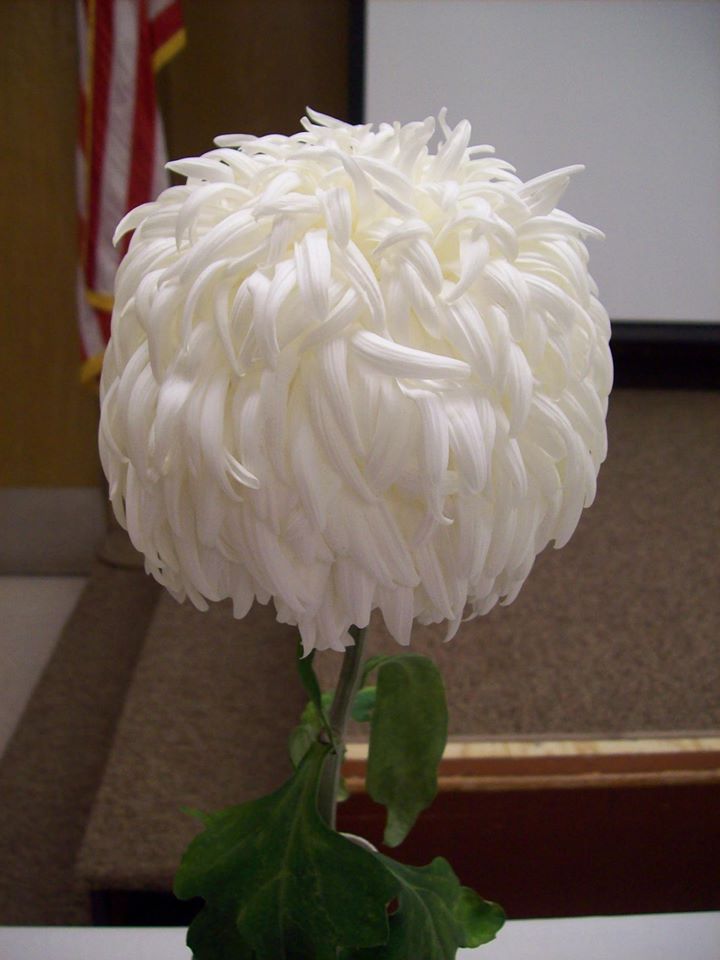
51021Only a few decades ago, when horticulture was taken more seriously, potted blooming plants like chrysanthemums, orchids, azaleas, hydrangeas, lilies and even poinsettias, got the respect that they really deserve. Now they are more commonly purchased in full bloom, enjoyed only as long as their bloom lasts, and then discarded as their blooms deteriorate.
Some get put outside, but often die before they actually get repotted or planted into the garden. Many of those that do get planted, die when their sensitive greenhouse-grown foliage gets scorched by real sun exposure. Others succumb to desiccation before they can disperse their roots. Only orchids want to stay in their original pots for a while, but they rarely get the attention and regular watering that they crave.

Chrysanthemums happen to be in season now, both as potted plants for the interior of the home, and as autumn annuals in the garden. Yet, they are quite sustainable as perennials that can live for quite a few years. They only need to be groomed accordingly so that they can bloom in season, and new stems can replace the old. When they get planted into the garden, multiple plants in a single pot should be separated.

Many chrysanthemums get tall enough to require staking. If left to perform naturally, they bloom profusely. Hobbyists who want to grow larger flowers remove axillary flower buds (sideshoots) to concentrate resources into single terminal (top) flowers that most effectively display their distinctive colors, textures and forms. Sadly, many of the most impressive chrysanthemums have become rare as more profuse bloomers have become more popular.

The Chrysanthemum Society, which can be found on Facebook, is one of the most reliable resources for anyone wanting to grow some of the rare but really fancy exhibition types of Chrysanthemums. The internet makes it possible to get involved with regional chapters well beyond their designated regions. Chrysanthemum fanatics are more than happy to show off and talk about their favorite flowers.

Fall For Spring Bulbs Now

61019thumbThey are certainly not much to look at now. They are even less interesting once buried out of sight in the garden. The big and colorful pictures on the boxes that they arrive in are probably a bit more spectacular than the flowers expected early next spring will actually be. Nonetheless, it will be amazing to see such flashy bloom emerge from seemingly lifeless bulbs that get planted now.
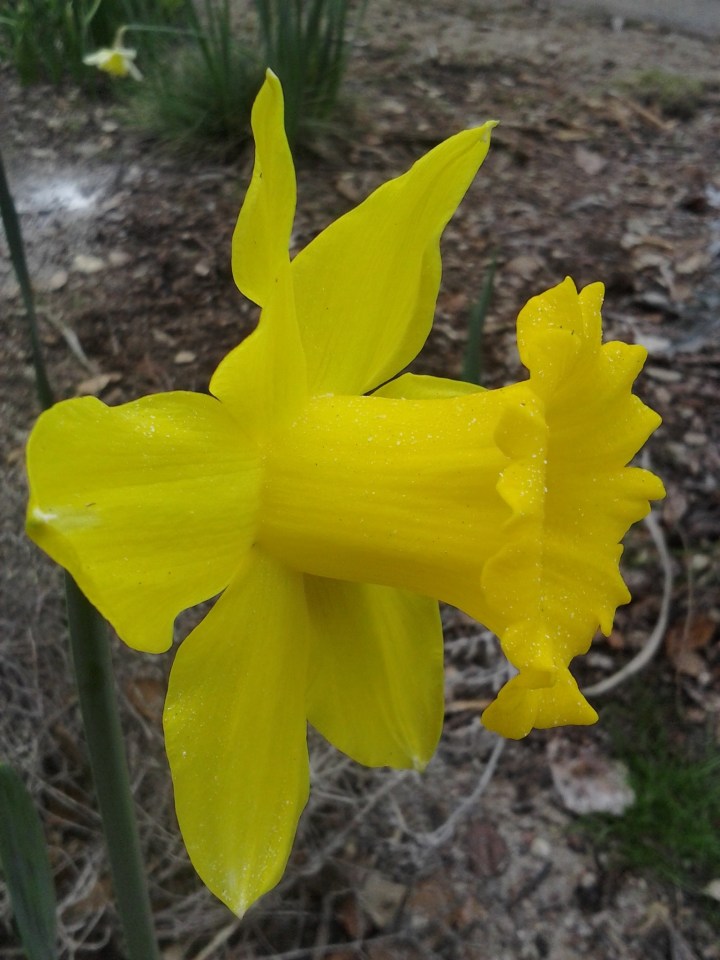
Dormant bulbs are so easy to plants precisely because they are dormant, and therefore lacking any foliage, bloom or roots that can be damaged in the process of planting. They only want to be planted at the right depth, and preferably in the correct orientation (with their tops up and their bottoms down). They like to be planted now, so that they can slowly chill through cool winter weather.

Chill through winter is important to convince dormant bulbs that it really is winter. In such a mild climate, some plants might wonder about that. Cool winter weather either initiates the development of blooms within dormant bulbs, or stimulates bloom as weather subsequently warms. Many tulip, hyacinth, anemone and ranunculus might not get enough chill here to bloom after their first year.

Daffodil, narcissus, grape hyacinth and some iris are not so discriminating. They are likely to bloom even better in their second spring, and can naturalize in good soil with occasional watering. Freesia and crocus might also naturalize, but want more water. Crocosmia and montbretia can actually be invasive. Dahlia and gladiola are summer bulbs, so will be available for planting later.

All bulbs, as well as the corms, rhizomes, tubers and tuberous roots that are commonly known as bulbs, become available in nurseries when it is time for them to be planted, for obvious reasons. Some will be available for quite a while, so can be planted in phases every two week or so, like vegetable plants. Each subsequent phase starts to bloom as each previous phase finishes bloom.

Phasing only works for certain bulbs that are on a tight schedule, and only for the first season. By the second year, they will be synchronized. Iris, anemone and ranunculus tend to bloom together, when the weather is right, regardless of when they were phased. Plants with aggressive roots might not bother bulbs in their first season, but can smother bulbs that might otherwise naturalize.

Mexican Bush Sage

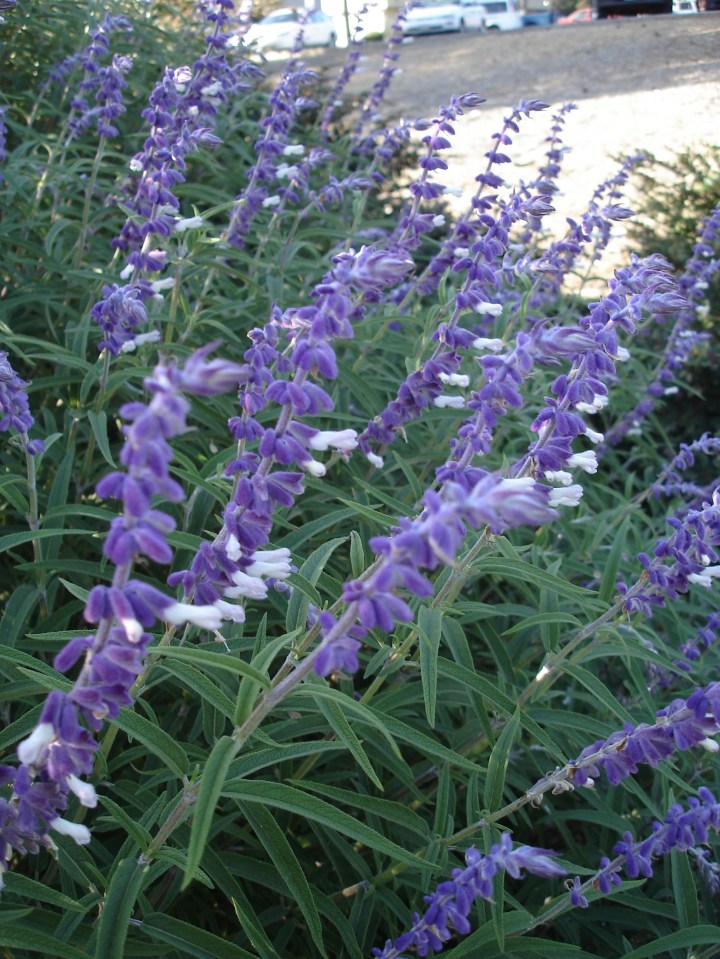
51014In the first year, Mexican bush sage, Salvia leucantha, does not get very big. Then it gets cut back to the ground at the end of winter. It gets about twice as big in the second year, only to get cut back again as winter ends. By the third or fourth year, healthy maturing plants can grow to five feet tall and seven feet wide each season. While cut back, big clumps can be divided to propagate.
Strikingly purplish blue floral spikes bloom from summer or early autumn until frost. The odd white ‘tags’ that protrude from the fuzzy bracts are the true flowers. The lanceolate leaves are grayish sage green and somewhat fuzzy. Plants are well rounded like tumble weeds, and should not be shorn. Mexican bush sage is very popular among hummingbirds, butterflies and bees.

Mexican bush sage wants full sun exposure, and unlike most other sages, it prefers relatively rich soil. Fertilizer can compensate for inferior or dense soil, and improves foliar density, but too much can delay bloom. New plants like to be watered regularly, especially if they grow well. As they mature and disperse their roots, they become less reliant on regular watering.

The Right Bulbs Save Energy

51014thumbAfter working so hard to bloom so impressively in spring or summer, bulbs redirect their efforts into saving up their energy for winter dormancy. That is why their fading foliage lingers after faded flowers get pruned away. The foliage eventually dries and deteriorates, leaving plumped dormant bulbs to overwinter underground. It is all their natural life cycle.
However, to bloom well the following spring, many bulbs need to be chilled while dormant. Such bulbs are from cooler climates. The chill convinces them that it really is winter, and that it will be safe to bloom when weather gets warmer in spring. They can get rather confused without adequate chill. Some may never bloom as well as they did their first spring.

Tulip, hyacinth, lily, anemone and ranunculus are probably the best examples of the worst perennial bulbs. Technically, they are perennials. Where winters are cooler, they may naturalize and bloom every spring. Here, winters are just too mild. They bloom very impressively in their first spring, but rarely bloom as well the second spring, and only if pampered.

Narcissus, daffodil, grape hyacinth and bearded iris are much more reliable. Crocus and freesia are a bit more demanding, but can be reliable if they get what they want. Montbretia and crocosmia are reliable enough to become invasive. Gladiola and dahlia, which are not quite as reliable as crocus, are summer bulbs, so get planted a bit later.

Of course not all bulbs are true bulbs. Some are corms, rhizomes, tubers or tuberous roots. Some get planted deeply. Bearded iris and a few others get planted shallowly. A few others do best in pots. In their first year, some bulbs can be planted in phases so that they bloom in phases the following spring. However, all bulbs of each type will synchronize by their second year.

Anemone, ranunculus and bearded iris bloom too synchronously to be phased. No matter when they get planted, each type blooms at the same time. However, some bearded iris bloom as early as the earliest of daffodil, and others bloom late. Some even bloom twice!

Six on Saturday: Zoning Out


Zonal geraniums, Pelargonium hortorum, can bloom anytime it wants to here, but really does tend to slow down somewhat through autumn and winter. As growth slows, older foliage will deteriorate and become more susceptible to rust and decay. Where exposed, older grown might succumb to frost over winter. Zonal geraniums will soon be zoning out.

Such deterioration and winter frost damage is not as bad as it looks, unless of course, frost is severe enough to kill the entire affected plants. By the time old growth looks shabby enough to be removed, new growth is probably already starting to develop down near the roots. After the last frost date (when no more frost is likely), old growth can be cut back to expose new growth that will soon replace it. Even if new growth is very minimal, growth will accelerate once exposed by the removal of old foliage, and as weather warms into spring.

That is still a few months away. For now, zonal geraniums are just beginning the process of zoning out, which is why their floral trusses are neither as big nor as abundant as they had been through summer. While they are busy with that, autumn flowers are beginning to bloom, and some of the winter flowers are getting ready for their season. Winter flowers get started in autumn because growth is slower in cooler weather, even for plants that prefer cool weather.

1. Chrysanthemum is ‘the’ classic autumn flower. These are blooming well enough in the infirmary that they will soon be relocated out into prominent spots or pots out in landscaped areas.P81006

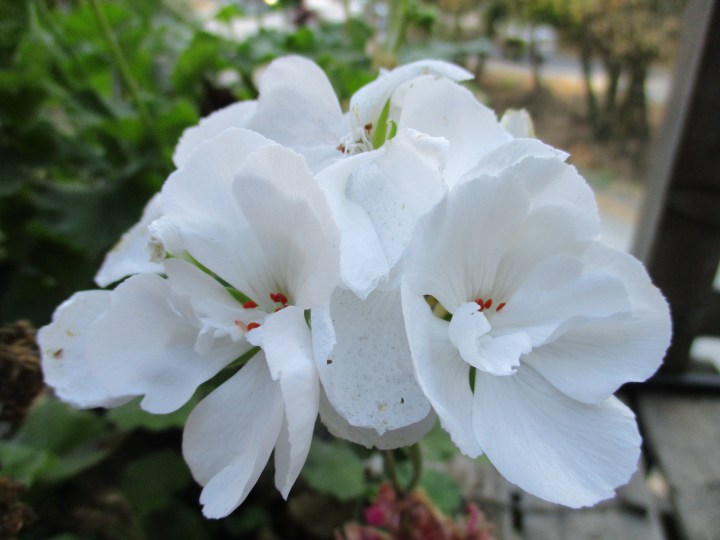
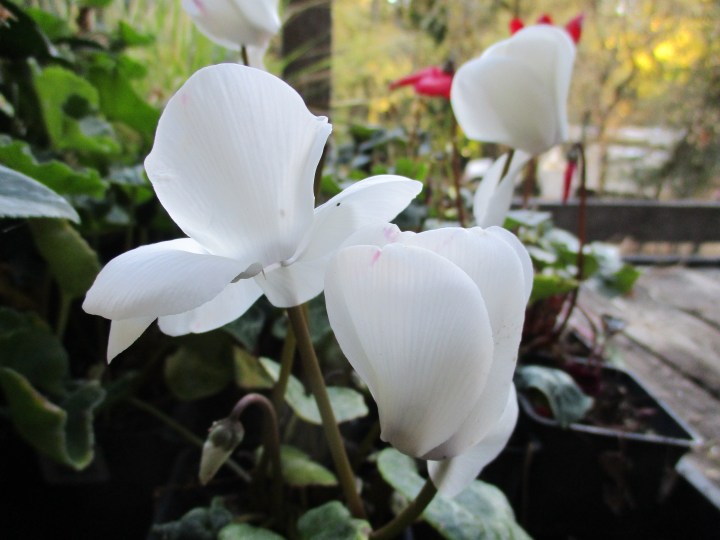
2. Cyclamen is a winter flower that is just now starting to grow after its long summer dormancy. These rudimentary first blooms are not much to brag about, but will likely be followed by enough for these plants to also be recycled back into the landscape from which they came last spring. These white flowers really are the best of the cyclamen for now. (I did not take this picture just because white is my favorite color.)P81006+

3. Reddish orange zonal geranium, and the magenta zonal geranium below, exhibit two more of those colors that I can not identify. I will just say that it is reddish orange. I happen to like it because the color resembles that of one of my two first zonal geraniums. Mine is not so well bred, so exhibits weedier growth and less prominent bloom. Nonetheless, I like mine because it is so resilient and predictable. I cut it to the ground at the end of winter, before new growth develops, and it grows right back. This prettier garden variety would probably prefer a gentler process.P81006++

4. Red zonal geranium seems to me to be the most elegant of those blooming here presently. Of course, I do not know for certain if it is. I do not know much about color. It just seems to me that this color is not as garish as the magenta sort of color below, or as unrefined as the common reddish orange above.P81006+++

5. Magenta zonal geranium, like the reddish orange zonal geranium above, is another color that I can not identify. It is a bit too flashy for my taste. However, the other one of my two first zonal geraniums blooms with a softer hue of a similar color. As much as I prefer to not admit it, my two first zonal geraniums are still my favorites, even though they bloom in colors that I am none too keen on.P81006++++

6. White zonal geranium happens to contrast well with the dark greens of landscapes in the redwood forests. Although it is my favorite of the four zonal geraniums that are blooming here now, my first two weedy zonal geraniums that bloom with unrefined reddish orange and garish magenta are still my two favorites.P81006+++++

This is the link for Six on Saturday, for anyone else who would like to participate:

https://thepropagatorblog.wordpress.com/2017/09/18/six-on-saturday-a-participant-guide/

Mulla Mulla

81010The common name sounds funny, but it is easier to pronounce then than the Latin name. Mulla mulla, Ptilotus exaltus, is an Australian species that has been locally available longer than its limited popularity suggests. It may seem to be more peculiar than it is because it is grown primarily by specialty growers, who happen to grow many cool plants that should be more popular than they are.
Like many species that are grown as annuals, the mulla mulla is really a short term perennial that can perform for a few years, but is unfortunately more often grown as a warm season annual. It will finish blooming soon, but if left in the garden through winter dormancy, young plants should resume in about April or May. It can succumb to frost if the weather gets cold enough through winter.

Although it can survive with less, mulla mulla prefers somewhat regular watering, and good sun exposure. New spring growth develops rather vigorously without getting much more than half a foot high and wide. Fuzzy cylindrical blooms that stand above the foliage are about three inches long. Floral color is pinkish mauve, with a silvery sheen. Deadheading promotes subsequent bloom.

Six on Saturday: Gazania


Gazanias were not planned. The English daisies that were planted last spring as warm season annuals that might hopefully continue as perennials succumbed to rust. Seriously! This rust was nasty! I had no idea that English daisy was so susceptible to rust! They were so ugly that they needed to be removed. They were replaced with the gazanias a bit more than half way through.

Gazanias are not the flashiest of choices for the prominent planters that they went into, but they work. If they continue to bloom through winter, they can stay as long as they like. If they stay long enough to get bald spots, we can trim around the edges and plug the scraps back into the bald spots. I would rather put a bit of effort into maintaining them than replace them as the seasons change.

These pictures were taken about two weeks ago, along with the picture of the gazania that was posted last week. For some unknown reason, the gazanias are presently taking a break from blooming.

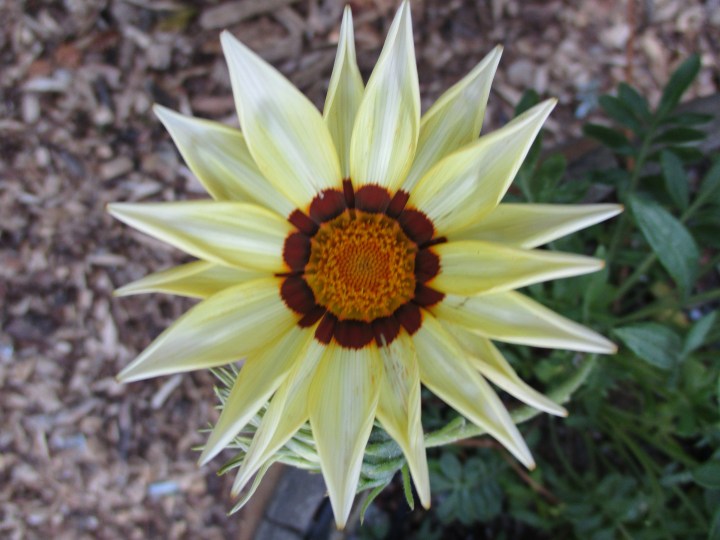
1. White is actually not my favorite color for gazanias. Yes, white is my favorite color. I just think that gazanias are at their best in brighter colors like yellow and orange. This white is not the best anyway. It looks like very pale yellow to me.P80922

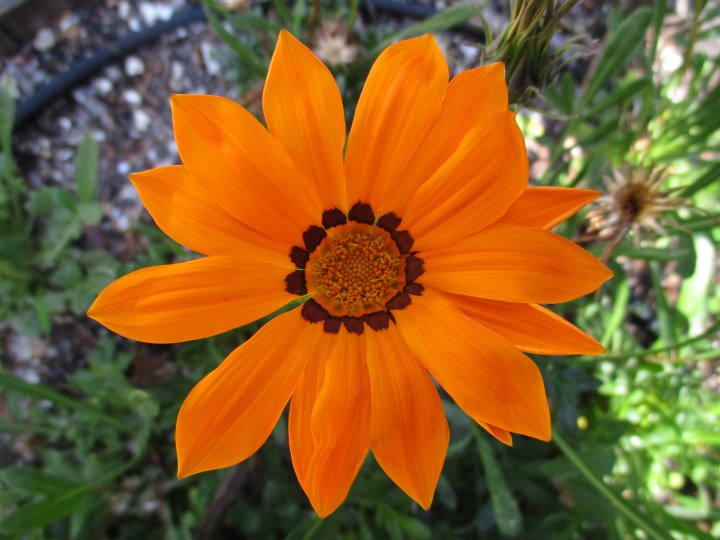
2. Yellow, in conjunction with orange, is one of the two classic colors for gazanias, and is one of my two favorites . . . in conjunction with orange.P80922+

3. Orange is the other half of the caption to the picture above. (Just read the same caption, and switch ‘yellow’ for ‘orange’, and ‘orange’ for ‘yellow’.)P80922++

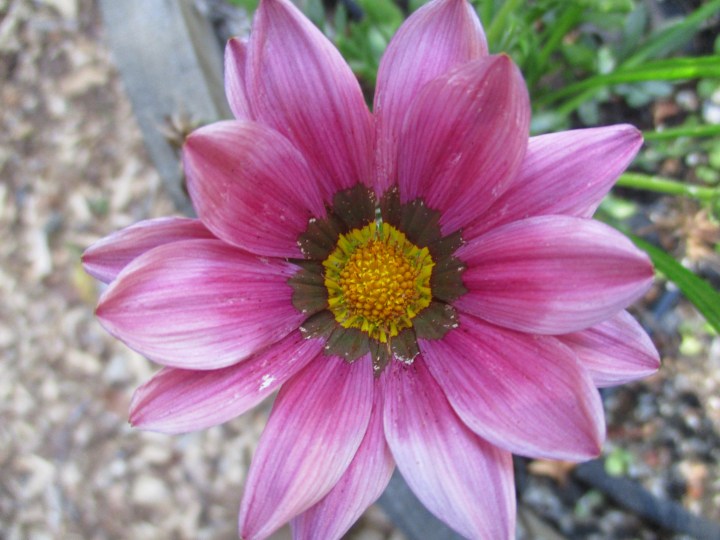
4. Pink might really be light burgundy. It was a bit darker when it first bloomed. This might be one of those colors that only girls can identify.P80922+++

5. Yellow with red stripes looks like something that blooms in the garden of Ronald McDonald.P80922++++

6. Cream with burgundy stripes looks like something that blooms in the garden of a clown with slightly more discriminating taste.P80922+++++

This is the link for Six on Saturday, for anyone else who would like to participate:

https://thepropagatorblog.wordpress.com/2017/09/18/six-on-saturday-a-participant-guide/

Lion’s Tail

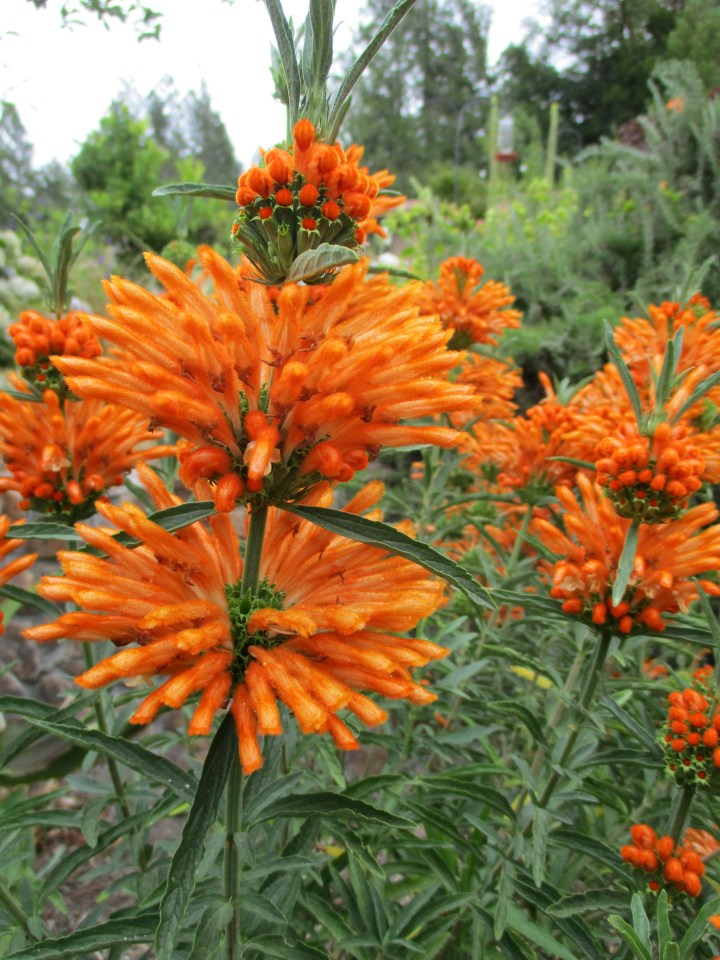
80919It does not get much more orange than this. Lion’s tail, Leonotis leonurus, tends to start with a relatively light duty bloom phase in the middle of spring, and then continue blooming in increasingly prolific phases until it finally culminates with the most spectacular bloom phase of the year about now, late in summer or early in autumn. The bloom is about as bright orange as California poppy!

Deadheading and pruning between bloom phases is not as simple as it might seem. Cutting back too aggressively postpones the next bloom phase. Bloomed stems should instead be cut back just below the deteriorating blooms. This unfortunately allows maturing plants to get somewhat overgrown and in need of more severe pruning over winter, before their first bloom phase of spring.

By now, well blooming plants may be as tall as six feet. As they mature, plants tend to get a bit wider than tall. The narrow evergreen leaves are about three inches long. Bloom is typical of related salvias, with dense tufts of tubular flowers neatly arranged in tiers on upright stems. Lion’s tail just happens to bloom with distinctively wide floral tufts. Cultivars with yellow or white flowers are rare.