Six on Saturday: Sedge Removal


What a nasty job! We know this sedge, or whatever it is, as ‘razor grass’ because it cuts like razors. It is difficult to pull from the rocky creek bottom and bank with the creeping stolons still attached. The creek is mucky. The water is wet. The gloves I wear to avoid getting slashed obviously get just as mucky and wet.

It was such a miserable job last autumn that we postponed most of it for winter. I figured that I could wait for the dangerous foliage to die back, and then just pull up the stolons below the dead foliage. It might have been a good idea, if only we had returned to actually execute our plan. By the time we got back, new foliage was already maturing.

I was so dreading returning to this job, but then found that the fresh new foliage was not nearly as dangerous as the more mature foliage that we pulled late last summer and autumn Furthermore, the new rosettes had not dispersed their roots quite as firmly as expected. They were suspiciously easy to pull, with the stolons still attached. Dead old rosettes seemed to be completely necrotic and decayed. It was too easy.

I expect at least a few new rosettes will develop later. There were likely some down under the muck that were not up when I was there. I also expect that some will grow from bits of stolon that were left behind. However, nothing has been seen in the past three weeks or so since we did this. (I would have shared these pictures sooner, but there were other pictures to share instead.)

Speaking of other pictures to share, there are six more on my secondary ‘Six on Saturday‘ post. I did not want to save them for later because they are almost irrelevant to horticulture, but I did not want to delete them without first sharing either.

1. Sedge, or whatever it is, is difficult to handle, and is even more difficult to handle when trying to separate the stolons from the stones on the bank of the creek.P90629

2. It did not take long to fill each of these plastic bins. I did not leave any foliage hanging over the edge, because I did not want to get cut when picking up the bins.P90629+

3. These bins can be used as a flotation device. Actually, it was rather annoying that they kept floating away until they got filled. It was a nice day to be in the creek.P90629++

4. This acorus grass was mostly overwhelmed by the sedge, or whatever it is. I should have gotten a ‘before’ picture. It looks great now, and is happy in the muck.P90629+++

5. While pulling sedge, I found these two knees developing from the roots of one of our two bald cypress. This particular tree was supposed to be a dawn redwood.P90629++++

6. I also noticed that the montbretia was blooming more than it normally does down in the deep shade. It is a voracious weed too, but inhibits even worse weeds.P90629+++++

This is the link for Six on Saturday, for anyone else who would like to participate:

https://thepropagatorblog.wordpress.com/2017/09/18/six-on-saturday-a-participant-guide/

Six on Saturday: Serious Weeds


The humongous perennial pea that I showed off last week was relatively innocuous. These six are some of the more prolific weeds. Actually, except for the first two, these are some of the most aggressive and problematic weeds in this region. All are exotic, which means that they are not native. Some were imported intentionally. Some were more likely stowaways. All except for #2 were found right outside here. #2 was found closer to town.

1. Vetch was most likely imported intentionally as a cover crop, forage crop or both. Because I do not know which vetch this is, I do not know why it is here. This is neither of the two species of vetch that are native here. It is a polite and pretty weed that never seems to become much of problem. Consequently, not much is known about it, or how it affects the ecosystem. Most of us just let it do what it wants to because it improves the soil.P90622

2. Queen Anne’s lace might have been imported intentionally because the young roots, young leaves and flowers are edible. It is, after all, a wild version of carrot. However, the small roots mature quickly and become too tough to eat, and often develop bad flavor. Furthermore, it is avoided because it it too easily confused with the extremely toxic poison hemlock! It can be a companion plant for attracting pollinators, but is mostly ignored.P90622+

3. Saint John’s wort was imported intentionally as a ground cover for landscapes, and escaped into the wild where it competes aggressively with native plants. It is toxic to grazing animals, so must be removed from where it appears in pastureland. Unfortunately, its wiry but tough stolons are extremely difficult to eradicate. This species is unavailable here, not just because it is invasive, but because it is so susceptible to rust. It never looks good.P90622++

4. Broom is one of the nastiest. Some believe it to be Scottish broom (which we call ‘Scotch broom’). Some believe it to be Spanish. Actually, it is most likely French. It doesn’t matter. It is terribly prolific and aggressive, with seed that remain viable and continue to germinate for many years after parent plants get removed. It was imported intentionally just because it is so pretty in bloom. So many of the worst weeds arrived here like that.P90622+++

5. Himalayan blackberry, like Queen Anne’s lace, might have been imported intentionally because it produces something edible. It happens to makes decent blackberries. However, it is neither as reliable nor as productive as garden variety blackberries. Berries might be sparse and of inferior quality, and are very difficult to pick because the canes are so very wickedly thorny! Canes are extremely vigorous and aggressive, and difficult to kill!P90622++++

6. Thistle was likely a stowaway. There is no realistic reason to have imported it. Nothing eats it. It is too wickedly spiny to handle. It does not work as a cover crop, although it does try to cover as much area as it can get its prolific seed into. There are other thistles that are more invasive, but none that are as mean as this one is with those formidable spines! I do not know for certain what species this is, but it is not one of the native thistles.P90622+++++

This is the link for Six on Saturday, for anyone else who would like to participate:

https://thepropagatorblog.wordpress.com/2017/09/18/six-on-saturday-a-participant-guide/

Six on Saturday: Gophers and Weeds


Both have been very active all spring. Some of the sneakiest have been getting away with their activity unobserved.

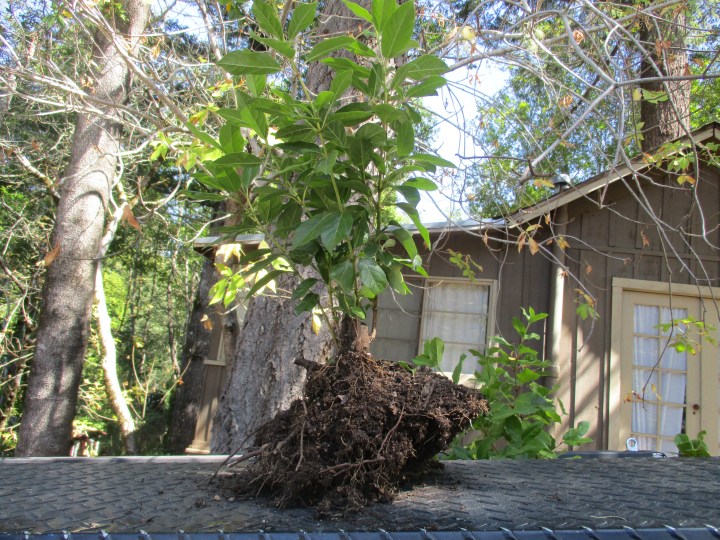
1. This is a fifteen foot tall camellia, or what remains of it. For comparison, that is a six foot long bench it is laying on. It still looks green and healthy, but started leaning. Upon closer examination, I found that it was not rooted to the ground. It pulled right out! The roots were almost completely gone! There was no indication that there was a problem.P90615

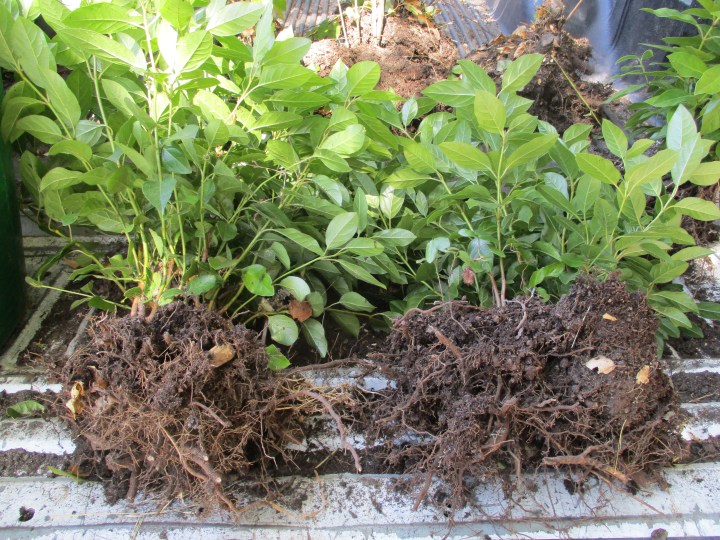
2. This is what remained of the root system. Gophers ate through just about everything that was sustaining and supporting the big camellia above. No excavation or gopher mounds were observed. The area around the camellia was obscured by Algerian ivy. This all happened faster than the camellia could express symptoms associated with such damage.P90615+

3. ‘Kramer’s Supreme’. More specifically, “Award Winning – ‘Kramer’s Supreme’ – Camellia japonica – Trade Mark Registered”. Someone should have removed the label before it damaged the stem it was attached to. Actually, the long dead stem was stubbed just a few inches above the upper margin of this picture. It doesn’t matter now anyway.P90615++

4. This big mound of greenery is all a single big weed, perennial pea. I put it next to the wheel for comparison of size. It grew in a newly landscaped area where we did not expect such big weeds to grow so quickly. It did not seem to be as big as it is, so was easily ignored. Why didn’t gophers eat this instead of the now dead camellia above?!P90615+++

5. As you can almost see in the bad picture, perennial pea is not an unsightly weed. It also lays low and fits into the landscape in such a manner that it is easy to ignore while targeting more obtrusive weeds elsewhere. That is how the specimen in the picture above got so big. This one is not nearly as big, but overwhelmed a few smaller perennials.P90615++++

6. Perennial pea flowers are quite pretty. If possible, I like to let them bloom before pulling them up. Most look like these. Some bloom with fluffier double flowers. Some are lighter pink. A few are darker purplish. White is quite rare. As prolific as they are where they are not wanted, they are surprisingly unreliable from seed sown where actually desired.P90615+++++

This is the link for Six on Saturday, for anyone else who would like to participate:

https://thepropagatorblog.wordpress.com/2017/09/18/six-on-saturday-a-participant-guide/
Six on Saturday: Off Schedule


Every year is different. The weather is different. Bloom times are different. Growth rates are different.

1. Asiatic lily. This is one of five that were planted late enough last winter to be blooming right now, after others have finished. I would not have planted them so late, but that was when one of the neighbors shared them. They are a different color of the same sort of lily as the rose lily that was also blooming late last week.P90608

2. Peruvian lily. It seems to me that they were only beginning to bloom by this time last year. This year, they started blooming sparsely more than a month ago, and were blooming as profusely as they are now more than two weeks ago. There are pink and peach Peruvian lilies here too. I showed them off last years. (A peach flower can be seen out of focus at the bottom of the picture. A pink flower can be seen out of focus at the lower left corner of the previous picture #1 of Asiatic lily.P90608+

3. Rhododendron. Some bloom early and get battered by winter weather. Some bloom late and might get slightly roasted in the arid air of late spring. This one always bloom late like this, and has no problem with the weather. I do not know what cultivar it is. It certainly seems happy.P90608++

4. Dahlia. #1 Asiatic lily bloomed late. #2 Peruvian lily bloomed early. #3 rhododendron bloomed late. This dahlia did both. Dahlias typically only begin to bloom late in June. As you can see, this one already bloomed. I would not have shared this bad picture of a deteriorating early bloom, but was impressed that it bloomed at all. You see, it was dug and stored TWO winters ago, and then forgotten about. It somehow survived in storage through last year. I found it late last winter, and after determining that part of it was actually still viable, buried it right behind the lilies #1. It grew as if nothing had ever happened, and bloomed a year late and a month early. It has nice buds on in, so should resume bloom right on schedule, and continue to frost.P90608+++

5. Boston ivy. Four were planted over winter to climb a concrete retaining wall and a pair of concrete pillars supporting a bridge. The plan is to remove the Algerian ivy that hangs down over the retaining wall as it is replaced by the Boston ivy climbing up from below. I do not want to remove the Algerian ivy until necessary. I just want to keep it out of the way. I did not expect the Boston ivy to start growing like a weed so early. I cut the Algerian ivy farther to the left after getting this picture.P90608++++

6. Flowering cherry. Two plants; above were early. Two were late. One was both early and late. Well, this one won’t break the tie. These flowering cherries bloomed on time and are well foliated as they should be. In fact, they are better foliated and healthier than they have been in several years. They were so unhealthy last year that we had planned to cut them down and replace them by now. We just have not done so because we have not found replacements for them yet. Therefore, we are late; but it is not their fault. If it were at all possible, I would not remove them.P90608+++++

This is the link for Six on Saturday, for anyone else who would like to participate:

https://thepropagatorblog.wordpress.com/2017/09/18/six-on-saturday-a-participant-guide/

Six on Saturday: Oh, The Shame!


Not my shame of course; but that of the trees in the pictures below.

Do not try this at home. I only did it because I am a horticulturist and arborist; and I happen to be one of the last arborists in America who condones coppicing and pollarding, which are depicted here.

Coppicing is cutting trees or shrubbery down to the ground annually, or at least regularly every few years or so. Some coppiced trees form basal burls or lignotubers. Some just form thicket growth that replaces itself after getting coppiced back to the ground.

Pollarding is similar to coppicing, but rather than cutting all growth back to a stump or stumps at ground level, it involves pruning all growth back to the same distended knuckles at the ends of a few main limbs annually, or at least regularly every few years or so. It is done in such a manner that the pruning wounds are compartmentalized by the new growth of the following year. Knuckles can be elongated by leaving single short stubs.

There are a few reasons for coppicing and pollarding. Some subjects develop an abundance of appealingly lush foliage. Some develop an abundance of appealing or useful twiggy growth. Coppiced red twig dogwoods are much twiggier and more colorful while bare in winter. Pollarded or coppiced willows produce an abundance of canes for basketry. White mulberries are pollarded to provide an abundance of lush foliage to feed silkworms.

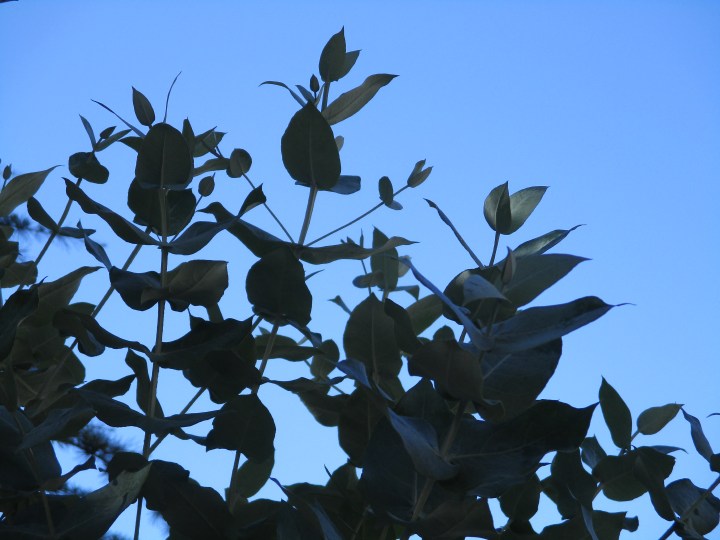
I coppiced a Eucalyptus globulus ‘Compacta’ and pollarded a Eucalyptus globulus for two main reasons. Both are such problematic trees that I do not want to plant either into the ground, so must keep them contained. Also, I want the remarkably aromatic juvenile foliage that develops in response to coppicing and pollarding.

1. Eucalyptus globulus ‘Compacta’ coppiced stump. It is not such a great example of a coppiced stump, since the tree did not grow enough two years ago to get coppiced last year. Consequently, the few main trunks that were just recently coppiced are already starting to form their own separate lignotubers on top of the original, which is now rotting below. Soon enough, they will fuse to form a single lignotuber, concealing the evidence.P90601

2. Eucalyptus globulus ‘Compacta’ before getting coppiced. It is quite small for a specimen that was not coppiced last year.P90601+

3. Eucalyptus globulus ‘Compacta’ after getting coppiced. Rhody is not impressed.P90601++

4. Eucalyptus cinerea in need of pollarding. This tree grew too big too fast to survive any longer in the relatively small #15 (15 gallon) can. Fortunately, in just a few days, it will instead get installed into a landscape where it can disperse roots and mature into a normal unpollarded tree. After a few years, it might get pollarded anyway, just to produce silvery juvenile foliage withing reach of the ground, but that is not a concern just yet.P90601+++

5. Eucalyptus globulus pollarded knuckle. This is only the second pollarding procedure for this subject. The first procedure involved lopping the lanky single trunk off right here where the knuckle is now. The multiple limbs that developed were just recently lopped off, leaving this distended knuckle to repeat the process, hopefully annually.P90601++++

6. Eucalyptus globulus pollarded trunk. This is why Eucalyptus globulus should not get pollarded! They look ridiculous if deprived of their naturally elegant form. They do not look much more dignified with multiple pollarded limbs. Oh, the shame!P90601+++++

This is the link for Six on Saturday, for anyone else who would like to participate:

https://thepropagatorblog.wordpress.com/2017/09/18/six-on-saturday-a-participant-guide/

Six on Saturday: Abbreviated Rose Parade


There are a few other roses that I could have gotten pictures of in order to submit a complete set of six, but I wanted to show off just these four that bloom in what is known as the ‘rose bed’. A fifth purple cultivar was not blooming when I got these pictures. What seems to be a sixth cultivar that I did not get a picture of is really suckers of ‘Doctor Huey’ understock that appeared far enough away from the original plant to not be a problem.

There are several rose shrubs and standards (trees) in the rose bed, but they are limited to these five and a half distinct and mostly unidentified cultivars. They are the most prominently located roses that I work with. The other roses are in other landscapes, or at the yard of the maintenance shops. Two of the larger groups of roses are uniform beds of carpet roses, which I am really none too keen on.

1. The few rose standards (trees) seem to be floribundas. This one looks familiar, but not familiar enough for me to guess the name of it.P90525

2. I would guess that this hybrid tea rose that grows in a shrub form is ‘Double Delight’. It does happen to be quite pleasantly fragrant.P90525+

3. This one seems to be a floribunda like the standards (trees) but grows in shrub form like #2 above. I do not believe it is notably fragrant.P90525++

4. I would guess that this one is the common floribunda ‘Iceberg’, growing as a standard. One is a double graft with a purple floribunda.P90525+++

5. Well, that was it. The fifth purple cultivar is not blooming, and ‘Doctor Huey’ bloomed only once for the year. This nearby yellow calla is irrelevant.P90525++++

6. This piece of dead madrone is just as irrelevant, but I though it was amusingly sculptural. I probably should have been more careful while cutting it apart.P90525+++++

This is the link for Six on Saturday, for anyone else who would like to participate:

https://thepropagatorblog.wordpress.com/2017/09/18/six-on-saturday-a-participant-guide/

Six on Saturday: Willow


Rain is rare here so late in the season. It is also potentially damaging to some of the plants in the landscapes, and some of the latest of the spring flowers that are still blooming. Most of the deciduous plants are lush with new foliage on limber stems that are still adapting to the increased foliar weight. Foliage gets even heavier when it gets wet from rain. For the willows, the extra weight is enough to break limbs.

Willow limbs do not often break away cleanly. They instead split apart so that they fall slowly while still attached to the main tree. In the swampy conditions where they naturally grow, the broken but still attached limbs develop roots where they touch the ground, and then grow into new trees. Broken limbs are therefore not a problem for willows. Nonetheless, they are a problem in the landscapes.

1. This looks like mozzarella cheese being pulled apart. My great uncle used to bring some of the good Italian stuff when he came up from Long Beach for some of the Holidays. Oh my, how off topic!P90518

2. This is what it really was. Willow limbs are surprisingly weak this time of year. They don’t just break. They split apart. I should have gotten a picture of it before I cut it up.P90518+

3. It landed right across a walkway, where I could not put off breaking it apart and taking it away. With all the rain that caused it to break, the lawn was too swampy to walk around on.P90518++

4. It landed on this bench too, or at least the left half of it. With hundreds of acres of unused and unlandscaped forest out there, why must falling trees land in such inappropriate situations?P90518+++

5. All that mess was not even a full load. It just didn’t take up much space after it was all broken apart and loaded up. There was plenty of other willow to cut later in the day, and for the next few days.P90518++++

6. Willow! My niece named him. I knew better than to argue. I never liked the name though. I and almost everyone but my niece knew him as Bill, which is short for Willow. My friend Steven knew him as William.WILLOW

This is the link for Six on Saturday, for anyone else who would like to participate:

https://thepropagatorblog.wordpress.com/2017/09/18/six-on-saturday-a-participant-guide/
The Seventh On Saturday

P90511KThis is the one that got away; or actually, the one that was never caught. It bloomed after I got the pictures for the ‘Six on Saturday’ post for this morning. It could be the same unopened bud in picture #3 of the Six on Saturday post, as it is now blooming. If not the same bud, it is on the same plant, and now looks even more like the common ‘Simplicity’ rose. It is not my favorite, but I did not select it.
That is how the recovery nursery works. It is where we bring salvageable plants that need to be removed from their landscapes. Some were in the way of other projects. Some were not the right plants for their particular situations. Some were even donated by neighbors who thought we might be able to utilize them somewhere in the landscapes.
Some of plants brought in are not there long. They might get groomed and then moved directly to a more appropriate situation. That happens more during winter, when we dig up dormant plants and relocate them while the weather is still cool and rainy. We did this with a big overgrown forsythia that was dug and divided into five or so new plants before getting relocated into a new landscape. It helps is we can delay relocation until winter.
There are many potentially salvageable plants that must be moved at a particular time, even if it is not while they are dormant. They get groomed and canned (potted), and can take their time to recover before we put them back into the landscapes. Unfortunately, many do not recover adequately. Some end up staying too long because we can not find homes for them. After several years, the roses will finally be going to a new home soon.

Six on Saturday: The Yard


This is no home garden. It is the yard outside the various shops of the Maintenance Department where I work part time. It contains some of the salvageable plant material that we try to recycle from some of the landscapes from which it must be removed. Over winter, some plants get dug and relocated directly, rather than come to the yard. Otherwise, plants come here to get canned (potted) to recover, and then find a home.

Because no one sees our yard, we need not maintain it like we maintain the rest of the landscapes. Consequently, it collects a few weeds. Also, because there are other shops in the same buildings, there are a few unexpected odds and ends left strewn about by other types of professionals, such as the electrician. Hence, #6.

1. You know, when I took this picture, I though that the annual grassy weeds somehow looked pretty in front of the wild cucumber vine on the cyclone fence. I’m not the artsy sort; so will not try to explain it.P90511

2. Mixed in with the wild cucumber vine, which incidentally makes not edible cucumbers, this potato vine blooms, but incidentally makes not potatoes. Of course, I never dug it up to confirm that claim.P90511+

3. This rose, which might be ‘Simplicity’, has been here for a few years. No one remembers where it came from. It was supposed to get planted into a landscape while it was still dormant. Too late now.P90511++

4. This rose might be ‘Medallion’, but it is hard to say for certain. It is not as big as it should be. It was supposed to get planted while dormant too. There actually is a landscape that can use both of them.P90511+++

5. Shasta daisy has been blooming for a while now. You would think that it would be easy to find a home for this one, but it is still in the yard. It is big enough to divide into more plants if still here this winter.P90511++++

6. Spring bulbs are done now.P90511+++++

This is the link for Six on Saturday, for anyone else who would like to participate:

https://thepropagatorblog.wordpress.com/2017/09/18/six-on-saturday-a-participant-guide/

Six on Saturday: Rhody!!

P71014

This is not really about Rhody, the terrier whom I work for. I just threw that extra picture in because, if you know who Rhody is, you were expecting to see his picture after reading the title. The six pictures below are really just rhododendrons that were blooming last week.

Last year was the best bloom of rhododendrons and azaleas in many years here. Those who have known them for many years can not remember a more spectacular bloom, with so many of different cultivars of the rhododendrons blooming so profusely in the same season.

The bloom this year is unusually sparse. No one can explain it. They have good years and bad years, just like anything else in the garden. Fortunately, even in their bad years, the flowers that bloom are spectacular.

1. Of the six this week, this is my least favorite. It is a vary pale pink, but not pale enough to be white. There are not many florets on the trusses.P90504

2. I refer to this one as ‘Taurus’; but I really do not know what it is. ‘Taurus’ is very susceptible to thrip. This one sustains only minor damage from thrip, while a few others nearby are are seriously damaged.P90504+

3. This one may not look much better than #1, but the color is pinker, and the trusses are impressively big with more florets when it is in full bloom. It grows as a tree nearly twenty feet tall.P90504++

4. I refer to this one as ‘Anah Kruschke’, but like for #2 above and #5 below, I am not sure about its identity. ‘Anah Kruschke’ should not be damaged by thrip as badly as this one is. I think my colleague grew this one.P90504+++

5. Of the three here that I have names for, this is the one that is most certainly not what I like to think it is. ‘Helene Schiffner’, which happens to be one of my favorites, is not blushed with yellow.P90504++++

6. I believe that my esteemed colleague grew this one as well as #4. I remember delivering a significant order of rhododendrons here years ago, at about the same time this and #4 were installed.P90504+++++

This is the link for Six on Saturday, for anyone else who would like to participate:

https://thepropagatorblog.wordpress.com/2017/09/18/six-on-saturday-a-participant-guide/