Memorial Tree Update to the Updated Update, etc. – the Sequel to all those other Sequels

P80415KWe can keep this more brief than that long title.

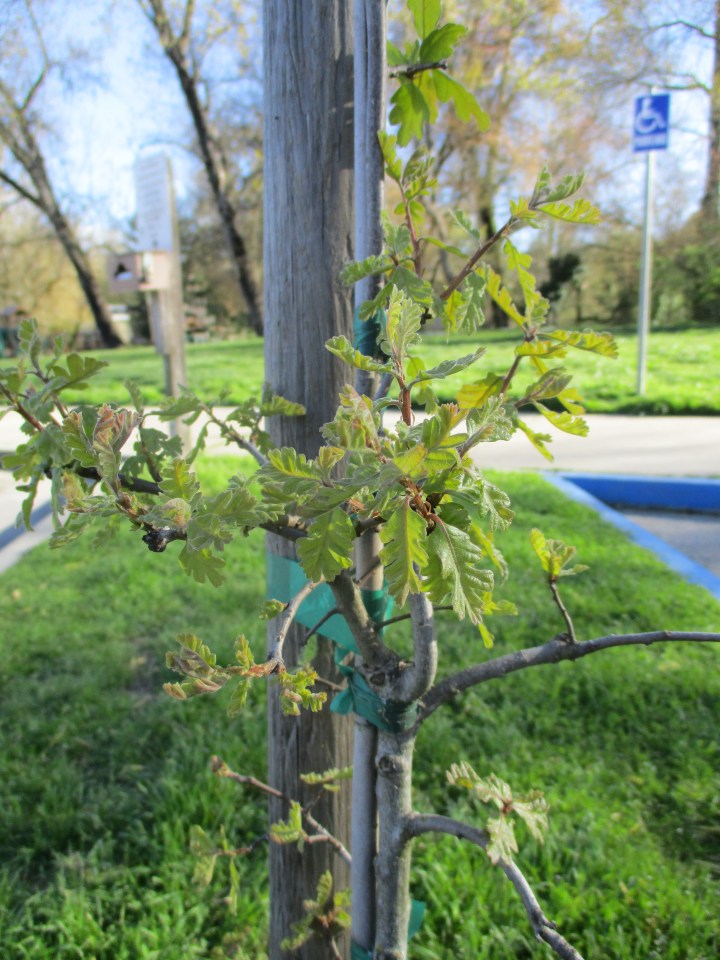
The small and young Memorial Tree, which is also known as the Scofield Tree, in Felton Covered Bridge Park is doing quite well. Nothing unexpected is happening. It just looks too happy to not get a picture of it. It is well foliated and lush like a happy valley oak should be at this time of year. The only improvement it could implement would be to divert more growth to the main vertical trunk. So far, growth is somewhat evenly distributed over all actively growing stems. The little tree is consequently quite fluffy. The main trunk will eventually get bound to a stake to direct growth upward for a straight and vertical trunk. Lateral stems may need to get pruned back so that they do not dominate. They remain for now, to sustain healthy growth and to promote trunk caliper growth. Weeds around the trunk will get pulled so that ‘gardeners’ will hopefully keep a safe distance with their weed whackers. The previous update with links to even more previous updates can be found at https://tonytomeo.wordpress.com/2018/03/31/scofield-tree-update-spring-2018/ .

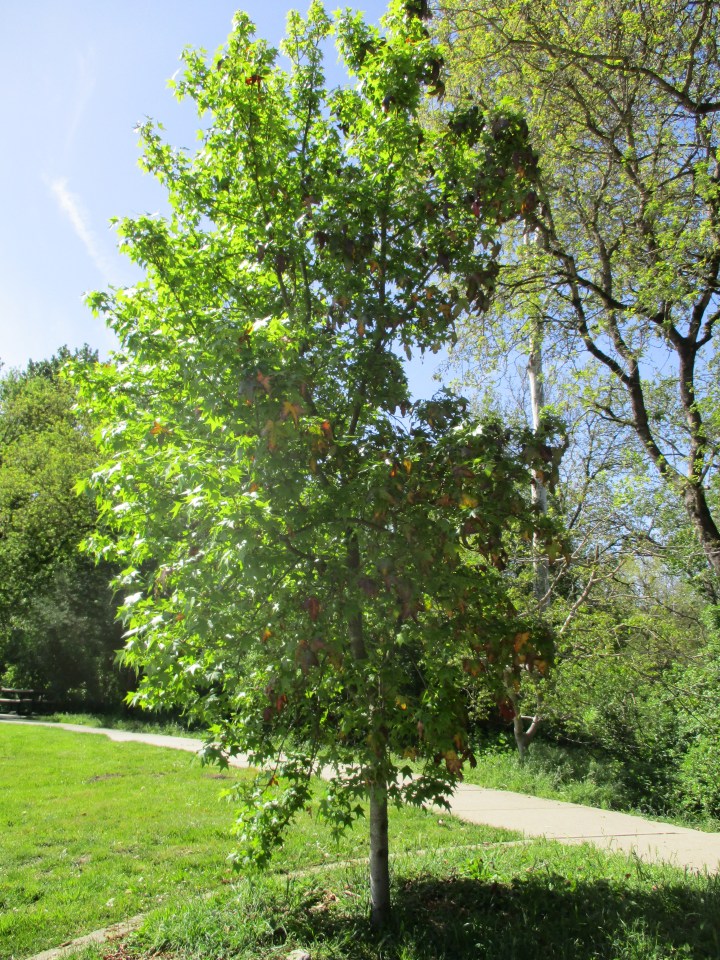
Charlie’s Memorial Tree is a healthy sweetgum nearby, just outside of the southwest corner of the same parking lot that the Memorial Tree is in. It is several years older and significantly larger than the Memorial Tree, and is also quite healthy and foliating lushly. However, no matter how diligently it gets correctively pruned, it continues to develop minor structural deficiencies, which are unfortunately normal for the species. The top was broken out while the tree was young, so a lateral branch dominated as a new top, only to get broken as well. Consequently, as the tree matures, the trunk will be somewhat bent and slightly leaning, which is the big picture, is not really a problem. Charlie is the little Boston Terrier depicted in the mural that was mentioned in the article from yesterday at https://tonytomeo.wordpress.com/2018/04/14/foliage-is-not-always-the-answer/ .P80415K+
A Tree Falls In The Forest

70412thumbThe Great Basin bristlecone pine of the eastern Sierra Nevada can live more than five thousand years. The giant sequoia of the western Sierra Nevada can live more than three thousand years. The familiar coastal redwood from the Coastal Ranges can live more than two thousand years. Besides impressive longevity, one thing that they all have in common is that they all eventually die.
Most trees in home gardens do not live much more than a century. Some oaks can last a long time. Willows, poplars and acacias do not. Trees typically do not live as long in landscape situations as they do naturally in the wild because their life cycles are accelerated by watering and fertilizing, and also because watering promotes rot. Some trees get removed because they grow too big.

While trees are young and growing, they sometimes need help with structural problems. They might need pruning to eliminate limbs that are likely to break away and fall. On rare occasion, trees might need pruning to reduce weight and resistance to wind if stability becomes a concern. Falling limbs or falling trees are very natural in the wild, but can be serious problems around the home.

As trees age, they develop more structural deficiencies, which are increasingly difficult to repair or accommodate. Most big old hardwood trees have some degree of decay within their main trunks, even if no such damage is visible from the outside. Although perfectly natural, this decay eventually compromises structural integrity. Stability is slowly compromised as aging roots decay.

It is true that most trees that fall or drop limbs are more likely to do so while getting thrashed by winter storms. However, there are other factors that can bring down limbs or entire trees. Warming spring weather promotes growth of new foliage, which significantly increases the weight and wind resistance of structurally deficient limbs and destabilized trees. Warmth also accelerates decay. Even after winter storms, there are many other reasons to be aware of the health of trees.

High Fashion

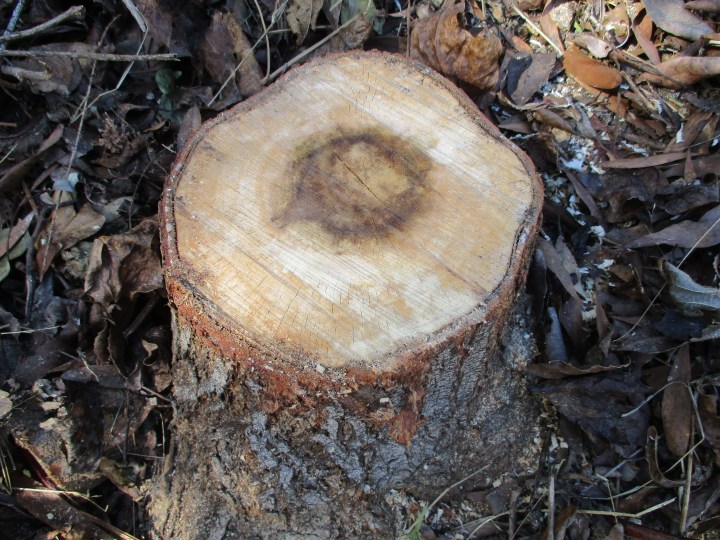
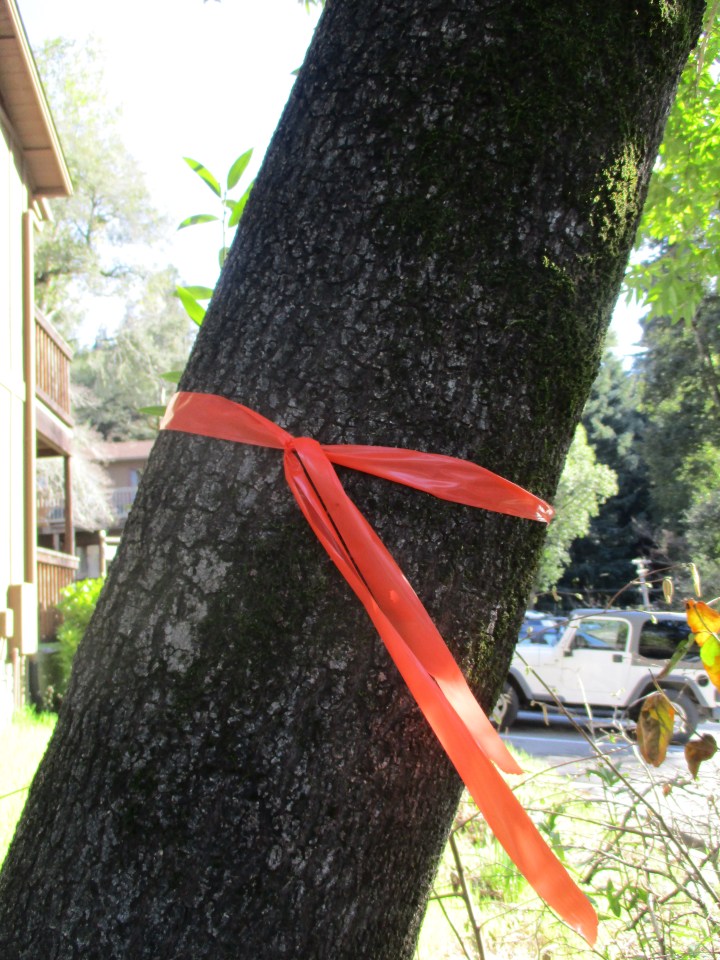
P80404This exquisite yet elegantly simple persimmon orange cravat is to die for! See how distinguishing it is for the Umbellularia californica sporting it! The brilliant color is so appropriate for a tree that needs to stand out in a crowd! How else would the arborists coming to cut it down find it? Yes, it is to die for!
This sort of high fashion is not normally so high. Trees that are tagged by surveyors are typically more discretely tagged with spray paint down near the ground. We just used this orange tape because we were only hastily marking a few or our own trees for removal, and nothing else.

The problem with tape in other situations is that it can be removed and applied to another tree. One of my colleagues sent his crew to cut down a street tree downtown that had been marked with orange tape, only to find later that the wrong tree had been cut down. The client had procured a permit for the tree that the arborist had tied the tape onto, but not another tree next to it that he wanted removed also. After the arborist marked the tree to be removed with tape and left, the client removed the tape, and tied it onto the tree that was to be preserved. Of course, the crew cut down the tree with the orange tape. The sleazy client did not want to pay for the removal because the wrong tree had been cut down, and then hired another tree service to legally remove the tree for which the removal permit had been issued, while leaving the first arborist liable for cutting down a protected tree without a permit. Fortunately, a neighboring merchant knew what the client was up to, saw him move the tape, and reported the incident to the responding code enforcement agents. The arborist got paid. The client got two huge fines; one for removing the tree without a permit, and one for the value of the rather valuable tree.

Tape works fine in the nursery because there is no one there to do anything sleazy. Besides, paint would be messy. Many years ago, we used red tape for stock that needed to be disposed of, orange tape for stock that needed to be shifted into the next larger size, and blue tape for stock that was sold and needed to be moved to a holding corral or loaded onto a delivery truck. Of course, different nurseries might use different colors and a different code.

For the sort of tree work that I was involved with, orange or red paint was used only on trees that were to be removed. It would not have been appropriate to tag good trees with paint! We usually marked trees for removal with a circled ‘X’ or just an ‘X’, in a very visible manner.

Surveyors use paint in a more discrete fashion, with single dots or other small markings of paint down near the ground. They use a variety of colors and a standardized code system. The paint is not permanent, and weathers away after a year or so. Some trees get tagged for pruning for clearance from utility cables. Some get tagged for clearance above roadways and sidewalks. A few that are hazardous or in need of such severe pruning that they will be ruined in the process get tagged for removal. Each color of paint means something different. Each specific tag is a message to whomever is responsible for the prescribed procedure. Some who are responsive to the coded messages work for the respective municipality. Others work for a utility company of some sort. They may not know what all the tagging means, but they recognize the meaning of the tags that are addressed to them.

That is why, when a client asks me what a particular tag on a tree means, I can only say that I do not know. I know what tags my associates use, and I can guess what a prominent circled ‘X’ or an ‘X’ means because I know of so many arborists who use that tag. I do happen to know what the bright orange tape around the bay tree above means because my associate put it there. However, I do not know what a blue dot, green dot, yellow dot, orange vertical line or red horizontal line mean.

Scofield Tree Update – Spring 2018

P80331KNot much has happened since the last update on Christmas Eve. https://tonytomeo.wordpress.com/2017/12/24/scofield-tree-update/ The Scofield Tree has been bare all winter, and is only now developing new foliage.
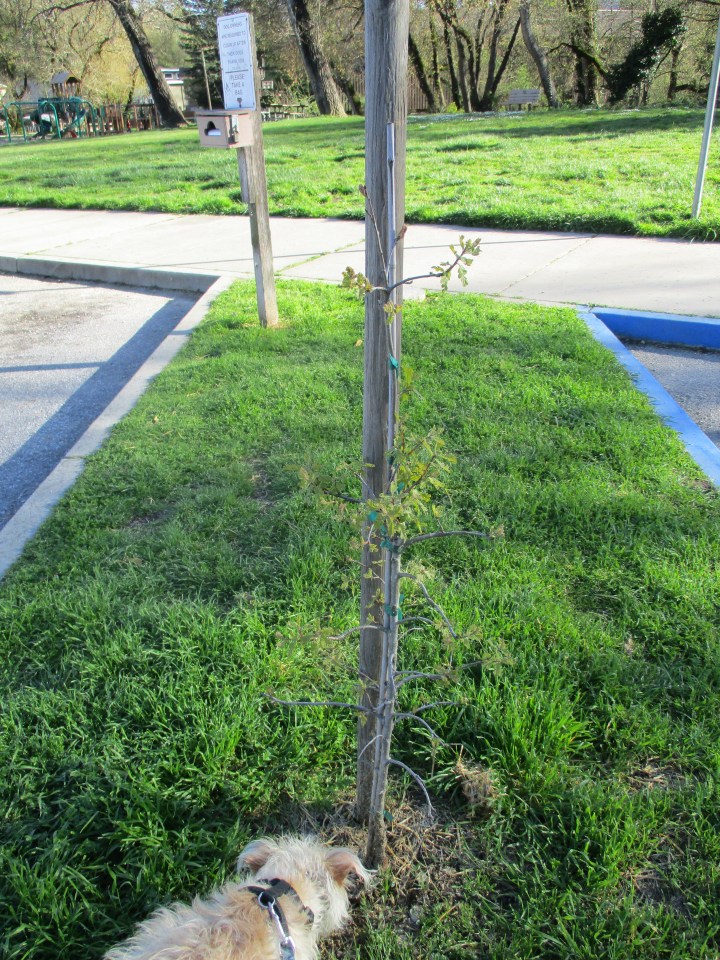
It was planted more than two years ago, but had been set back by some serious damage from an altercation with a weed whacker. Unbelievably, after emphatic explanation of how dangerous weed whackers are to such young trees, and an unfulfilled promise that the tree would be outfitted with a tree guard, a ‘gardener’ attacked the tree with a weed whacker AGAIN! Fortunately, the tree had previously developed enough scar tissue to not be damaged by this latest assault.

It will certainly be pampered this year. It really needs to grow. The bark at the base needs to be tough enough to survive an even more aggressive weed whacker attack. The trunk must be resilient to someone bumping into it, or a dog getting a leash tangled around it. Eventually, the trunk will be resilient to a car bumping into it, which is a possibility in the parking lot in which it is located. The canopy must eventually grow up and above the height of parked cars and those getting into and out of those cars. Ideally, it should be out of reach of gardeners with cutting tools that they do not know how to use properly.

The old lodgepole stake will be replaced because it is likely rotten at the base. The binding stake will also be replaced because it has warped in the last two years. Such binding is not horticulturally correct, but is necessary to correct disfigurement, as well as to help protect from more damage. Fertilizer should accelerate growth.

The first article about the Scofield Tree was posted back on October 6. https://tonytomeo.wordpress.com/2017/10/06/small-tree-in-a-big-park/P80331K+

Hanging Gardens of Babylon

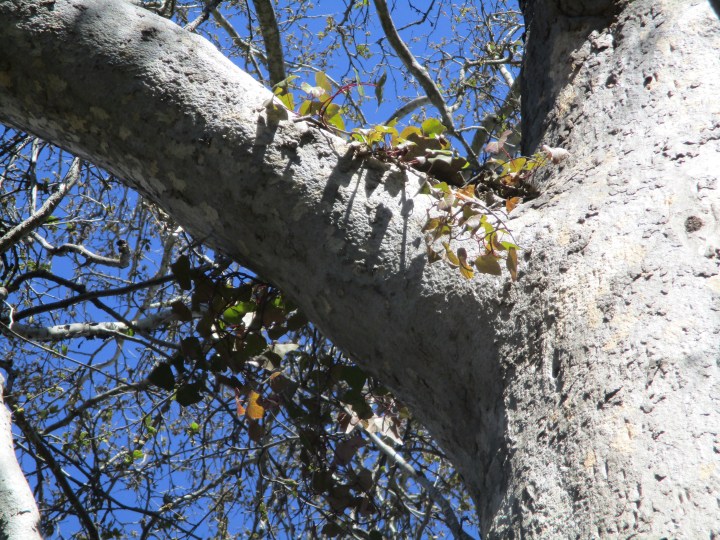
P80328The ivy in this sycamore did not just climb up from the ground to hang over this big limb. If you look closely, you will see no vine coming up from the ground. This small patch of ivy as well as a small pyracantha, are growing in a decayed cavity on top of the big limb. The ivy may have climbed up a long time ago, and then rooted into the cavity before the original vine was somehow removed. Alternatively, the ivy might have grown from a seed that was dropped by a bird or ivy vines that are higher up in nearby box elder trees. It is impossible to say now.P80328+It is also difficult to say why there is such a large cavity on top of the limb. It could have originated as a large scar incurred from the impact of another large limb that fell from above. There are a few cavities higher up that were caused by large limbs breaking away. Although unlikely, the cavity could have developed from sun scald damage, after the upper surface of the big limb suddenly became exposed by the loss of limbs higher up.P80328++This other aerial patch of ivy hangs from a smaller cavity higher in the same tree. Oddly, among sycamores, such cavities on upper surfaces of large limbs are not uncommon. Sycamores often drop large limbs from high in their canopies, exposing or damaging lower limbs below. Their lightly colored bark is very susceptible to sun scald if suddenly exposed after always being shaded. It is also not very resilient to heavy impact. Of course, more typical cavities develop on trunks where significant limbs broke or were pruned away. Other plants can grow in these as well, as demonstrated by the ‘epiphyte’. https://tonytomeo.wordpress.com/2017/11/15/epiphyte/

Six on Saturday: Blackwood Acacia


Blackwood acacia, Acacia melanoxylon, happens to be one of my least favorite trees, but it does happen to be rather interesting. Mature trees have no leaves. Really. I don’t mean that they defoliate through winter and refoliate in spring. Only juvenile growth has bipinnately compound leaves. As growth matures, leaves are smaller, and are outfitted with distinctively winged petioles. As growth progresses, the winged petioles, known as ‘phyllodes’, become more prominent, and lack vestigial leaves. Therefore, once mature trees outgrow their juvenile growth, no leaves remain.

I dislike blackwood acacia because it is an invasive exotic species, like Acacia dealbata, but not as invasive. Mature trees sucker profusely from roots to form groves of several straight and vertical trunks. Where they are not a problem, groves of mature trees are rather handsome, but do not last long before they start to deteriorate. Foliar liter has an herbicidal effect that inhibits weed growth, but also inhibits the growth of desirable plants. It also produces an objectionable aroma.

1. Juvenile leaves are bipinnately compound, like those of Acacia dealbata.P80310
2. Leaves become more diminutive with distinctively distended petioles as growth matures.P80310+
3. Adult foliage is comprised exclusively of phyllodes, without leaves. The phyllodes function and look just like simple leaves.P80310++
4. Blackwood acacia flowers are not much to look at. Even in full bloom, they are grungy yellowish white.P80310+++
5. At least the bark is handsome.P80310++++
6. The best blackwood acacia is a dead blackwood acacia.P80310+++++
This is the link for Six on Saturday, for anyone else who would like to participate:

https://thepropagatorblog.wordpress.com/2017/09/18/six-on-saturday-a-participant-guide/

Purple Leaf Plum

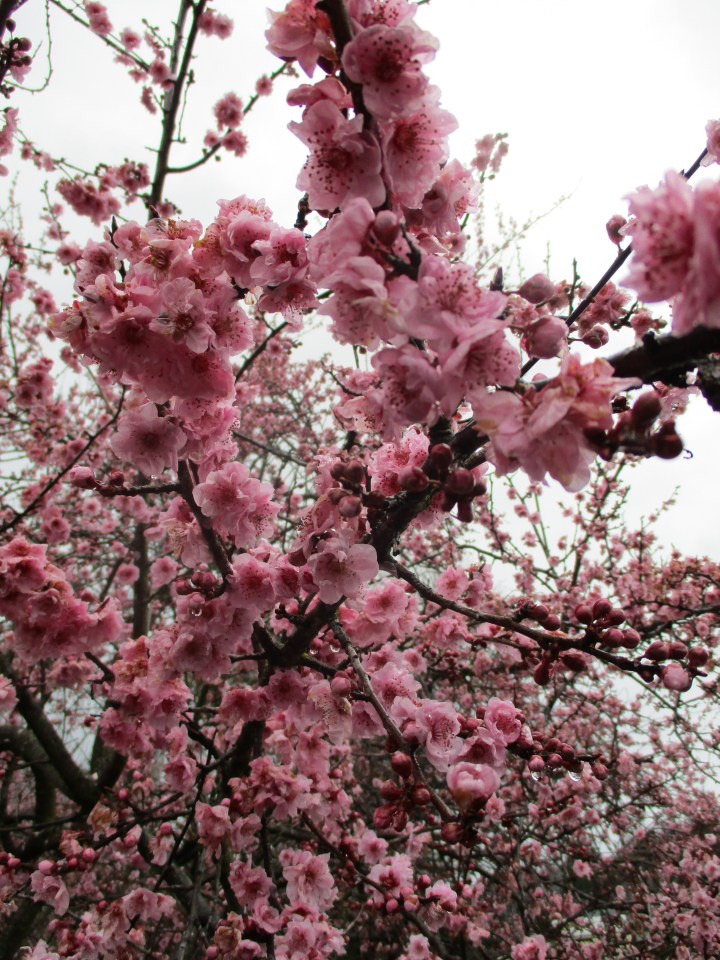
70308Of all the fruitless fruit trees, the purple leaf plum is the most popular here, but probably not for the obvious allure of its rich purplish or bronze foliage that maintains color until it falls in autumn. Purple leaf plum is simply so easy to grow. It does not need to be pruned as regularly as flowering peaches or flowering crabapples do. It is not as sensitive to sunscald as flowering cherries are.
Most purple leaf plums bloom with double or single pink flowers. Old varieties that bloom with white flowers are uncommon. Mature trees might get taller than a two story house, with nicely rounded canopies. Trees are usually pruned up onto single straight trunks, although mature trees in older landscapes might have a few sculptural trunks. Purple leaf plum want full sun and occasional watering.

Almond

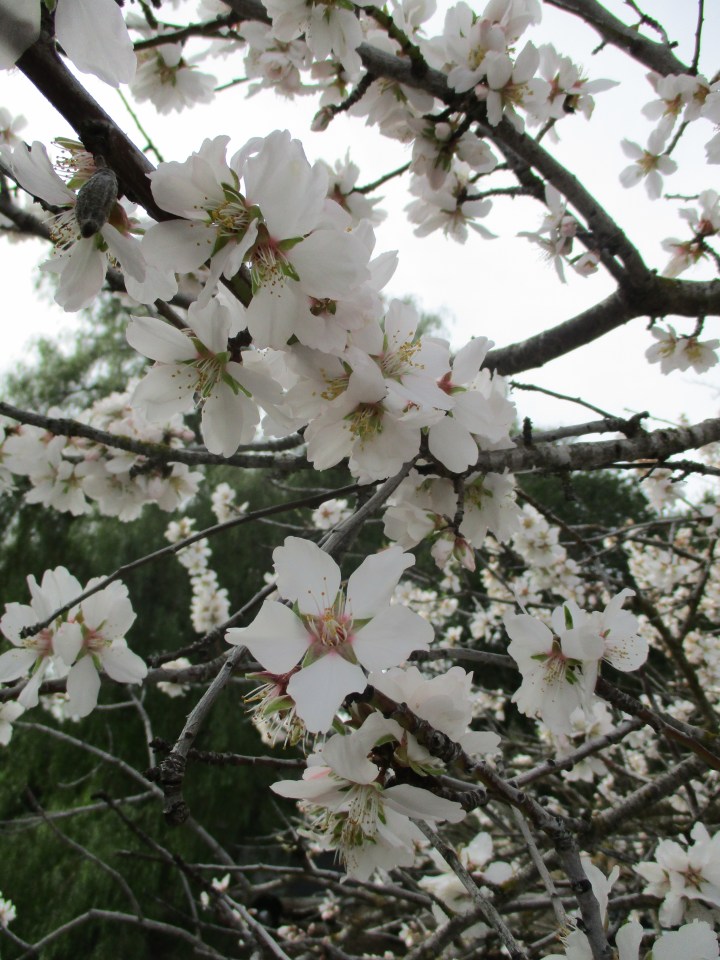
70301It is known more as a small to mid-sized shade tree that produces edible nuts, but almond, Prunus dulcis, also blooms magnificently as soon as the weather allows. Actually, it often blooms a bit earlier than it should. Nut production can be ruined if rain dislodges blossoms or developing nuts. The profuse white flowers are small but slightly larger than those of other related stone fruit trees.

Yes, almond is the same genus as apricot, cherry, plum, peach and the other stone fruits. The fruit is actually very similar, but instead of developing into sweet flesh, it merely forms a hull that dries and separates from the nut within. The nuts are the large seeds or stones, like peach pits that can be eaten. Hulled but unshelled almond nuts are about one or two inches long. Because the nuts get shaken from trees instead of picked, trees can be allowed to get about two stories tall.

Two Heads Are Better Than One

P80221Three or four might be better than two. Perhaps that is what this queen palm was thinking when it decided to get extras.

This is not a good picture, and the tree is a bit too shaggy with old foliage to see what is going on inside clearly. To the left, a secondary limb is curving downward and away from the main trunk, before curving back upward as a secondary canopy. Another limb is developing immediately above this secondary canopy, and another is visible to the right of the main trunk. It is hard to say how many individual canopies are within the collective canopy of this single specimen.

What is weird about this development is that the popularly available palms do not form branches. Think of it. When was the last time you saw a palm tree with a limb or branches? Before you answer that, yuccas (such as Joshua trees) and dracaenas are not palms. Also, clumping palms like Mediterranean fan palm do not form limbs from their main trunks. They merely develop multiple trunks from basal pups.

The very few specie of palm that develop branches regularly are very rare and live very far away. Date palms, either grown for dates or recycled into landscapes from displaced date orchards, have the potential to develop pups higher on their trunks, but rarely do so.

Palms are only trees because they have trunks. Otherwise, they are merely really big perennials, with single terminal buds from which all their foliage, flowers and fruit develop. If deprived of the terminal bud, a palm can not generate a new one, which is why a palm will die if topped.

So why does this queen palm have more than one terminal bud? It is impossible to say.

Six on Saturday: Big League


Again, my six pictures are not from my own garden, which incidentally, is not at all interesting. Instead, these pictures are from the biggest site I work at. It is many acres, with some very big features.
1. Big lawns are acres of turf. The kid in front of the building in the distance shows how big the building and lawn is. This is the biggest of three big lawns.P80217
2. Big trees are very common here. These are coastal redwoods. There are also big Douglas firs and ponderosa pines.P80217+
3. Big water features are not constructed backyard fountains or koi ponds. This is Bean Creek, which flows into Zayante Creek less than half a mile away. It is more than a hundred feet below where the picture was taken.P80217++
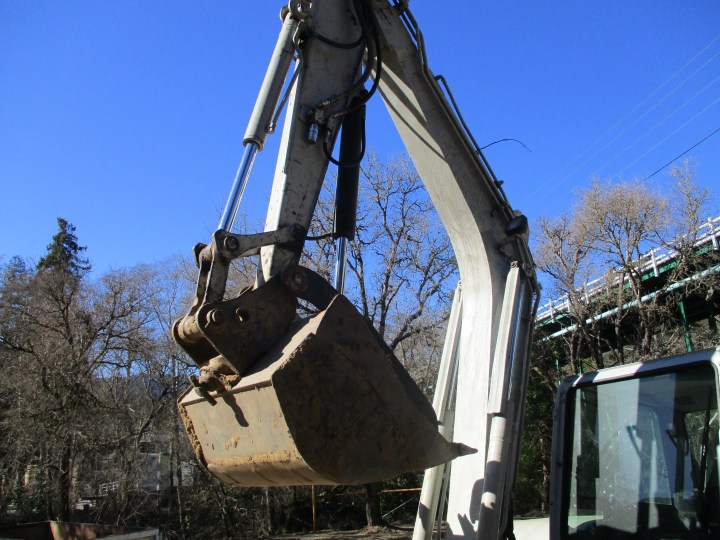
4. Big shovels are necessary for working in such big gardens.P80217+++
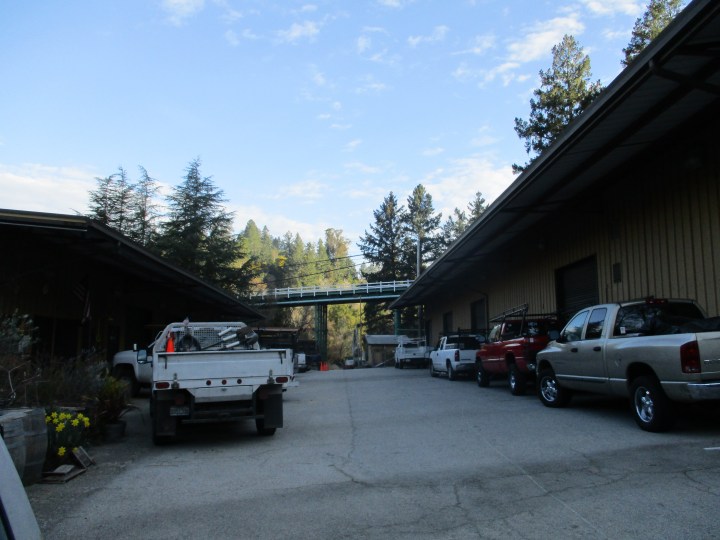
5. Big garden sheds and big garden carts made by Dodge, Ford and Chevrolet are also very important.P80217++++
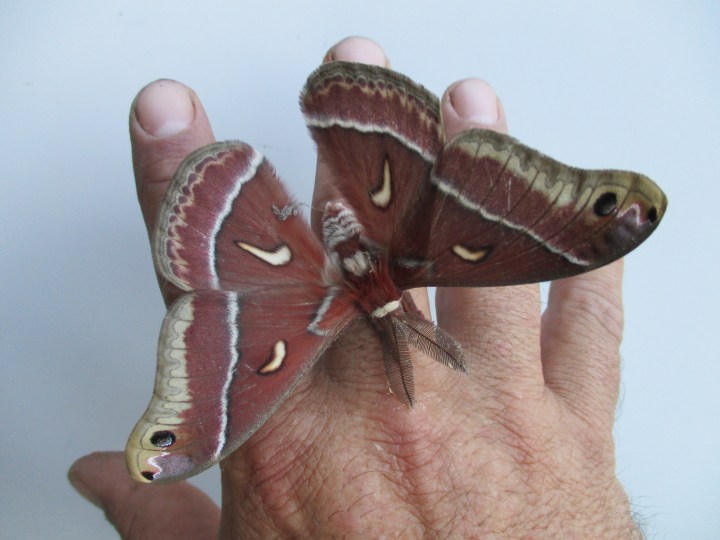
6. Big insects are quite at home in such big gardens.P80217+++++
This is the link for Six on Saturday, for anyone else who would like to participate:

https://thepropagatorblog.wordpress.com/2017/09/18/six-on-saturday-a-participant-guide/