A well designed landscape should be an asset, not a liability. It should beautify and enhance the function of outdoor space, while harmonizing with associated indoor spaces. In order to continually do so, even a very well designed landscape requires maintenance so that it does not become so overgrown that it becomes unsightly and obstructive.
Some landscapes require less maintenance than others. There happens to be very few that can be allowed to grow wild, but only because their components are allowed the space they need to do what they do naturally. It is not fair to incorporate plants merely because they are appealing, and then expect them to conform to unnatural constraints without some degree of intervention.
As an arborist, I often see trees that must be pruned for clearance from roofs, gutters, walls, windows, lighting, utility cables and roadways. It is normal for trees and large shrubbery to encroach into such features. Furthermore, it should not be much of a problem if such trees and shrubbery are maintained properly.
The landscape in the picture above contains several desirable plants that could, with a bit of effort, be maintained within the very limited space; New Zealand tea tree, Chinese wisteria, golden bamboo, Heavenly bamboo (Nandina), star jasmine, Spanish lavender, fleabane, oxalis and a small juniper. Some of these might not have been identified correctly, and there may be more in there, but it is impossible to distinguish from this picture.
The golden bamboo and Chinese wisteria are probably a bit excessive. However, there is a nice arbor above that would be ideal for the Chinese wisteria if someone would be willing to put the effort into pruning and containing it. It takes serious commitment to contain golden bamboo, but it is possible, and might perhaps be justifiable to retain a more tolerable quantity of its handsome form outside the window that it is in front of.
One of the most obvious problems with this landscape is that it is so crowded that the various components are barely indistinguishable from each other, and lack the space to perform as they would like to. This is about clearance though. As you can see, the collective plant material has been pruned only to maintain clearance from around the lower part of the doorway, and from the pavement of the parking lot. So much more is needed.
Anyone getting out of or into a car parked next to this landscape must duck under the New Zealand tea tree or Chinese wisteria. The upper part of the doorway is not much better. Vertical clearance needs to be restored and maintained. The New Zealand tea tree seems to have some serious potential anyway, and would likely be very appealing if pruned to expose the main trunk and limbs.
Furthermore, there are windows behind all that mess! Unless someone really wants privacy and dislikes curtains, those windows should be exposed to allow sunlight in. All this obscuring vegetation darkens and cools the interior, which increases reliance on electrical lighting and some sort of heating. Besides, it just looks trashy.
Not only does the vegetation inhibit sunlight coming into the building, but it also inhibits light coming out from the building. The lighting that is barely visible at the top of the pillars flanking the doorway is there to illuminate the parking lot at night. Another doorway outside the left margin of this picture, is for ATM machines, so is outfitted with security lighting, which is almost inoperative because of the lack of pruning for adequate clearance.
Ivy Geranium
This is one of the more traditional perennials for old fashioned window boxes, not only because it cascades downward to avoid obstructing associated windows, but also because, back before window screens were commonly available, the aromatic foliage was purported to repel mosquitoes. Ivy geranium, Pelargonium peltatum, is splendid for hanging pots and retaining walls as well.
The best bloom is usually later in summer or in early autumn, but sporadic bloom can continue almost throughout the year. The flowers are very similar to those of more common zonal geranium, but perhaps more abundant. The slightly more extensive color range goes beyond hues of white, pink, red and peach, to include rich burgundy, pinkish lavender and candy striped red with white.
The rounded and lobed light green leaves are rather succulent, so are easily damaged. Some cultivars have slight foliar halos (semicircular zones of darker color around the centers of the leaves) almost like those of zonal geraniums, but not quite as prominent. The thin and nearly succulent stems are easy to root as cuttings. Although fragile, they can sprawl or cascade as much as six feet.
Summer Turns Up The Heat
Does the heat seem to have come on suddenly this year? There was all that rain through winter, then a quick but delightful spring, and now it is suddenly over a hundred degrees in some places! What happened?! There is certainly nothing abnormal about such warmth in the middle of June. It just comes as a surprise when it arrives so suddenly after such pleasantly mild spring weather.
At least warm weather here is not as dreadful as it is in other climates. It cools down a bit overnight. Humidity is typically (although not always) low. There is typically at least a bit of breeze by late afternoon, just after the worst of the warmth. We need not contend with the sort of dankly humid heat, that lasts all day and into the night without even a slight breeze, that so much of America gets.
Of course, that is no consolation now. By our standards, it is hot. Gardening is no fun, and some of it gets neglected. We become more aware of where shade trees should have been planted. We might also notice wilted or pallid plants that are not getting enough water. Pruning that was delayed while new spring growth matured may need to be delayed a bit longer, until the weather cools.
Unfortunately, the minimal humidity and occasional breezes that make the weather more comfortable for us make it more uncomfortable for the plants in the garden. Plants can realistically tolerate more heat than we can, but prefer it to be in conjunction with humidity. Otherwise, they can lose too much moisture to evapotransipiration (evaporation from foliar surfaces), and wilt or desiccate.
Automated irrigation obviously needs to be adjusted accordingly. Potted plants need more of an increase than those in the ground. Those that are overgrown, in hanging pots, or exposed to the typical evening breezes will be the most consumptive. It is not always easy to know how much they need, but one can be certain that if they are wilting, they need more than they have been getting.
Pots exposed to sunlight can get uncomfortably warm. If cascading or bushy growth does not shade the south sides, smaller potted plants can.
Crop Circles
These are perfect conditions for crop circles. Even without any convenient grain crops, there is plenty of tall grass in unmanaged and ungrazed fields. All this grass needs is to be crafted into crop circles.
The first crop circles that I ever witnessed were made by cows. I was not much more than six, and my younger brother who found them was not much more than five. No one bothered to explain to us that cows were related to cattle who grazed nearby. Consequently, we had no concept of what cows were.
Earlier in the day, we had discovered what was described to us as a ‘cow pie’. Naturally, we were skeptical. It looked just like what cattle leave behind, which was not good. I was not about to try it, so got my younger brother to taste it. Apparently, it tasted about as bad as it looked. It seemed quite suspicious that a cow would made such an unappealing pie, and then just leave it out on the ground like that.
When we found the first of a few crop circles, our older sister and her friend told us that it and those we found afterward were made by the same cow or cows who made the unappetizing pie. Apparently, cows like to lay down in long grass. Although we did not know what a cow looked like, we ascertained from the sizes and shapes of the crop circles that the cows who made them were quite large and somewhat circular.
Furthermore, since we did not see any trails leading to or from the crop circles, we deduced that the the cows who made them flew in from above. We were very intelligent kids.
Of course, since then, I found that baby deer make small crop circles; but because they have such long and lanky legs, they do not leave such obvious trails leading to and from such crop circles either. There is no need to fly in from above.
Rhody made a very small crop circle, and because he is so lean, did not leave much of a trail coming or going. He is not tall enough to step over the grass, but is narrow enough to get through it without disturbing it much.
Pink Trumpet Tree

This is why I do not often use pictures that my colleague, Brent Green, sends to me. He frequently tells me what I should feature in my gardening column, and sends me what he considers to be good pictures for such topics. This picture would have been good for writing about the sky over Los Angeles, or the neighbors’ driveway, since those are two of the most prominent features here. Where did all the smog go?
Chimneys in Los Angeles seem silly to me. Even if the weather got cool enough for a fire in a fireplace, there is no firewood to burn. The chimney to the far right certainly seems to be original to the house, but how did it survive all the earthquakes since the house was built, probably in the 1940s or 1950s? There have been a few moderate earthquakes since then.
Those signs that warn potential criminals of non-existent home security systems are even sillier, and just cluttering otherwise nice landscapes. There is nothing official looking about them. There are bins of them for sale in the local big box stores. Shouldn’t we all assume that since the home on the left is in Los Angeles, that it is outfitted with home security system that is more impressive than that silly, irrelevant and unwelcoming sign?
I would guess that what Brent really wanted to send a picture of was the big pink trumpet tree, Tabebuia heterophylla. After all, it does happen to be sort of in the middle of the picture. It really was spectacular while blooming late last winter. However, even if Brent had sent a good picture of it, I would not have featured it. Most of those who read my gardening column are not within regions where pink trumpet tree blooms like this.
Six on Saturday: Gophers and Weeds
Both have been very active all spring. Some of the sneakiest have been getting away with their activity unobserved.
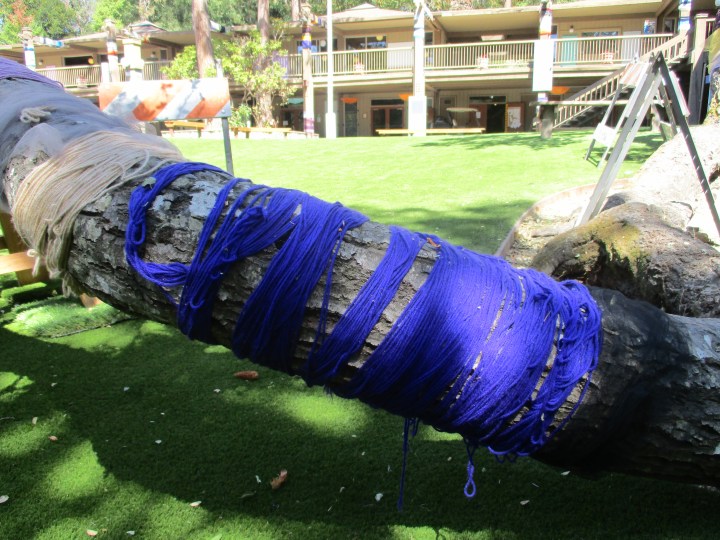
1. This is a fifteen foot tall camellia, or what remains of it. For comparison, that is a six foot long bench it is laying on. It still looks green and healthy, but started leaning. Upon closer examination, I found that it was not rooted to the ground. It pulled right out! The roots were almost completely gone! There was no indication that there was a problem.
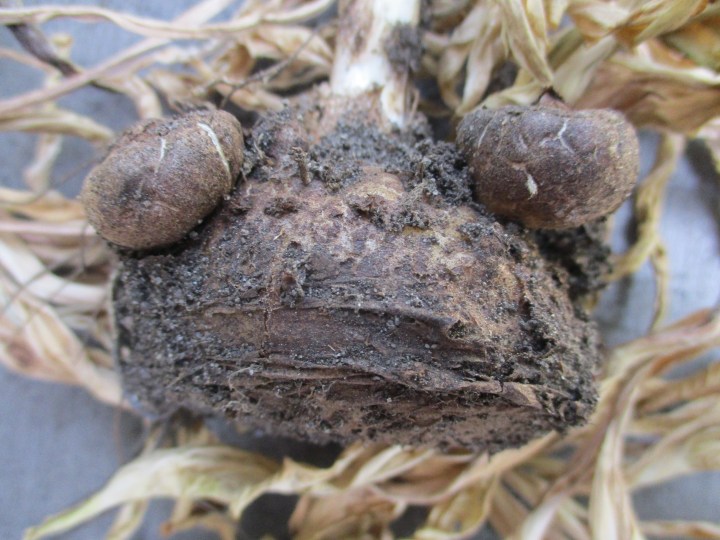
2. This is what remained of the root system. Gophers ate through just about everything that was sustaining and supporting the big camellia above. No excavation or gopher mounds were observed. The area around the camellia was obscured by Algerian ivy. This all happened faster than the camellia could express symptoms associated with such damage.
3. ‘Kramer’s Supreme’. More specifically, “Award Winning – ‘Kramer’s Supreme’ – Camellia japonica – Trade Mark Registered”. Someone should have removed the label before it damaged the stem it was attached to. Actually, the long dead stem was stubbed just a few inches above the upper margin of this picture. It doesn’t matter now anyway.
4. This big mound of greenery is all a single big weed, perennial pea. I put it next to the wheel for comparison of size. It grew in a newly landscaped area where we did not expect such big weeds to grow so quickly. It did not seem to be as big as it is, so was easily ignored. Why didn’t gophers eat this instead of the now dead camellia above?!
5. As you can almost see in the bad picture, perennial pea is not an unsightly weed. It also lays low and fits into the landscape in such a manner that it is easy to ignore while targeting more obtrusive weeds elsewhere. That is how the specimen in the picture above got so big. This one is not nearly as big, but overwhelmed a few smaller perennials.
6. Perennial pea flowers are quite pretty. If possible, I like to let them bloom before pulling them up. Most look like these. Some bloom with fluffier double flowers. Some are lighter pink. A few are darker purplish. White is quite rare. As prolific as they are where they are not wanted, they are surprisingly unreliable from seed sown where actually desired.
This is the link for Six on Saturday, for anyone else who would like to participate:
https://thepropagatorblog.wordpress.com/2017/09/18/six-on-saturday-a-participant-guide/
Hinoki Cypress
In California, it is hard to imagine that hinoki cypress, Chamaecyparis obtusa, gets big enough to be harvested for lumber in Japan. Almost all of the local garden varieties stay quite short. The largest rarely get up to second story eaves. The most compact types that are grown for bonsai, do not get much more than a few inches tall. Most are somewhere in between, to about ten feet tall.
The ruffled sprays of evergreen foliage are surprisingly dense relative to the soft texture and often irregularly loose branch structure. Mature trees often shed branches to reveal sculptural reddish trunks and limbs within, while maintaining the distinct density of their foliar tufts. The minute leaf scales have rounded tips. (Other specie have pointed leaves.) Tiny round cones are rarely seen.
Because of slow growth and irregular form, hinoki cypress is an excellent specimen ‘trophy’ tree, but not so useful as hedging shrubbery. It prefers a bit of shade, and will tolerate considerable shade. However, varieties with yellow new growth are more colorful with good (but not harsh) exposure. It does not take much pruning and grooming to enhance form and expose branch structure.
Foliar Color Long Before Autumn
The best and brightest color in the garden is obviously still provided by flowers. Autumn color can be spectacular, but only amongst relatively few deciduous trees, shrubs and vines that turn color reliably in mild climates, and only if the weather is conducive to coloration. The next best option for color beyond green is the sort of colored foliage that does not wait for autumn to materialize.
Foliage can be shaded with varying degrees of yellow, red, pink, purple, bronze, grayish blue or gray, or variegated with white, yellow or silvery gray. Plants that display such colorful foliage can be as small as flowering annuals, or as substantial as shade trees. Many are deciduous plants that also turn color in autumn. Most of the best are actually evergreen, so hold their color through winter.
Color tends to be richest as new foliage emerges in spring, and fades more or less through summer. Gold junipers only start out gold, but then fade to green within only a few months. The purplish foliage of ‘Forest Pansy’ redbud fades to coffee stained green. Yet, bronze New Zealand flax is always bronze. Dusty miller is always gray. Some plants are more reliably colorful than others are.
Exposure is important too. Most blue or gray foliage, whether juniper, agave, spruce, eucalyptus, olive or silver Mediterranean fan palm foliage, will be significantly greener if shaded. However, white variegation of English holly, hydrangea, ivy, hosta and pittosporum have better contrast if partly shaded. Colorful Japanese maples color better with good exposure, but roast if too exposed.
Many plants with colorful foliage are notorious for developing greener mutant growth known as ‘sports’. Because sports have more chlorophyll, they grow more vigorously than more colorful growth does, and can overwhelm and replace the more desirable colorful foliage if not pruned out. Many types of white or yellow variegated euonymus, as well as the more intricately variegated New Zealand flax, can revert to monochromatic green within only a few years.
Horridculture – Pesticides
‘Cide’ as a suffix that designates something to be killed. ‘Insecticide’ kills insects. ‘Miticide’ kills mites. ‘Molluscicide’ kills molluscs such as snails and slugs. ‘Herbicide’ kills herbaceous plants, which are presumably weeds. These examples and other chemicals that kill things that are considered to be pests are collectively known as ‘pesticides’. Many are potentially useful in the garden, since that is where so many familiar pests are problematic.
Most modern pesticides are designed for physiological characteristics that are unique to the targeted pest. They therefore kill only very specific pests, but are generally harmless to other organisms. For example, horticultural oil, which is one of the simplest of all insecticides and miticides, kills insects and mites by obstructing the exoskeletal pores through which they respire. It is harmless to those of us who conduct respiration by means of lungs.
In fact, most (although not all) commonly available pesticides, if used properly, are relatively safe for those who are not the targeted pests. (Rodenticides that remain toxic to predators who eat afflicted rodents are some of the exceptions, but that is a topic for later.) That is why I have no compunction about using such pesticides. When necessary, I would use them on the farm, in the landscapes that I so often work in, or in the home garden.
However, such pesticides are almost never necessary. Seriously. I would not refrain from using them, but the need for such use almost never presents itself. Insecticides and, to a much lesser extent, miticides are sometimes applied on the farm (although I have not been there to apply any in a few years). I applied a minor fungicide for rust on English daisies in a landscape more than a year ago. Otherwise, pesticides are almost never necessary.
It is not that there are no pests. There most certainly are. Roses get aphid. Rhododendrons get thrip. Snapdragons get rust. We just deal with such pests without much pesticides.
There are so many alternative horticultural techniques to use instead. We prune roses so aggressively in winter that they regenerate faster in spring than the aphid can keep up with. We prune rhododendrons to eliminate much of the congested and sheltered inner growth where thrip tend to proliferate. Snapdragons are so susceptible to rust that we probably will not grow them again. Pests are not eradicated, but are reasonably controlled.
All too often, the problem with pests is not the pests at all, but improper horticulture.
Star Jasmine
There is some debate about the origin of the common name of Confederate jasmine. Some attribute it to its popularity in the former Confederate States of America. Others believe it originated in the Malay Confederacy, much closer to its native range. That is irrelevant here, where we know this popular vine with very fragrant flowers simply as star jasmine, Trachelospermum jasminoides.
One might think that it is too common, but there are reasons for that. The dark green foliage is so delightfully glossy all year. As appealing as it is alone, it is even better as a contrasting backdrop for the small but strikingly white star shaped flowers that bloom in profusion about now, and continue to bloom sporadically for much of the rest of the year. The lavish fragrance is totally awesome!
The twining vines climb luxuriantly to about the height of first floor eaves. They can climb much higher, but higher growth takes a while to get as billowy as lower growth. However, it is more often grown as a shrubby ground cover, only about two feet deep. The simple leaves are two to three inches long, and one to one and a half inches wide. The clustered flowers are about an inch wide.