Rainy Season


As I mentioned this morning, the first storm since spring delivered a bit more than an inch and a half of rain before dawn on Wednesday, ending the fire season. The second storm is here right now. It is expected to be followed by a continuous series of storms that will provide rain through Monday, showers through Thursday, more rain on Friday, and showers . . . forever!

It is now the rainy season.

The video above shows what rain does. It gets things wet. It is, after all, composed of water. It falls mysteriously from the sky, which, as you can plainly see, is occupied only by a mostly monochromatic gray cloud cover. Seriously! There is nothing else up there. There is no one on the roof with a hose or anything of the sort. All that water just falls from the cloud cover above.

I could not get video of individual raindrops falling. They are too small and too fast. Only a few can be seen indirectly in the video, falling in front of the water cascading from the rusted out gutter. The spots on the video are raindrops that landed on the lens, so were no longer so animate. The cascading water is, of course, an accumulation of many raindrops that fell on the roof.

Besides ending the long fire season, rain also disrupts the slim fall color season, when foliage of certain deciduous trees turns color as the weather cools in autumn. There is not much to brag about anyway. Only a few native trees are moderately colorful. More colorful exotic trees are not very popular because they do not color as well as they do where autumn weather is cooler.P91130K

Before the rain, these birches were a nice clear yellow, but were already defoliating. Their fallen leaves were as pretty on the ground as they were in the trees, but unfortunately needed to be blown. By now, there is likely more on the ground than there is in the trees, but it will need to be blown too. At least it gets to stay on the open ground in the rest of the casual landscape.P91130K+

The only tulip tree here got cool enough to defoliate before the birches this year, but not quite cool enough to color well first. It is a grand tree nonetheless. We do not expect exemplary color in autumn in our splendidly mild climate anyway. The sweetgums will compensate. They are only beginning to color, and should hold some of their foliage rather well through the weather.P91130K++
Six on Saturday: First Storm


The first storm since spring came through Tuesday night. It was cool enough for a bit of snow on the summits of the Diablo Range, including Mount Hamilton, east of the Santa Clara Valley. The fire season is now over. More storms are forecast. More will continue through the remainder of winter and into spring. Even chaparral climates eventually get a seasonal ration of rain.

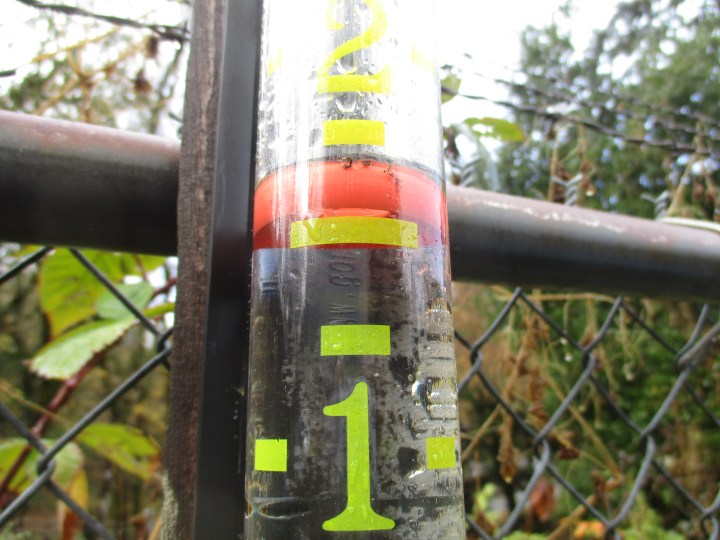
1. An inch and a half of rain is generous for a first storm. It is more than 10% of what my garden in town got annually. This side of the Santa Cruz Mountains gets about three times as much.P91130

2. My reflection in the rain caught in this ‘tote’ is not as artistic as it was in the green bucket last year. I tried. A flash would have added interest. I do not really know how the camera works.P91130+

3. Cyclamen, even the common florists’ type, deserve more than to be grown as cool season annuals, and then discarded in spring. I can rant about that later. For now, they sure are pretty.P91130++

4. After the rain, even a close up of this seriously abused juniper is pretty. It was recycled from one site into another, only to be removed again. It is now canned and waiting for a new home.P91130+++

5. Storms are messy. There was not much wind with this storm. Nonetheless, rotten limbs get heavier and softer as they get soaked by rain. This one broke apart more as I dragged it away.P91130++++

6. What is worse than runoff from the road washing away some of the yellow birch foliage dislodged by rain, is that it likely took away some of the amaryllis seed tossed out here earlier.P91130+++++

This is the link for Six on Saturday, for anyone else who would like to participate:

https://thepropagatorblog.wordpress.com/2017/09/18/six-on-saturday-a-participant-guide/

Horridculture – Multi-Grafts

P91116+++Bare root fruit trees will be available in about a month. It is probably my favorite time of year for going to nurseries. (Since I grow just about everything I want from bits of landscape debris, I do not often go to retail nurseries.) It is also rather frustrating to see what sorts of bare root material are popular nowadays, and what sorts are not. Horticulture has gotten so ridiculous!
Most of the formerly common cultivars of fruit trees that I remember are no longer available. They were common for a reason. They perform well here. Retailers used to select cultivars for their respective regions, instead of pimping out weird new but unproven cultivars, or just taking the same faddish cultivars that get sent to other stores within a vast chain of big box stores.

One of the weirdest of fads are multi-grafted fruit trees and roses.

Multi-grafts are certainly not new technology. Back when horticulture was taken more seriously, fruit trees for home gardens (which might be the only ones of their kind in their respective gardens) were sometimes, if needed, outfitted with a secondary scion of a pollinating cultivar. The pollinator could be pruned low and subordinated, as long as it bloomed with a few flowers.

Most of us preferred to simply plant two separate trees that could pollinate each other. If one was less desirable than the other, it was just maintained as a smaller tree so that it would not occupy so much space that could be utilized by more desirable types. Each tree had its own uncrowded area. If one succumbed to disease, it did not necessarily affect those associated with it.

Multi-graft trees are not so easy. If the trunk of a multi-graft pear tree gets infested with fire blight, all the scions grafted to it succumb. Because almost no one prunes them properly, the most vigorous cultivars dominate and crowd the less vigorous. Even well pruned trees are always asymmetrical because each cultivar exhibits a different growth rate and branch structure.

Multi-graft rose standards (trees) just look weird and freakishly unnatural. Pruning must ensure that one cultivar does not crowd out the other, just like for fruit trees. The multi-graft rose in the picture above was planted with three others just like it. Two of them crowded out one of their two scions. It would have been easier to simply plant two in white and two in burgundy.

Multi-graft plants are useful only if ground space is very limited, but air space is not. For example, such a tree planted in a hole in a deck can extend limbs over the deck where other trees can not live. If maintained properly and separately, each part can produce its share of fruit in season. I once did this with a pear tree that was espaliered on a fence over a concrete driveway.

Street-Smart Gingko

P91124Much of my work involves street trees. They need more of my kind of attention than most other trees. They must conform to more restrictive limitations. They endure more abuse. They are the most prominent trees on urban properties. Because some are assets of their respective municipalities, they are more stringently protected by local ordinances than other trees are.

I planted quite a few street trees too. While selecting trees for the medians of San Vicente Boulevard in Los Angeles, we considered the clearance of the lowest limbs above the highest truck traffic, the docility of roots under curbs and pavement, the potential for foliar debris, the resiliency to neglect, and the resistance to pathogens. Those were just some of the major concerns.

We sort of wanted them to look good too.

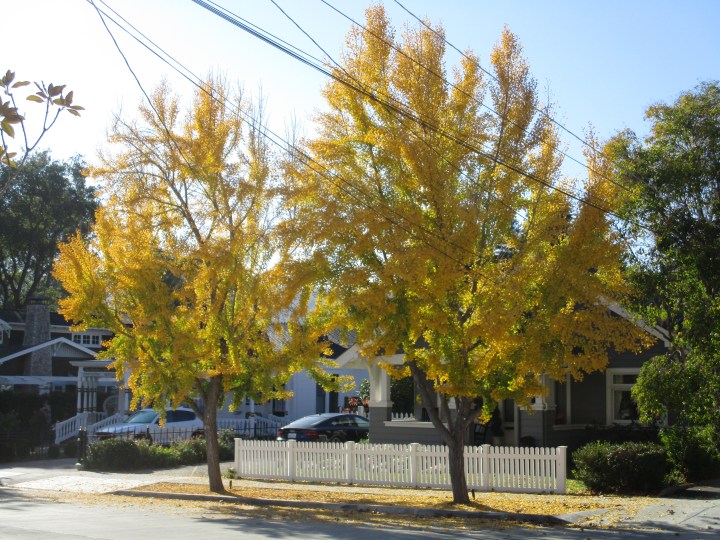
Ginkgoes, at least modern (fruitless) cultivars, work well as street trees. They are tall and slender, and can be pruned for clearance above streets and sidewalks. Their roots are reasonably complaisant, and take many years to displace concrete. ginkgoes defoliate neatly in autumn, with no debris for the rest of the year. They are resistant to pathogens and tolerant of neglect.

They also look great in their monochromatic but brilliant yellow fall color. (Try to not notice all those utility cables.)

This pair of ginkgoes is in front of an old home in town that was formerly the office of the Los Gatos Weekly Times, before it expanded into the larger Silicon Valley Community Newspapers group. Two decades and one year ago, this was where I dropped off the first of my weekly gardening columns, first as hard copy on paper, then on floppy discs. The trees were smaller then.

One day back in about 1999 or so, I stopped by on my way back from delivering rhododendrons and other horticultural commodities from the farm. I was driving the big delivery box truck. I realized how important adequate clearance is when the truck tore a significant limb from the tree on the left. The tree and I both can attest to the resiliency of the species to such abuse.P91124+

Almost RAIN!

P91123KThere have been only three hints at precipitation since last spring.

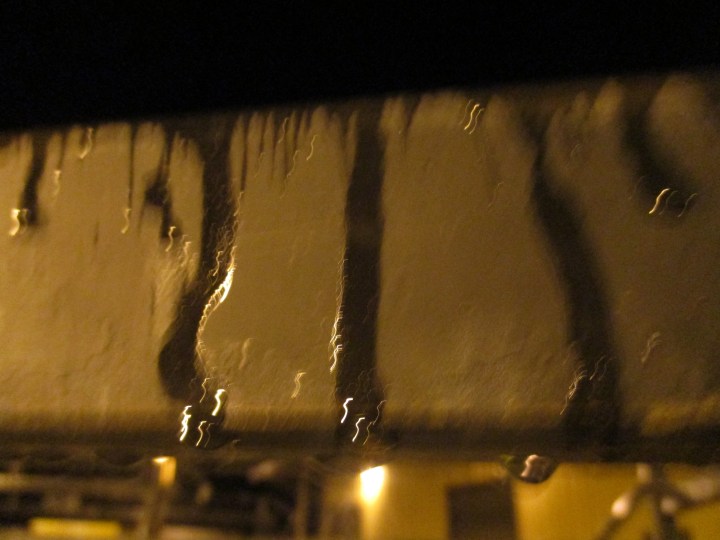
The (sideways) picture above shows the same dampened hood of a Chevrolet that provided the illustration for a post on another blog on September 30.

The picture below shows a similarly dampened but different windshield from that which provided the illustration for a post on November 16, regarding a bit of precipitation two days prior, on November 14.P91123K+

All four pictures here were actually taken just after a very brief rain shower that happened just after midnight on November 19. I tried to be artistic with them, but I am not a photographer.

The picture below demonstrates how difficult it is to hold the camera steady while getting a close up picture of rain dripping from a lumber rack at night. Do digital cameras automatically extend exposure to accommodate for the darkness? Is it blurred or merely ‘abstract’?P91123K++

The rain shower was very brief, lasting only a few minutes, but dropped dozens of individual raindrops, maybe more than a hundred! In fact, there were enough of them to collectively flow from one of the roofs, accumulate in a gutter, and flow down this downspout and onto the pavement below! (I really do not know why a diverter is needed on pavement, but there it is.)P91123K+++

I bet that if all the precipitation than fell from the sky during these last three incidents could have been collected, there would have been more than a pint! As excellent as it was, it was not even the best of it. For the first time since last spring, a storm is predicted to move in and start RAINING about noon on Tuesday, November 26! Showers should continue afterward.

The rainy season will likely begin with this first storm. That is how the weather typically operates here.

Six on Saturday: Stumped


Stumps are mostly left to rot after a tree gets cut down in our unrefined landscapes. Only those that are in the way get ground out. Some that remain probably would have been ground out if they were accessible to a stump grinder, because they are so unbecoming. Burning them out in winter is impractical for those that are close to buildings, and is no longer socially acceptable.

1. This one was nearly four feet high and nearly five feet wide! No one knows why it was not cut lower to grade. It was an unappealingly prominent feature of its landscape for several years.P91123

2. Mushrooms around the base indicated that it was quite rotten. A lack of stubble or stumps from secondary growth indicated that the tree was likely dead before it was cut down years ago.P91123+

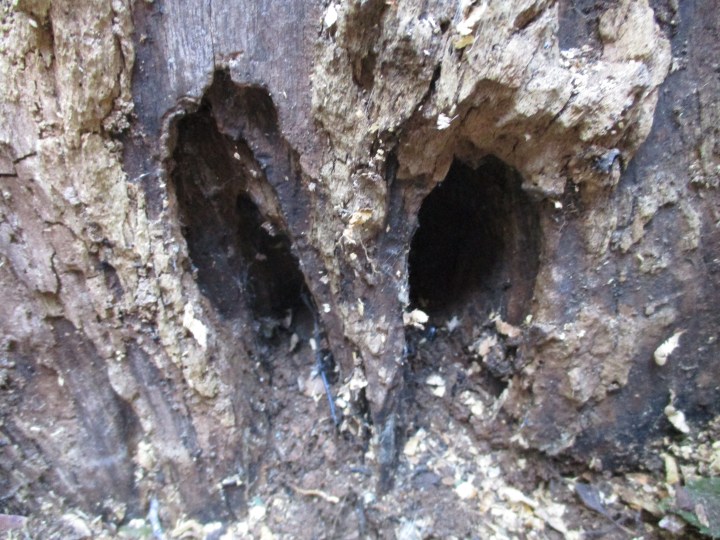
3. It was rotten enough to be inhabited by rodents. It looked like a duplex. Alternatively, the holes could have been excavated by skunks pursuing grubs. They did not seem to be very deep.P91123++

4. As big as it was, the stump was not quite big enough to become a hot tub as the rotten guts were removed. Besides, it was already an unsightly focal point without steam coming out of it.P91123+++

5. What remains is a low pile of pulverized rotten wood with leaves from nearby dogwoods and a sweetgum tossed about on top to make it look less like a low pile of pulverized rotten wood.P91123++++

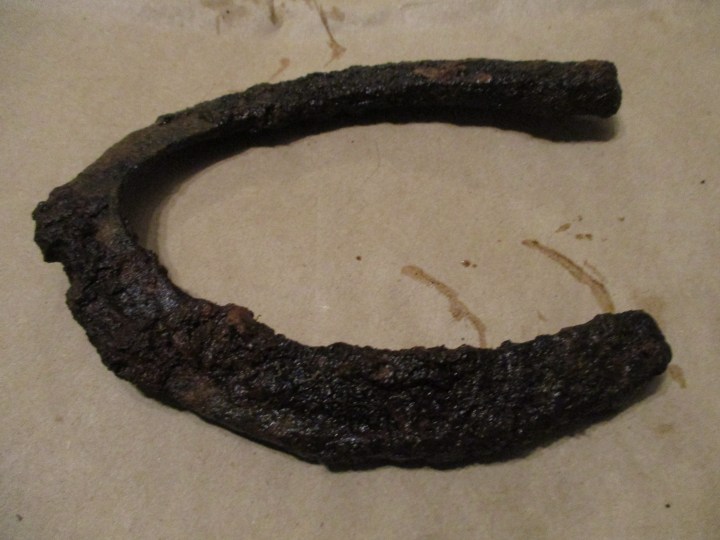
6. There was a slice part way into the stump near grade, as if someone tried to cut it properly when the tree was cut down. This old bent horseshoe was found about where the slice stopped.P91123+++++

This is the link for Six on Saturday, for anyone else who would like to participate:

https://thepropagatorblog.wordpress.com/2017/09/18/six-on-saturday-a-participant-guide/

Horridculture – “One Of These Things . . . “

P91120Remember this from Sesame Street?

One of these things is not like the others
One of these things just doesn’t belong
Can you tell which thing is not like the others
By the time I finish my song?

Identifying a blue balloon as different from three red balloons might be construed as discriminatory, but was fun back before we went into kindergarten. So was selecting the bigger bowl of Big Bird’s birdseed from three small bowls; or the beanie from three pairs of sunglasses; or the letter from three numbers. It is not so fun now, when conformity to a landscape is important.

In the picture above, one of the four prominent trees in the foreground of the walkway and rail fence, excluding the obscured middle tree, is different from the others. They are all the same age. They are all sycamores. They are all happy and healthy. They were all supposed to conform to the landscape of native vegetation in the background. Which thing is not like the others?

The second tree from the left is a London plane, Platanus X acerifolia. The other trees, as well as the fifth middle tree and the sycamores in the background, are native California sycamores, Platanus racemosa. Not only is the London plane not native, but it is distinctly smaller and more symmetrical, with a conspicuously straighter trunk and relatively orangish autumn foliage.

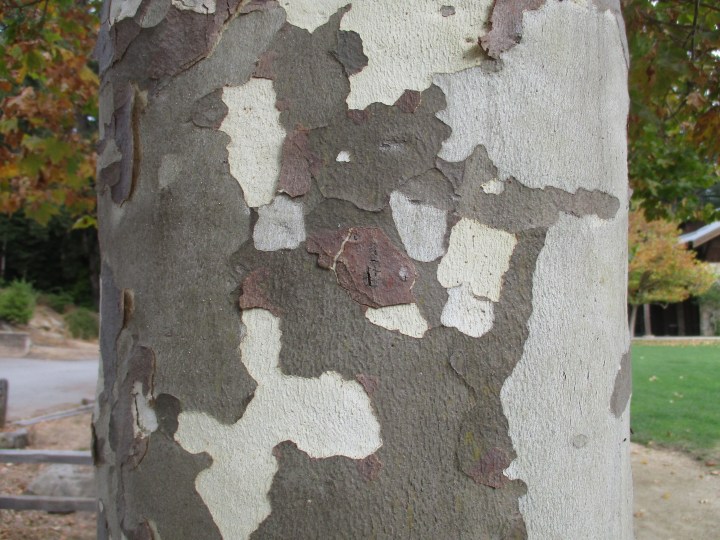
The picture below shows the bark of London plane, with a trunk of a California sycamore in the background. The second picture shows how dissimilar the bark of the California sycamore is.P91120+P91120++

Individually, there is nothing wrong with the London plane. A few could have made a nice homogenous grove in the same spot, although they would never attain the grand scale expected of California sycamore. The problem is that the London plane is similar to, but not the same as, the California sycamores. It will always look like one of the California sycamores with problems.

A completely distinct tree would have been better. If it were a redwood or a magnolia, or anything that is not so similar to California sycamore, it would not be expected to conform to them.

I see it commonly. Himalayan birch get added to groves of European white birch, even though their trunks are whiter and straighter, and their canopies are much more upright. Taller and leaner Mexican fan palms get added to otherwise formal rows of California fan palms. The formality of rows of tall and slim Lombardy poplars is similarly disrupted by fatter Theves poplar.

These bad matches are often honest mistakes. It is not easy to distinguish Theves poplar from Lombardy poplar; and Lombardy poplar is rarely available. Sometimes, so-called ‘gardeners’ or ‘landscapers’ simply do not care. An ‘Aptos Blue’ redwood was added to a grove that was exclusive to ‘Soquel’ in a nearby park, just because it was closest to the parking lot at the nursery.

So-called ‘landscapers’ sometimes ‘sub’, or substitute, a commonly available cultivar or species for something that was specified by a landscape design, but is not so readily available. It often works out just fine. However, I once inspected a landscape in which a ground cover cultivar of cotoneaster was subbed with Cotoneaster lacteus, which promptly grew higher than the eaves!

Rose Hips

P91117Chopped dried rose hips can be purchased from a supermarket in town that stocks an impressive variety of useful bulk herbs. They are used as a dietary supplement and remedy for several minor ailments. Although most of the copious vitamin C they contain while fresh is ruined by drying and storage, they are still popularly used as a remedy or preventative for colds and flu.

It would be reasonable to assume that the rose hips that are available in markets would be from a species that has been cultivated and developed for a few centuries. After all, rose hips have been used as an herbal supplement for a very long time. Surprisingly, those that are available in the local market here are from the common and native California wild rose, Rosa californica.

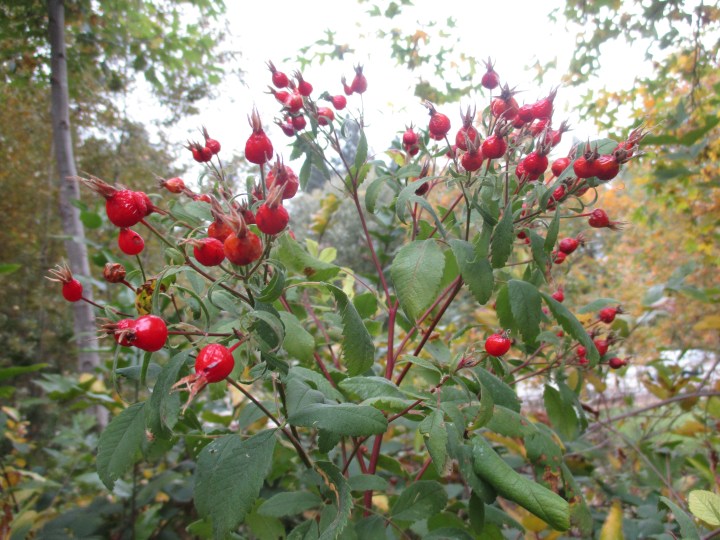
That means that those that grow wild on the outskirts of the landscapes here produce the same rose hips that can be purchased in markets. There are only a few others species of wild rose that grow wild in California, and even fewer that are endemic locally. Those in the picture were actually planted into a landscape composed of natives, but are thought to be Rosa californica.

I normally leave these rose hips for the birds; but because the birds take all my cotoneaster berries, I am not too worried bout them getting enough to eat. I left the rose hips that are pretty where they can be seen, but took quite a few that were out of view on the backside of a riparian thicket of rose bramble. I do not yet know what to do with them, but will figure that out later.

Once dried, these rose hips will be easily pulverized into coarse and seedy ‘grounds’ that can be added to blends of herbal tea.P91117+

Not Quite Rain

P91116KMost of us here agree that the minimal bit of precipitation that fell from the sky on Thursday was not real rain. There are a few different theories about what it actually was though. It could be considered to have been drizzle. It alternatively could have been heavy fog or mist. Some of us make up silly names for what it was, such as fine rain, dusting, spritzes, sprinkles or mizzle.

Is it just me, or do those last three sound like inane kitten names? ‘Dusting’, sounds dirty and dry, which it was not.

Whatever it was, it was the second occurrence of such precipitation since the rainy season ended last spring. Something similar happened on the last day of September. I wrote about it in my other blog, with a picture of it on the hood of a parked car, rather than the windshield. I think it was more of a surprise then because it was earlier, and the chance of precipitation was slim.

This weather pattern is still within what would be considered normal here. The rainy season typically starts a bit earlier, even if with just a single primary storm passing through, followed by a long pause before more follow. There is no strict schedule though. We know that the rain will eventually start, and that rainy seasons that start late tend to provide significantly more rain.

Rain is likely just as uncomfortable here as it is everywhere else. Perhaps it is even dirtier, because it rinses off dust and crud that has been accumulating since spring. No one wants to work in their garden while it is wet. Nonetheless, because there is no rain for nearly half the year, the first storm of a season is something to be celebrated. The forecast predicts no celebration yet.

Six on Saturday: The Endless Summer


Summer really did end here. There was a minimal frostless frost to prove it more than two weeks ago. This climate just happens to lack the more apparent seasonal changes that others get to show off. Except for a bit of drizzle last Thursday, and a bit at the end of September, there has been no rain since last spring. It may seem to be boring, but such weather is normal here.

1. There is typically more foliar color by now. Sweetgums are only beginning to yellow. However, these dogwoods started to defoliate early without much color. This is about as good as it got.P91116

2. Not all of the warm season annuals have been replaced with cool season annuals. These petunias are blooming too happily to be replaced with pansies or violas like we installed elsewhere.P91116+

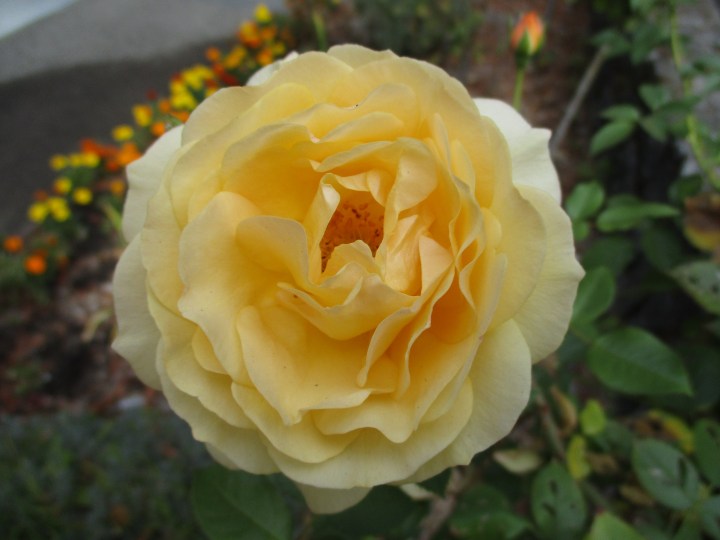
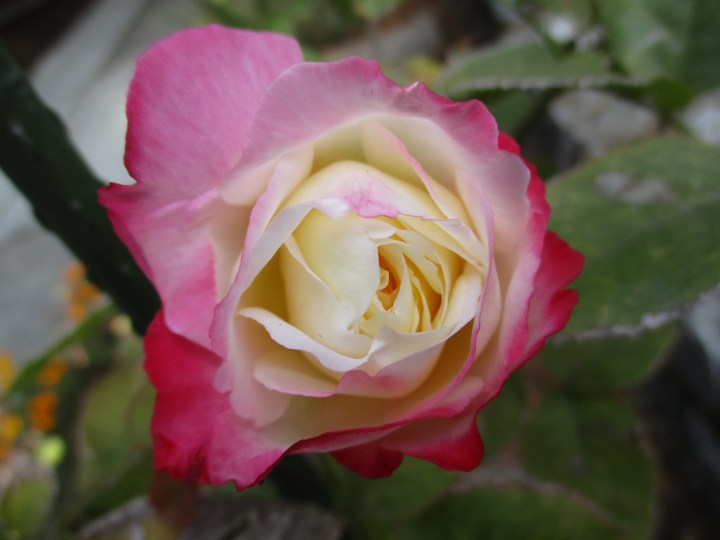
3. Roses continue to bloom. This one looks like ‘Double Delight’ to me. I really do not know what it is. The flowers are rather small, so it must have noticed that nights are longer and cooler.P91116++

4. These two look silly to me because both are grafted together onto the same standard (tree rose). I believe they are ‘Iceberg’ and ‘Burgundy Iceberg’. I would not mind them individually.P91116+++

5. Even by our local standards, roses should be finishing by now, with only a few that are still blooming when they get pruned in winter. I do not know what this one is, but it still looks great.P91116++++

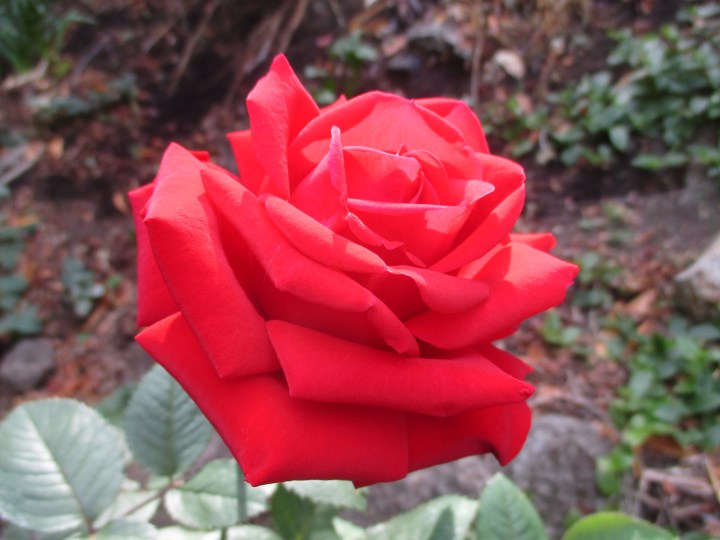
6. This is my favorite of these six pictures. I do not know what this rose is either. It is in a neighbor’s garden. It did not start to bloom until part was through summer, and is now at its best.P91116+++++

This is the link for Six on Saturday, for anyone else who would like to participate:

https://thepropagatorblog.wordpress.com/2017/09/18/six-on-saturday-a-participant-guide/