French Marigold

P90921KActually, French marigold, Tagetes patula, is no more French than African marigold is African. All are from Mexico and Guatemala. They were merely popularized and bred respectively in France and Africa. There are now hundreds of varieties. Yet, their color range is surprisingly limited to hues and shades of yellow, orange and ruddy brown. White marigolds are really just very pale yellow.

While African marigold is only occasionally grown for bigger cutting flowers on taller stems, French marigold is much more popularly grown for late warm season annual color. Because it blooms late in summer and early in autumn, and continues only until frost or sustained rain, it is often planted if earlier warm season annuals deteriorate while it is still too warm for cool season annuals.

French marigold can get more than a foot tall, and almost a foot wide, but typically stays closer to the ground. The delightfully aromatic and intricately textured foliage is rich dark green. Removal of deteriorating flowers (deadheading) promotes continued bloom, although a few spent flowers might be left to produce seed. Mildew can be a problem if watering is excessive or late in the day.

Fertilize For The Last Time

91009thumbFor many of us, this might seem to be irrelevant. We do not apply fertilizer to our landscapes and gardens. Some of us who use fertilizer do so mostly for seasonal vegetable plants and flowering annuals. Such plants will either not be around long enough to get fertilized again this year, or are cool season plants that are on a completely different fertilizer schedule through autumn and winter.

Two other main exceptions that that might continue to get fertilizer after summer are lawns and houseplants. Some types of turf grasses, particularly those in older lawns, can get a bit pale through the the cooler parts of winter, so appreciate a boost. Houseplants are mostly immune to the cold weather outside, so continue to to crave nutrients, even if slowed somewhat by shorter day length.

So, except for lawns, houseplants, and incoming and outgoing annuals and vegetables, most other plants in the garden do not need to be fertilized again until weather begins to warm next spring. Not only do they not need fertilizer, but some could be inconvenienced by it. They know what time it is, and that they should now be slowing down for winter. Fertilizer can interfere with the process.

There are a few reasons why plants slow down or go dormant through winter. Some of the nutrients that they need to maintain active growth are less soluble or otherwise less available to them at cooler temperatures. There is less sunlight too. Plants from climates with cooler winters tend to be more proficient with winter dormancy. Many are deciduous to limit damage from wintry weather.

Some plants might use a late application of fertilizer to get ready for winter dormancy. Others might just ignore it as it leaches through the soil. Those that are from milder climates might try to use it to continue growing later than they should. For plants that are potentially sensitive to frost, growth that develops too late will not likely mature soon enough to be resilient to even mild winter frost.

This is why fertilizer can be applied to many plants one last time about now, but no later.

AGAIN – NO Blue Ribbon!

P90929After all that fuss yesterday, about how much I wanted to win a first place blue ribbon for one of my jams or jellies at the Jam, Pie and Chili Contest of the Santa Cruz Mountains Harvest Festival, I must still do without! Not only did I not win the ever elusive first place blue ribbon that I so desperately crave, but for the first time ever, I did not win second or even third place!

However, it is not as disappointing as it seems. There were no ribbons to win. There was only the same single prize for each of the three categories, which is a winter pass for the hot tub and sauna at the Bear Creek Recreation and Community Center of Boulder Creek. Although it is not the blue ribbon that I can flaunt and brag incessantly about, it is a fabulously generous prize.

What was more disappointing was that the Contest was canceled. For the Jam category, there were only two other contestants with only a few submissions, and neither showed up! How can that even happen? My six submissions were the only six to compete! It was even worse for the Pie and Chili categories, with only one contestant bringing pumpkin pie and two types of chili!

Yes, it was disappointing, but only briefly. No one minded that there were only identical pumpkin pies to vote for in the Pie category. In fact, we all easily agreed that they were the best pies in the Contest! Selection of the best of two types of chili in the Chili category was slightly more challenging only because no one wanted to say that one chili was less excellent than the other.

I still crave the elusive first place blue ribbon, but can easily do without it too.

Every Dogwood Has His Day

P90928KDog days of summer are no time for a dogwood to bloom. It should be slowing down and getting ready for autumn. Plump floral buds start to develop, but then wait dormant as foliage turns color and falls away. Only after winter dormancy, just prior to the emergence of new foliage, floral buds bloom spectacularly. September is either half a year too early or half a year too late.

So, what is this dog and pony show?! ‘Eddie’s White Wonder’ dogwood is blooming not only in our landscape, but in other regions too. It is not just because our six new trees were distressed from installation earlier this year. That process would not have affected other trees. It was not because of our locally variable weather. It affected too many trees in too many other regions.

I certainly do not mean to dog our trees for their eagerness to bloom; but it is best to let sleeping dogs lie. They need their rest. Floral buds that bloom or try to bloom now will not be there to bloom when they should next spring. Only a few floppy blooms are seen on our trees, but closer inspection reveals that every bud is open, exposing the tiny individual flower buds within.

It does not need to rain cats and dogs for the floral buds to be ruined. Now that weather is cooling instead of warming as it would in spring, the floral buds that are now opening will not waste resources to finish blooming. The priority is slowing down for winter dormancy. Whether finished with bloom or not, opened floral buds will be shed along with foliage as autumn progresses.

Rhody might seem like he should obviously be an expert in regard to dogwoods, but he merely commented that “Bark is ruff!”P90928K+

Six on Saturday: Still NO Blue Ribbon


That could change later today, at the Jam, Pie and Chili Contest of the Santa Cruz Mountains Harvest Festival. My jams or jellies have won second place every year for the past few years, except for only one year when my mother’s peach jam won second place. How embarrassing! Anyway, for some of the past few years, my entries have won both second and third place.

However, none of my jams or jellies have won a first place blue ribbon!

This could be the year!

Will it be? Well, that is doubtful.

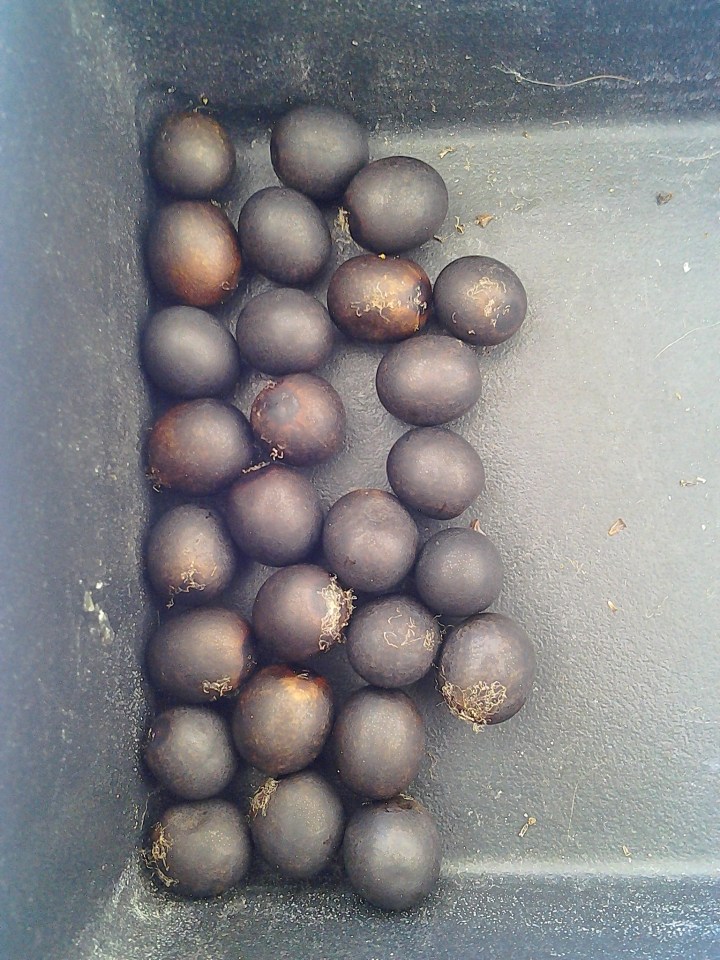
Blue elderberry jelly is what most often wins second place, except only when blackberry jelly . . . or my mother’s peach jam . . . is better. Unfortunately, blue elderberries were rather scarce this year, and what I got were not very good. In fact, they were downright bad. Other fruits, such as currants and gooseberries, were too scarce. Dogwood berries did not ripen soon enough.

For this year:

Peach jam looks and tastes great, but is about as chewy as a gummy bear.

Plum jelly is a sloppy mess that tastes sort of burnt.

Elderberry jelly is a bit sloppier, and, as mentioned above, is made with inferior fruit.

Blueberry jam is sort of like preserves. It is not bad. However, it is made from surplus ‘store-bought’ blueberries from a neighbor, instead of from locally grown or collected fruit.

Blackberry jam tastes great, but the seeds are weirdly tough this year, like wooden gravel.

Blackberry jelly is probably the best of the six, but tastes more like sugar than berries.

1. Do you notice anything missing among these few of the several ribbons that have been awarded to our jams and jellies in the past? There is not a single blue ribbon . . . yet. It will be mine!90928

2. Do you see what else is missing? Of course not. If you could see it, then it would not be missing. It would also be blue; as in the blue elderberries that normally make the ‘second’ best jelly!90928+

3. The native currants were no better. They are never abundant like blue elderberries are, but there are normally more than there were this year. I did not bother looking for gooseberries.90928++

4. Kousa dogwood made plenty of fruit, but it is not ripe yet! Oh well. Ironically, this particular tree might get cut down this winter. The abundant fruit is too messy on the pavement below.90928+++

5. Tomatoes are insultingly abundant where they grow wild around the compost piles and on roadsides. I do not need any more stoopid tomatoes! They will not help me win my blue ribbon!90928++++

6. Six submissions are ready for the Jam Contest later today: peach jam, plum jelly, elderberry jelly, blueberry jam, blackberry jam, blackberry jelly. I will write about the results tomorrow.90928+++++

This is the link for Six on Saturday, for anyone else who would like to participate:

https://thepropagatorblog.wordpress.com/2017/09/18/six-on-saturday-a-participant-guide/

Madagascar Periwinkle

40924Like gardenia, dogwood and snapdragon, the potentially finicky Madagascar periwinkle, Catharanthus roseus, is often challenging to grow. It enjoys, but seems to prefer more humidity than it gets here. The happiest plants can get nearly two feet tall and wide in sheltered and humid spots. (They can get even larger in exposed spots in humid climates.) Yet, most of us are satisfied with relatively scrawny plants less than half a foot tall.

Madagascar periwinkle is popularly grown as a warm season annual until the weather gets too cool in late autumn, but it can tolerate a bit of cool weather, and can even survive as a perennial through winter if sheltered. The one or two inch wide flowers have five petals and small red centers, and can be white or various shades of pink, pinkish red, lavender or pastel orange. All parts of Madagascar periwinkle are incidentally toxic.

Gardening For The Birds

40924thumbSome of the most convenient bird feeders in the garden are some of the many plants we grow. Since so many plants exploit the birds as much as they get exploited by the birds, they naturally produce something that the birds want, when they want it. Right now, meaty seeds cater to migratory birds that need to plump up to travel, hoping that some of the seeds get dropped elsewhere or buried for later (hence ‘sown’ if forgotten, as they often are).

Since the climate is so mild, there is always something blooming to provide nectar for both migrating and overwintering hummingbirds, which inadvertently pollinate the flowers that feed them. Later in the winter, colorful berries feed hungry overwintering birds, in exchange for the dispersion of the small seeds within. (Digestion of the seeds does not harm them, and promotes germination.) Robins do not seem to do much for the garden, but certainly do enjoy digging for worms in unraked leaf litter.

Those who enjoy birds often intentionally plant pyracantha or cotoneaster to provide berries for birds in winter. Various salvias that bloom at various times likewise make nectar for hummingbirds. Fading sunflowers can be left out this time of year until birds that eat the seeds are finished with them. Alternatively, bird feeders can actually provide more food, and extend the seasons through which such food is available. Suet feeders provide something that plants can not provide.

The problem with plants or bird feeders that attract birds is that they can also attract less desirable guests. Squirrels and rats are the worst. Some bird feeders can be protected with exclusion devices. Cats have no interest in the plants or bird feeders, but can be a serious problem for the birds, and are not so easy to dissuade. Fortunately, hawks are rarely a threat in urban gardens, especially where there are trees to inhibit their hunting from above.

Contrary to popular belief, providing food to migratory birds does not interfere with natural migration. Cooling weather and shorter days are enough to convince birds to leave. The extra food actually helps them on their way once they get going. It also helps those that naturally stay here through winter. Some birds actually migrate to here from colder regions to the north. With winters so mild, there is no need to go any further.

Horridculture – Watersprouts or Suckers?!

90501thumbDo we really know the differences between watersprouts and suckers? It seems simple enough. The definitions of each should be rather distinct.

When I grew citrus, I knew what sort of sucker that I had to contend with. Suckers were any unwanted stem and foliar growth from the understock below the graft union. In the picture of the trunk of the young plum tree above, the graft union is clearly visible between the scion to the upper left and the understock to the lower right. Suckers would be below such a graft union.

This sort of sucker is known as such because it sucks resources that should be directed to the more desirable but often weaker scion. A sucker that is more vigorous than its associated scion is likely to overwhelm and replace it if not removed. Scions are expected on freshly grafted plants, but should become less prevalent as they mature, and the scion dominates the understock.

Suckers might develop either on the short section of understock trunk between the graft union and the ground, or on the roots below the ground. They only need to be below the graft union.

Okay; that definition is simple enough. Here is another.

Watersprouts, as far as I am (still) concerned, are unusually vigorous and typically adventitious stem growth that can resemble suckers, but develops above a graft union. They should likely be removed, but might just be pruned back a bit if they happen to be where a new branch is desired. After all, they are genetically identical to the desired plant, whether it is grafted or not.

Because watersprouts grow above a graft union, they occur only among the branches and main trunks above the ground. They do not grow from the roots of understock below the ground.P90921+++

The picture above shows watersprouts on (VERY badly) pollarded bay trees.

Okay; that is another simple definition.

What about vigorous stems that grow from the roots of ungrafted trees? Can they be suckers if they are not sucking resources from a scion above a graft union? Can they be watersprouts if they are not growing from stems or trunks? It seems that the simple distinction between watersprout and sucker was the location relative to a graft union. What if there is no graft union?!

The vigorous black locust stems in the picture below are growing from the roots of ungrafted black locust trees (which, incidentally, were cut down last winter). Some might say that they are root suckers, which is a third and accurately descriptive designation for such vigorous stem growth. Otherwise, they could be either (or both) suckers or (and) watersprouts. Both work.

I know that many arborists refer to such root suckers from ungrafted trees as watersprouts, which is not at all inaccurate. I am also aware that many arborists refer to watersprouts like those on the bay trees above as suckers, . . . which is sort of inaccurate. I will not argue. I know what they mean.P90921+

Carrot

91002Bugs Bunny was an expert. He was always chewing on a carrot, Daucus carota, and rudely talking with his mouth full. Because carrots can be stored in refrigeration for a few months, Bugs Bunny could get one whenever he wanted to. However, in home gardens, they are cool season vegetables that are grown through spring and autumn, but not through summer or the middle part of winter.

Carrots are biennial. They complete their life cycle in two seasons. They are vegetative during their first season, as they produce their edible and elongated conical taproot. If not harvested, they bloom and go to seed in their second season. By then, their fat roots are tough and useless. Carrots are ready for harvest in three to four months after their seed are sown, depending on variety.

Carrots are famously bright orange. Yellow, white, red, purple and black varieties have been gaining popularity in the past many years. The longest carrots might be a foot and a half long, but most are less than half as long. Many are only about four inches long, or less. They may be as narrow as half an inch, or wider than two inches! Some carrots are more uniformly cylindrical than conical.

Get Cool Season Vegetables Going

91002thumbThe difficult part will be removing the aging warm season vegetable plants while they are still trying to produce. That is one of the disadvantages of gardening in such an excellently mild climate. It would be easier if frost or cooling weather caused them to start deteriorating by now. Perhaps some are already getting tired. Regardless, their space is needed for new cool season vegetables.

Some of us like to amend the soil in between some of the lingering warm season vegetable plants, and add seedlings of cool season vegetable plants. Then, there is less of a rush to remove the warm season vegetables as they succumb to autumn weather. Some of us just wait for the warm season vegetables to finish, which is a delaying compromise for the new cool season vegetables.

Whatever the preferred technique is, it is now getting to be time to plug in seedlings of broccoli, cauliflower and cabbage. Kale seedlings may be added as much as a month later. Seedlings can be purchased from nurseries. Those of us who want particular varieties that are unavailable in nurseries might have sown preferred seed in flats a month or so ago, to be ready for planting now.

Beets, carrots and turnips, like all root vegetables, should be grown from seed sown directly into the garden. Roots get disfigured if grown in flats or cell packs, and then transplanted. Besides, so many individual plants are needed, that such quantities of cell packs would be expensive. Seed for turnip greens, although not grown for their roots, likewise gets sown out directly, and about now.

Seed for leafy lettuces, spinach and peas should have been sown already, but it is not too late. Kale can alternatively be grown from seed sown directly now, rather than from seedlings plugged in later. If preferred, larger heading lettuces can be grown from seedlings plugged within the next month or so. Cucumbers can be risky. If seed has not yet been sown, seedlings can still be plugged.

Whether grown from seedlings or seed, this is only the first phase of cool season vegetables. For some, later phases will prolong harvest.