Memorial Tree Update

This is reblogged from ‘Felton League’, so some bits will be out of context. It is shared here because this is where all other updates about the Memorial Tree got posted.

tonytomeo's avatarFelton League

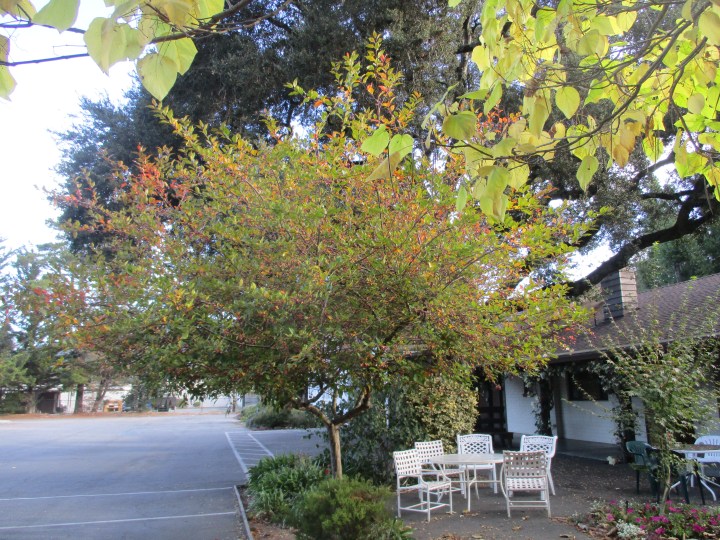
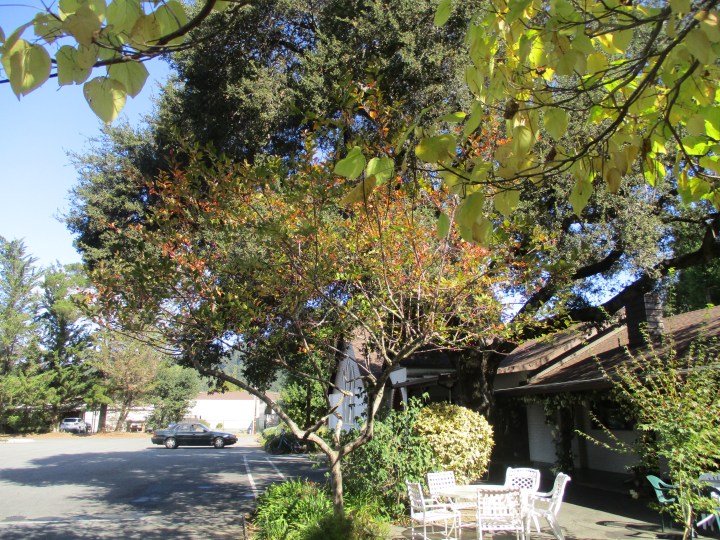
This is the best season so far! Because this is the first update on this blog, there is nothing here to compare the progress of this small Memorial Tree to; but links to older updates on another blog can be found at the older (reblogged) article, ‘May 2‘. Some of those updates link to even more updates. This little Memorial Tree has had quite a history in Felton Covered Bridge Park.

It is actually the fourth tree in this
particular spot. The original black oak was run over by a car many
years ago, leaving the site vacant for a long time. An Eastern red
cedar was planted on New Year’s Day in 2013, but later the following
summer, succumbed to what dogs do to small trees. A bigleaf maple was
planted the following winter, but also succumbed in its second year.

In the last few years since…

View original post 330 more words

The Grass Is Not Always Greener

P90810KThe lawn around the three small but gnarly oaks that were featured this morning in ‘Six on Saturday: Do Not Sit On Tree‘ was not always so perfectly green and uniform. Only a few months ago, it was real grass. Well, it was ‘sort of’ real grass. It was mostly dusty sand with some grass growing it in. There were weeds too, but even they were not very happy to be there.

Maintenance was ridiculous. Because some of the grass was actually alive, it needed to be mown regularly, which sometimes rutted damp soil, but more often blew dust from dry soil into the surrounding buildings. Because the soil retained such minimal moisture, the lawn needed to be irrigated regularly; but because of the old oaks trees, it could not be irrigated too generously.

The only reason that the lawn was there at all was because it got so much use. No one seemed to mind that it was such a dusty mess. The lawn dutifully served its purpose for half a century. Nonetheless, a better lawn was needed.

New sod would have been excellent, but would eventually succumb to the same wear and tear that was so brutal for the original lawn. There was also concern that the irrigation needed to sustain a turf lawn, particularly a new turf lawn, would eventually distress the aging oaks within. Ultimately, artificial turf was selected as an alternative to the real turf of the original lawn.

Rather than sow artificial seed for the artificial turf, artificial sod was installed, just like carpeting. It was remarkably quick and easy, and no one seems to mind that it is . . . well, artificial.

Because the old oaks are accustomed to the regularly scheduled irrigation of the original lawn, they will get watered by hose for the next few years, until they adapt to the lack of irrigation. (Of course, they will not get irrigated nearly as regularly as the original lawn was, but might get occasional deep irrigation just a few times through summer for only the next few summers.)

As resilient and undemanding as artificial turf is, it is not perfect. Almost immediately after installation, two melted spots appeared where guest had barbecued in portable grill. We do not know what happened to cause the damage, but we do know that the lawn will not repair itself.

Six on Saturday: Do Not Sit On Tree


1. Seriously!P90810

2. Allow me to explain. This is one of three small but very gnarly coast live oaks that grew from the roots of a single tree that was cut down or fell several decades ago. Because the trunks of the three trees are so horizontal and sculptural, children climb on them. Sometimes many children sit on the trunk of this particular tree to get their group picture taken. We had been concerned about how this might compromise the stability of the tree for quite a while. Before we constructed suspension devices to prop it and one of the other two trees with, it destabilized and sagged! We pruned much of the canopy away to eliminate some of the weight that exerts so much leverage against the root system, and propped the trunk with a saw horse. We hope that the tree survives the loss of roots that likely broke away in the process, but would not be surprised if it does not. We are not ready to cut it down. It and the two other trees are so well known and popular among guests. The sign is visible to the right. I will explain the colored yarn on the trunk in a moment.P90810+

3. The subject tree is to the lower right in this picture. The two other trees are sprawled to the upper left. The tree that extends farthest to the left will get propped as well. All three have been pruned more aggressively than they should have been to eliminate much of the weight.P90810++

4. The yarn on the trunks is decoration that the camp counselors installed prior to the arrival of the guests. It must have taken a long time to wrap this much yarn around the trunks, and there is a whole lot more in many other trees. I wrote about it earlier in ‘Boom! Zap! Wow! Bam! Zing!‘.P90810+++

5. This is a completely different coast live oak, with a completely different problem. It needed to be pruned for clearance from an adjacent roadway and walkway. The major limb that was here supported less than one tenth of the total canopy, but because it had been cut back repeatedly, it was unusually bulky. Consequently, the shiner that remains is about as wide ad the remaining trunk! That is VERY arboriculturally incorrect. To make matters worse, the cut was not at the correct angle, so eliminated the lower half of the ‘collar’ that is supposed to expand to compartmentalize (heal) the shiner. The problem now is that by the time the shiner heals, the interior of the trunk may be so rotten that the tree may need to be removed anyway. The limb needed to be removed. The only other option was to remove the entire tree.P90810++++

6. Nothing was done to this coast live oak. It grew like this naturally. Although not an exemplary specimen, it certainly is impressive.P90810+++++

This is the link for Six on Saturday, for anyone else who would like to participate:

https://thepropagatorblog.wordpress.com/2017/09/18/six-on-saturday-a-participant-guide/

Rhubarb

60810+It is not easy to get a pretty picture of rhubarb, Rheum rhabarbarum. The big and sometimes flabby leaves are only impressive to those who know about the succulent petioles (leaf stalks) below. The petioles do not look like much either, until they are cooked into pies or garnet colored preserves. Shabby stalks of tiny flowers rarely bloom, and should get cut out to favor more foliar growth.

Traditional rhubarb stalks are mostly green with a red blush, and a distinctively tart flavor. Some modern varieties with richer red color are not quite as vigorous, and have milder flavor. Varieties with light green petioles are probably the most productive, but are not so richly colored when cooked. Tender young stalks are preferred to firmer mature stalks. Leaves are toxic, so they are not eaten.

Petioles can be harvested as soon as they are big enough in late spring, and as late as autumn. The outer leaves get plucked first, which leaves smaller inner leaves to continue growing. Plucking most of the leaves gets more of the tender inner stalks, but also slows growth so that new stalks may not be ready for a few months. Rhubarb likes rich soil, sunny exposure, and plenty of water.

Forage To Find Unexpected Fruit

Felton League, the Facebook group of the homeless and their friends in Felton, California, briefly mentions the source of some interesting, but typically overlooked fruits that can be found in the wild or unrefined landscapes. Blackberries, American plums and elderberries collected from rural roadsides have produced award winning jellies for the Santa Cruz Mountains Harvest Festival.
Unlike the fruit that so many of us put so much effort into growing in our home gardens, these fruits and others are productive without any help. They are commonly overlooked only because they are so easy to ignore. In some ways, they are inferior to ‘garden variety’ fruit; but they also have certain advantages. Free fruit that takes no more effort than harvesting is obviously a good thing.
The most common wild blackberries are actually Himalayan blackberries that have naturalized. Unfortunately, they do not compare well to garden variety blackberries. They are not as abundant, and are difficult to pick from the wickedly thorny and rampant canes. Blue elderberries really are native, and are just as good or maybe better than black elderberries from eastern North America.
Figs, olives, grapes, rhubarb, prickly pears, apples and various citrus can sometimes be found in abandoned or neglected landscapes. Walnut, almond and wild plum trees sometimes grow from self-sown seed. Purple leaf plum is not always as fruitless as it is purported to be. Then there are all the other ornamental plants that happen to produce fruit that is useful to those willing to try it.
For example, Australian brush cherry, English hawthorn, Indian hawthorn (‘Majestic Beauty’), strawberry tree and even common freeway iceplant all produce fruit that can be cooked into luscious jelly. Of course, no fruit, particularly unfamiliar fruit, should be eaten or experimented with until it is confirmed to be safe for consumption. Many fruits really are toxic! Also, fruit should not be harvested from where it might be illegal to do so, such as private property or parks.

NOTE: This is an old article. Felton League is no longer a group on Facebook, but is now a blog here on WordPress.B90803K

Horridculture – Stinky Flowers

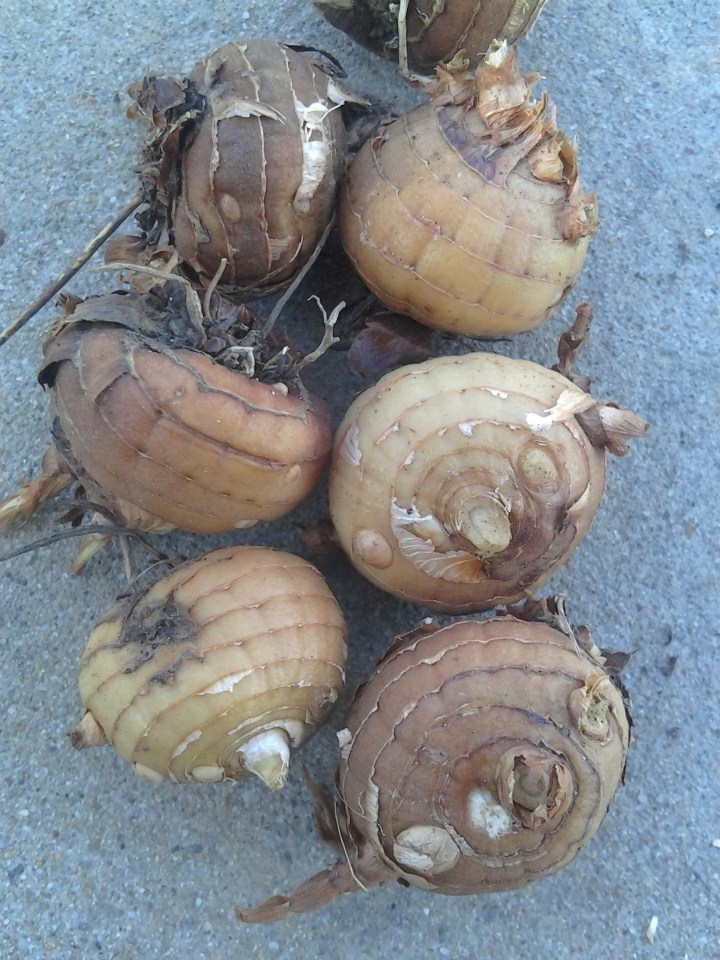
P90807Wednesday is my day to rant. However, I neglected to get out to find a picture or even a topic to rant about. Instead, I found this ugly little . . . what I believe to be a dormant rhizome. It looks more like a tuber or a tuberous root, and very well could be. Someone at work brought it from his home garden, where countless more naturalized and became aggressively invasive.

I do not know for certain what it is. I only know that it is some species of Arum. We refer to it as the ‘death arum’ because, while in bloom, it smells like death. Yet, it seems to be immune to death. It is extremely resilient. All attempts to eradicate any of it have only angered it, and accelerated its migration into other formerly uninfested parts of the garden. Now we have it here.

I am told that the deciduous rhizomes . . . or whatever they are, remain dormant through summer, and then regenerate foliage once the rain starts in autumn. Their visually unimpressive but olfactorily objectionable flowers bloom by late spring or early summer. Foliage and bloom shrivel in warm summer weather, and the remaining seeded stalks collapse shortly afterward.

The thin rubbery leaves are intricately lobed and spotted, which is very distinct from foliage of other arums. Each thin bloom is comprised of a sickly greenish white spathe and a comparably sickly pale tan or yellowish spadix. Seeds are contained in tiny round fruits that resemble capers, that linger briefly on top of the spotted stalks of faded blooms. It all is as weird as it sounds.

I will can (pot) the rhizome . . . (let’s just leave it at that) before autumn, and see what it does. I certainly do not want to plant it into the ground where it can get established and proliferate. Perhaps I will just grow it as a potted foliar oddity, and snip off floral stalks before they bloom. Perhaps I should send it to my colleague in Los Angeles, three hundred and sixty miles away!

Like many of the genera in the family Araceae, what we know as the death arum exhibits an objectionable floral fragrance because it is pollinated by flies. It does what it must to attract the pollinators whom it relies on. The technique is obviously effective, because seeded fruit develops, and the seed within gets dispersed farther and faster than the rhizomes ( . . . ) can migrate.

Chilean Jasmine

90814This is not just another mandevilla. Well, maybe it is. Mandevilla laxa is special though. It is known as Chilean jasmine because, unlike other mandevillas, it is so delightfully fragrant, particularly on warm summer evenings. Some say the fragrance is similar to that of gardenia, but not as strong. Others say it has a bit of vanilla mixed in. Sporadic bloom continues through most of summer.

The two inch long pure white flowers flare out to be a bit wider than long, and are a bit more relaxed than the neatly tailored flowers of other mandevillas. They bloom sequentially in small groups, with new flowers replacing the old for quite a while. The glossy rich green leaves can get almost twice as long at the flowers. Foliage last better on the coast, but is mostly deciduous elsewhere.

Chilean jasmine grows fast in spring, especially if pruned well after winter, but is surprisingly tame. It can grow past downstairs eaves, but should not reach upstairs eaves. It is satisfied with a light duty trellis. If carefully pruned out and removed each winter, it is one of the few vines that is complaisant enough for lattice. Light frost can kill stems to the ground, but they usually recover in spring.

Vegetables Change With The Seasons

90814thumbRight smack in the middle of the warm part of summer, it is already time to be getting ready for autumn gardening. This involves more than just ordering our autumn planted spring bulbs while the selection is still optimal. Most of us purchase bulbs from what is available in nurseries when they are in season anyway. Seed that gets sown in the next few weeks is a more immediate concern.

The majority of cool season vegetables will get planted later, when the seasons actually start to change to become . . . well, cool. Seed for beets and carrots gets sown directly in about a month, followed by pea seed even a bit later. At about that same time, many of us will plant small seedlings of other cool season vegetables, like broccoli, cauliflower, cabbage, lettuce, spinach and kale.

For many of us though, it is not that simple. If we want varieties of these cool season vegetables that are not likely to be available as seedlings in nurseries later, we must grow our own from seed. Whether they get sown directly into the garden, or into flats to be grown as seedlings to be planted later, broccoli seed should be sown about now. By the time it gets to growing, it will be autumn.

Seed purchased online or from mail order catalog should be ordered by now. It is not too late for broccoli if the seed arrives and gets sown soon. Cauliflower and cabbage seed gets sown within a month or so, as late August becomes early September. Lettuce and spinach seed should wait half way through September, like beet and carrot seed. Kale seed can wait until after September.

Seed for secondary phases of most of these cool season vegetables can be sown early next year.

In the meantime, warm season vegetables must continue to be harvested very regularly. If they stay in the garden long enough to get tough and bland, they also interfere with continued production. Foliar herbs can be harvested for drying just about any time they are fresh and not blooming. Regular harvesting inhibits bloom, and therefore promotes more of the desirable foliar herbal growth.

Suckers For Street Trees

P90804This grand sycamore has likely been here since the third day of Genesis. A few of the top branches got broken off when Noah’s Ark floated over. When I was a little kid, it was on the edge of a vacant field where road debris was dumped, and older kids rode their dirt bikes. Now it is on the western edge of the parking lot of Felton Covered Bridge Park. I write about it sometimes.

California Sycamore‘, ‘Hanging Gardens Of Babylon‘, ‘Nature Is Messy‘ and ‘Tufts‘ are some of the articles that feature this exquisite specimen. The last three of these examples describe some of the difficulties of old age for sycamores. Something that I may not have mentioned in these article though, is that such mature sycamores eventually develop root suckers.

I use the term ‘suckers’ loosely. For those of us who grow grafted trees, ‘suckers’ are stems that develop from below the graft unions of grafted trees, even if above the roots. They are from the understock below, so are genetically different from the scions above. Unusually vigorous stems above graft unions or on ungrafted trees, including the roots, are known as ‘watersprouts’.

For all other intents and purposes, ‘suckers’ really are just vigorous stems that emerge from roots, which is what we have here. Because no one was here to graft this grand sycamore on the third day of Genesis, these ‘suckers’ are genetically identical to the main tree. Unfortunately, their appearance indicates that the tree is finally acknowledging that it is slowly deteriorating.

Many trees do it, especially old riparian trees. When they know that they will not be around much longer, but still have some time to do so, they divert resources into their own replacement. Suckers are expected to mature into new trees after the original is gone. They recycle the mature original root system until they eventually replace it with younger and more vigorous roots.

Arborists may try to interfere with this process by removing suckers and watersprouts, and diverting resources back into older stems. This is actually helpful for trees that are distressed, but not yet decaying. For trees as mature as this sycamore, removal of vigorous suckers and watersprouts is mostly cosmetic, because thickets of such rampant growth becomes unsightly.

As violent as it sounds, it is best to abscise suckers like these when they first appear, and any that appear afterward. That involves literally tearing them from their roots to remove some of the callus growth from which they emerged. Cutting them at the ground not only leaves the callus growth to develop into distended burls, but also stimulates more vigorous sucker growth!

Now that these suckers have been cut down repeatedly over the past several years, simple abscision is no longer possible. Callus grown has expanded and fused into broad subterranean burl growth. Removal of such extensive burl would severely distress and possibly contribute to the destabilization of the already distressed tree. Suckers can now only be cut down to the ground.

Several years ago, when the first of the suckers started to appear, they were much easier to abscise. The process was delayed until winter dormancy. The small defoliated suckers were then abscised along with much of their associated callus. It did not accomplish much for the massive tree, and only delayed the inevitable for a few years, but generated an interesting byproduct.

The bare suckers with their bit of callus were ideal for growing into copies of the same tree. Most were plugged back into the riparian area nearby, but later killed by necessary vegetation management. A few others were canned (potted), and grew into small sycamore trees that were planted, with other sycamores, into broad medians and parkstrips in Mid City Los Angeles.

It is a long story about how those few trees ended up in Los Angeles, and were added to the fifty or so Birthday Trees that we plant annually on January 18. Sadly, their identities were lost in the process. If the other sycamores are genetically identical clones of each other, it may eventually be possible to distinguish genetic variations of those that were once root suckers here.

Bad Picture Of Good Berries

B90803KHimalayan blackberry is to cane berries what blue gum is to eucalypti. It is what gives all cane berries a bad reputation, and is why so few of us want to grow them. Himalayan blackberry grows as an extremely vigorous weeds, extending sharply thorny canes over anything within reach. When the canes are removed, the tough roots are extremely difficult to remove and kill.

If ignored, the canes ‘leap’, which means that they develop roots where they arch back downward to touch the ground. From there, they grow into new plants that extend new canes in all directions, to start the process all over again. (‘Leaping’ is like ‘layering’, which involves the development of roots where stems ‘lay’ on the ground.) Their seed gets where their canes do not.

The thorns are ‘prickles’, which really is a technical term for sharply pointed distensions of bark or epidermis. They are more like stout prickles of rose canes than the more finely textured prickles of garden varieties of cane berries. They are rigid, extremely sharp, and curved inward to snag victims on their way out; so are seriously wicked and potentially dangerous to handle.

Harvesting berries from second year canes is not easy. Most are out of reach within bramble thickets. Because they ripen through a long season, they must be harvested repeatedly, as those that were unripe during a previous harvest finish. This is why there are black, red and green berries in the same picture. The berries are small and variable, with good years and bad years.

This happens to be a good year. The thorny truss of a few small berries in the picture may not look like much; but there are plenty of them. The berries are quite richly flavored too. Those who have the patience to collect them will get some good jam or jelly out of the deal.