Six on Saturday: Nursery Schooled

Horticulture can be such a bad habit. (Where have I heard that before?) Once one learns how to grow horticultural commodities, it is difficult to stop. Pruning scraps get processed into more cuttings. Self sown seedlings get relocated instead of discarded. Extra pups (divisions) get salvaged as if the garden can accommodate more. There are several acres of landscapes here, but it is not enough for what we could grow.

1. While dividing a bunch of Morea bicolor, I found a single shoot of Morea iridioides. How did that get in there? I should have discarded it. Perhaps it will grow to become something useful.P00725-1

2. Pruning scraps of zonal geraniums got plugged as cuttings, but then did not get separated as they grew. There may be a dozen in there. They are nice, but we really do not need any more.P00725-2

3. When composting just is not good enough, plug cuttings instead. There may be a dozen Ponderosa lemon cuttings here. One is too many. They are not grafted, so will be on their own roots.P00725-3

4. Boston ivy is fortunately not as abundant as I thought it would be. We wanted four, so I plugged a hundred cuttings. It seemed to make sense at the time. Most did not survive. Plenty did.P00725-4

5. This self sown bigleaf maple is not in the nursery, but I want it to be. It should not remain where it is. I may dig and can it this autumn, as if there is a situation into which to install it later. P00725-5

6. These summer squash are not from the nursery, but from right downstairs. They are happy with all the runoff they get from above. Neighbors have been getting many pounds of squash.P00725-6

This is the link for Six on Saturday, for anyone else who would like to participate:

https://thepropagatorblog.wordpress.com/2017/09/18/six-on-saturday-a-participant-guide/
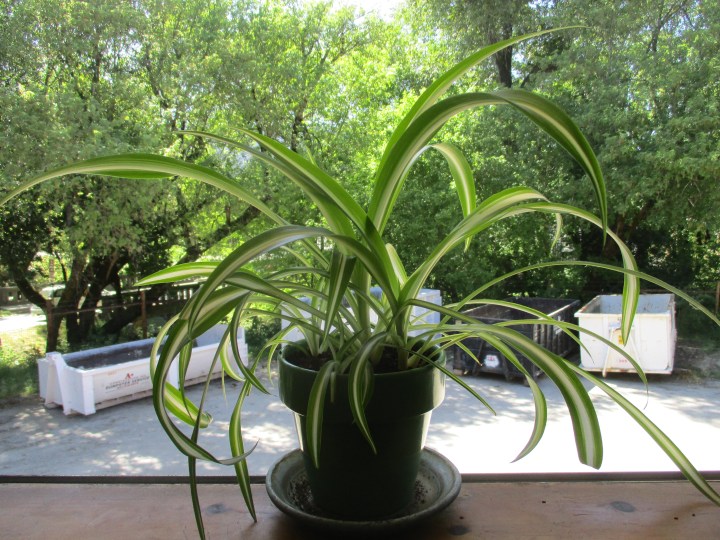
Horridculture – Dumpster View

P00722
Location – Locations – Location

Rather than addresses, most of the guest cabins at the conference center where I work for part of the week, have delightfully horticultural names; such as Camellia, Lupine, Holly, Dogwood, Huckleberry, Strawberry and Cottonwood. Others have names that are suggestive of idyllic locations, such as Meadowbrook, Creekwood and Rustic Dell. Then, . . . there is ‘Dumpster View’.

Dumpster View is not actually a guest cabin, or a lodge, or any building that any of the guests would ever see. It is part of our maintenance shops buildings. Although large, these building are outfitted with only a few windows. The largest building has only a single window for an office. The smaller building has only four windows. Two of the windows have a view only of dumpsters.

The picture above shows the view from the window in the galley. It was what I saw as I made coffee for the crew in the mornings back when we all were still working. As many as fifteen big dumpsters have congregated in that herd, right outside, beyond the spider plant. Because the area is a paved driveway with significant traffic, I can not even plant a tree to obscure the view.

No amount of houseplants bigger than the spider plant can obscure this view without becoming obtrusive. Hanging pots outside the window might detract from the outer scenery, but would require more attention than I want to devote to them. Curtains would be the most practical solution, but would get grungy in this particular situation. Besides, no one else here really notices.

Horticulture is not for everyone, and can not fix everything. No one stays in the shops buildings long enough to notice how horrid the views are anyway. We all leave to go to work in scenery that others vacation in.

Six on Saturday: Timber! III

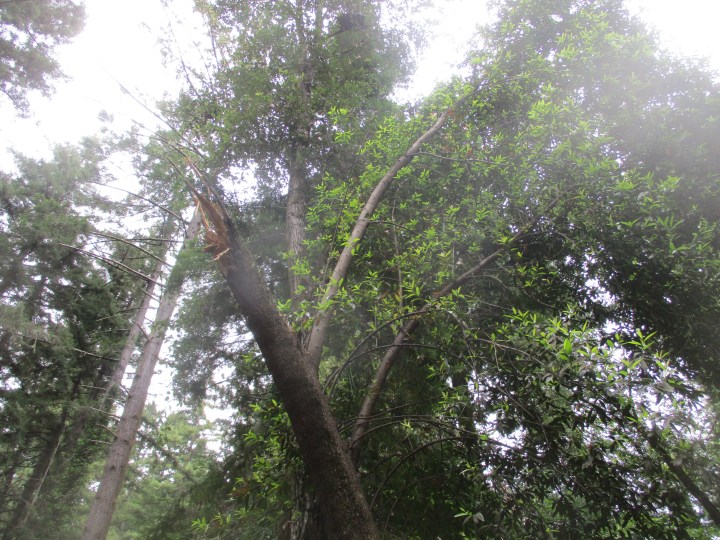
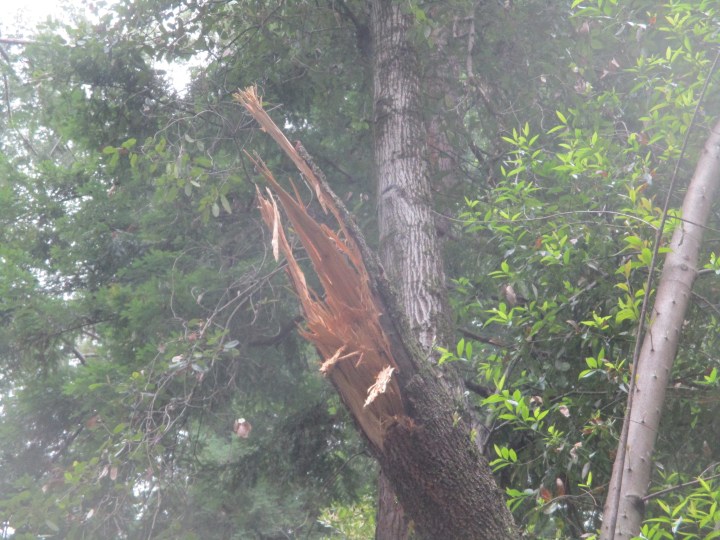
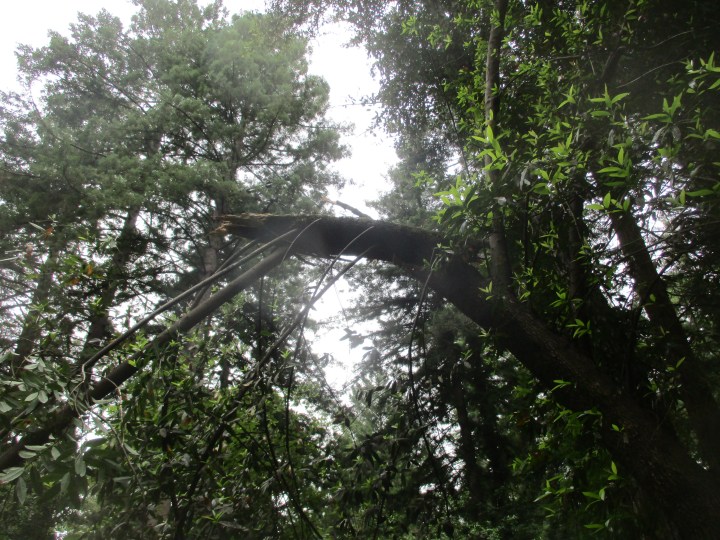
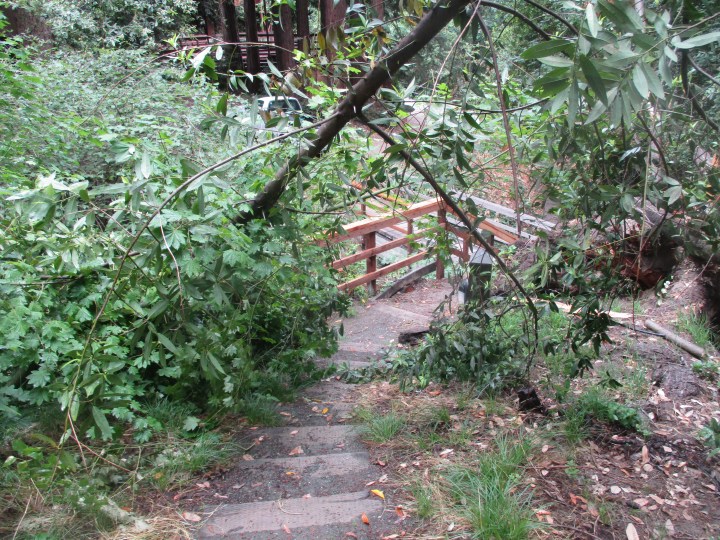
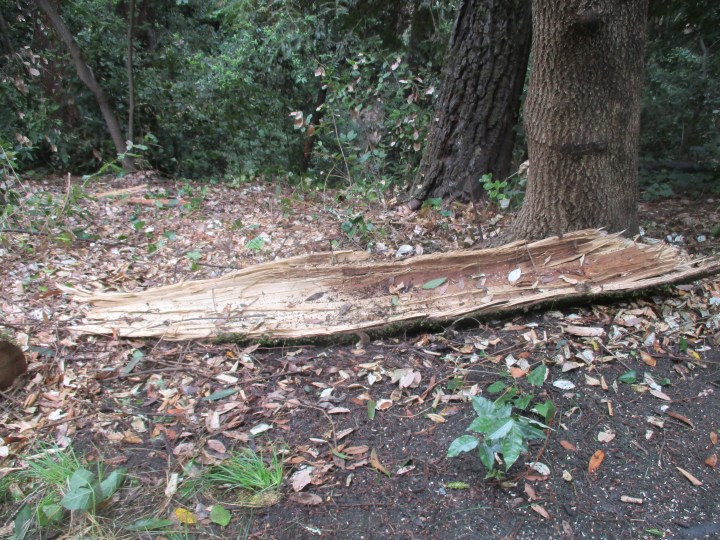
At the end of May, Six on Saturday – Timber! II, ended with a precariously disfigured bay tree. Timber!, on May 10, mentioned that most of the tree had previously broken apart and fallen on top of a big Douglas fir tree that had fallen earlier. Prior to this big mess, the bay tree had been leaning on the Douglas fir tree. Now, it just continues to deteriorate. The precariously disfigured limb that remained last May was the most recent victim of gravity. Not much of the tree remains.

1. This was what we were concerned about. The disfigured and fractured trunk twisted from leverage exerted onto it by an upper limb, which is now extended downward instead of upward.P00718-1

2. Damage was impressively minimal. An exemplary specimen of Chinese maple sustained a direct hit from the main limb of the bay tree, but also sustained only minor structural damage.P00718-2

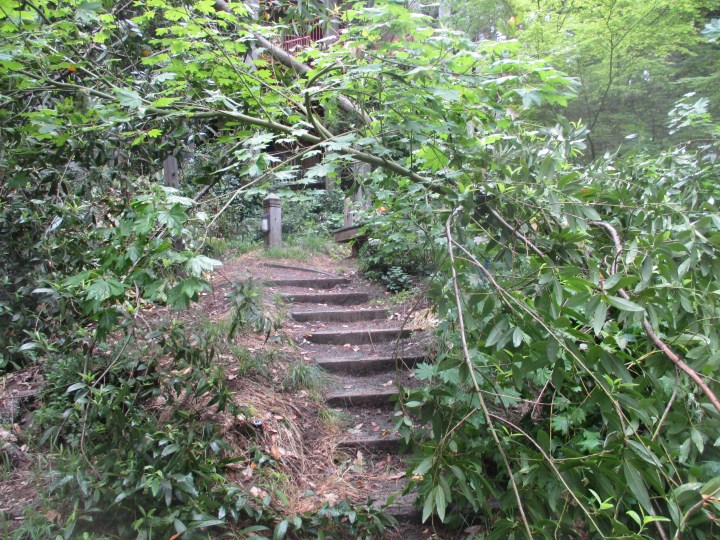
3. The trail somehow remained passable, although closed because of the big fallen limb dangling above. As the limb was dismantled, the fractured portion of the trunk broke away and fell.P00718-3

4. This big piece of the twisted and fractured portion of the trunk looks like a canoe, and is about as big. This was suspended more than twenty-five feet up, which is why the trail was closed.P00718-4

5. What remains of the bay tree is still severely disfigured, but is not so dangerously structurally compromised. It can remain until another arborist can get here to remove it and other trees.P00718-5

6. It looks worse up close. Nonetheless, there is not much we can do about it now. The limb to the far right originates from the same trunk. The big gray trunk in the background is a tan oak.P00718-6

This is the link for Six on Saturday, for anyone else who would like to participate:

https://thepropagatorblog.wordpress.com/2017/09/18/six-on-saturday-a-participant-guide/
Horridculture – Solar Power

P00715
This gives a new meaning to ‘shade tree’.

Leaves are the original solar panels. They collect solar energy, and convert into useful resources. Some of those resources get converted into other resources that are good for human consumption, such as fruit, vegetables, lumber, firewood and oxygen. However, one resource that leaves do not produce is electricity.

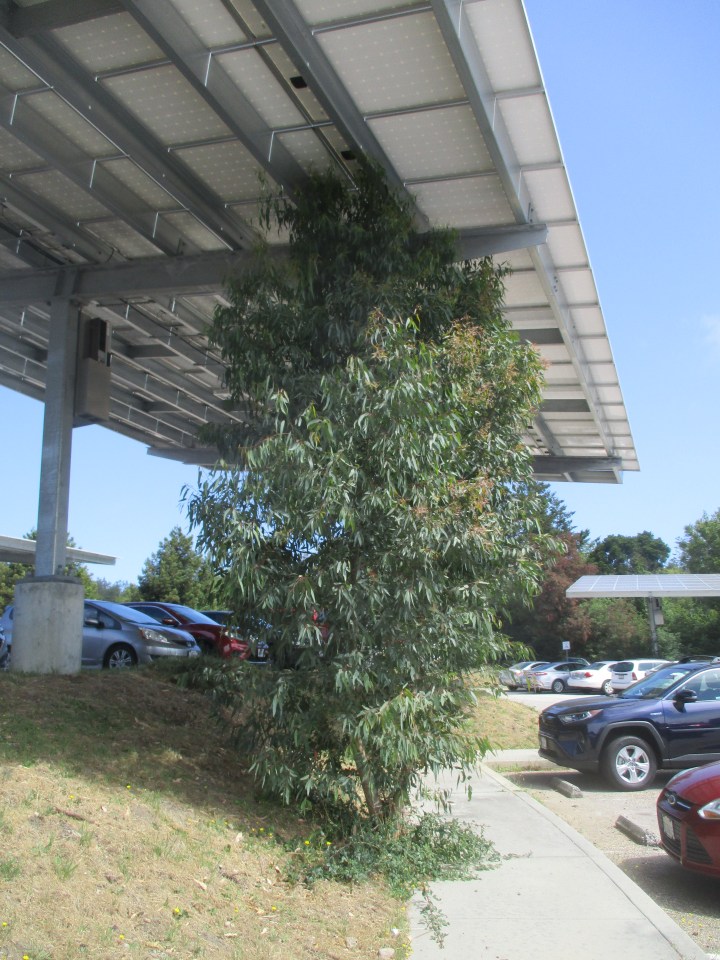
That is why the big solar array pictured above was installed over a big parking lot. There are a few of these arrays in this parking lot, and more in other nearby parking lots. Many trees were cut down to accommodate them. People who work nearby can use the electricity more than they could use vegetation, or anything that vegetation could produce within this area.

Shade trees are nice over parking lots, but are not necessary over a parking lot that is shaded so thoroughly by such big solar arrays. After parking during rainy weather, an umbrella is only necessary between the solar arrays and the adjacent office buildings. There are no more fallen leaves to clean up. Pavement and curbs will no longer be displaced by growing roots.

The red gum that is also pictured above, under the solar array, is not so impressed. It likely grew from a root of a red gum that was removed so that the solar array could be constructed. Sadly, it must be cut down again, not only because it is under the solar array, but also because it is against the sidewalk. It has clearance problems both above and below.

It is rather ironic that even after all the trees that formerly shaded this parking lot were cut down for the installation of this solar array, this young red gum that is so determined to survive can not stay. I can not help but wonder what this young red gum thinks of green energy.

Six on Saturday: Closeups II

This is the more foliar counterpart to the closeups for my Six on Saturday from last week. Some are closer than others. Some would be more easily identifiable without captions than others. All are quite random. All these subjects are in the storage nursery; but only #1 and #5 will eventually find homes in the landscapes here. The others will likely go into one of my own gardens. I have no idea of what to do with #2.

1. Agave pedunculifera – provided the most abstract picture of the six. The name is only a guess. Someone else might have been able to identify it as something else if more of it were visible.P00711-1

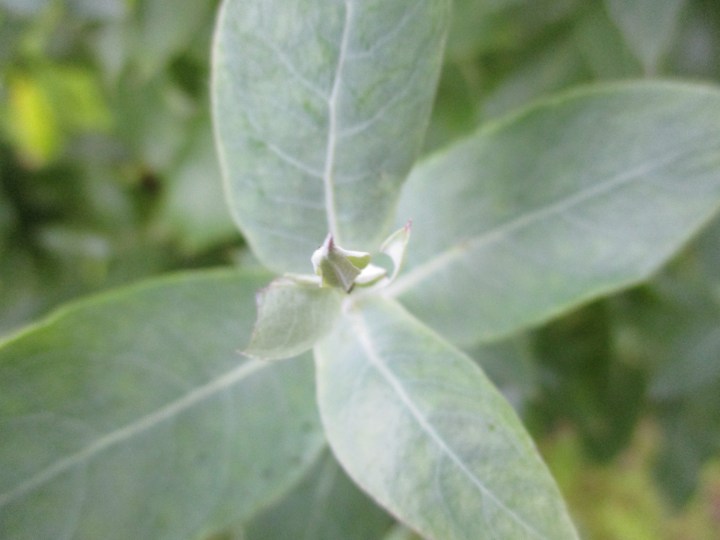
2. Eucalyptus globulus ‘Compacta’ – compact blue gum – was my second choice for juvenile blue gum foliage. It was easier to reach because it is more . . . compact. The other blue gum is tall.P00711-2

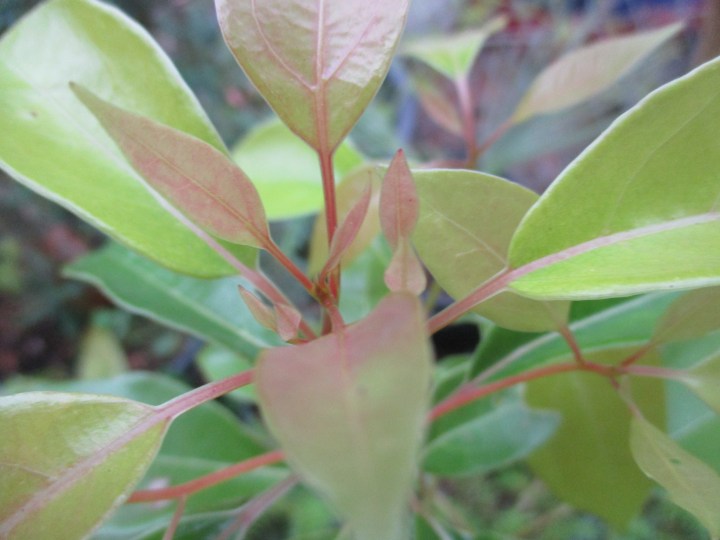
3. Cinnamomum camphora – camphor – is light yellowish green most of the time, and then gets slightly blushed with new growth late in spring. This young tree started late in partial shade.P00711-3

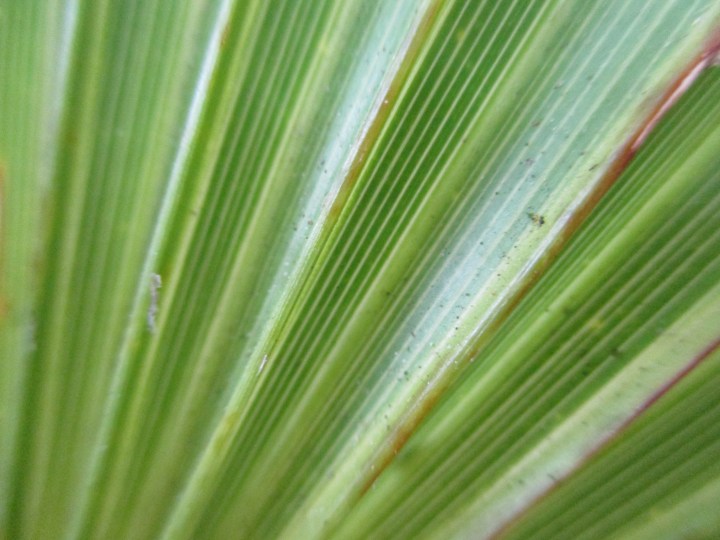
4. Trachicarpus fortunei – windmill palm – provided the second most abstract picture of the six. It is more recognizable though. Mediterranean fan palm is darker. Other fan palms are light.P00711-4

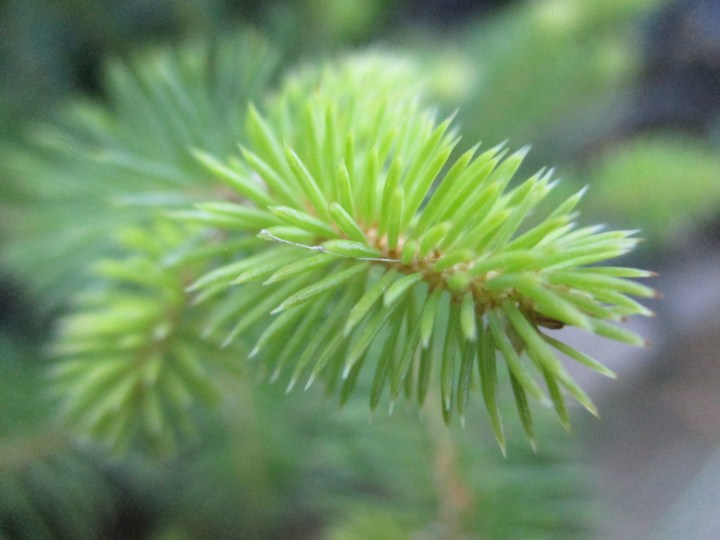
5. Picea sitchensis – Sitka spruce – was brought from Smith River, on the coast just south of Oregon. It does not seem to mind being so far from home. The happy new growth is impressive.P00711-5

6. Juniperus virginiana – Eastern red cedar – is my favorite this week because I brought it from Oklahoma. Cedrus deodara – deodar cedar – is the real cedar that provided the background.P00711-6

This is the link for Six on Saturday, for anyone else who would like to participate:

https://thepropagatorblog.wordpress.com/2017/09/18/six-on-saturday-a-participant-guide/
Horridculture – Weed Whackers

P00708
This must be the better half.

This neatly sliced prickly pear is too silly to rant about. There is another just like it. Two others were not sliced, as if, after the first two, someone realized that there was more to the roadside meadow than combustible dry grass. The prickly pear were put out there just last winter. They each extended only a single pad half a foot or so above grade, so were obscured by the grass.

Realistically, the damage is minimal and tolerable here. The priority of the crew who performed the vegetation management was to cut down all the combustibles. They did an efficient job of it. They did not expect to encounter anything that had been intentionally installed out there, or even any desirable vegetation. Besides, this prickly pear will recover as if nothing happened.

Unfortunately, damage caused by weed whackers is rarely so innocuous. Weed whackers are one of the most commonly misused horticultural power tools, and are very often used by those who are not aware of how to use them properly. They are easy enough to operate that minimal consideration is given to the potential for damage that they can cause. It is a bad combination.

Because weed whackers are often and improperly used to cut tall grass that is too close to trees for lawn mowers to cut, they commonly strip off bark and cambium from young tree trunks. A tree can not survive without its cambium, and quickly dies if too much is stripped away from the base of its trunk. That is why it is very important to pull weeds from around trees instead.

For now, there is nothing to do for the two sliced prickly pear. The bud to the upper right corner of the pictured specimen is beginning to develop into a new pad.

Six on Saturday: Closeups


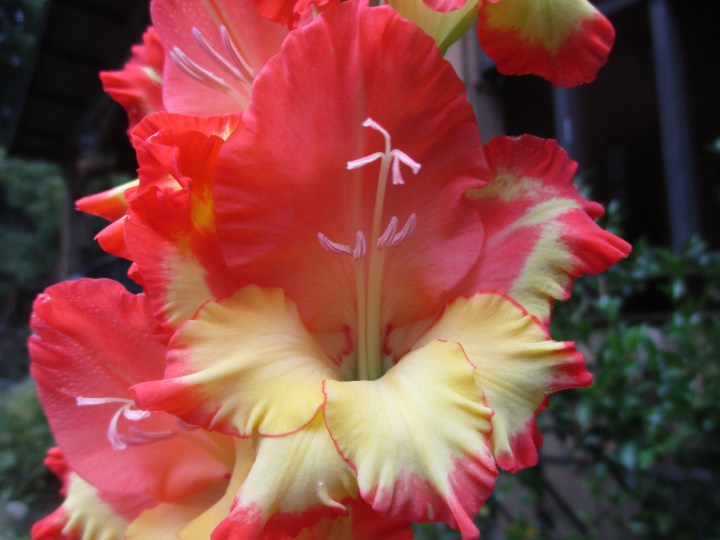
This is not how we normally look at these flowers, stems and vegetables (fruits). They might look strange out of context. That was sort of intended. ‘Six on Saturday’ allows more freedom of creativity than the simple illustrations that I use for the gardening column. The last two are closeups of the same two gladiolas that were featured last week. Perhaps they show color better.

I should try this again for next week.

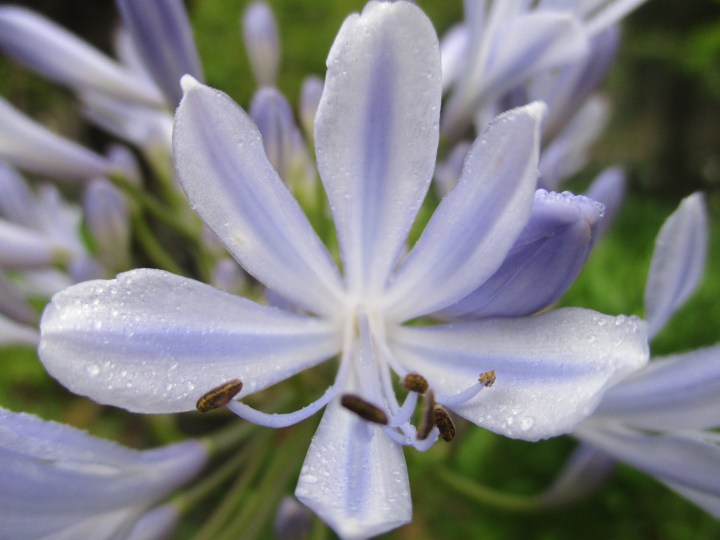
1. Lily of the Nile is the ‘Fourth of July Flower’. It blooms for the Fourth of July, and the florets radiate from the center of their floral truss like fireworks. I will write more about this at noon.P00704-1

2. Epiphyllum stems, like the stems of other cacti, do all the work of foliage. Because they are flat, they actually look like big and weirdly arching leaves. New tip growth is still rather blushed.P00704-2

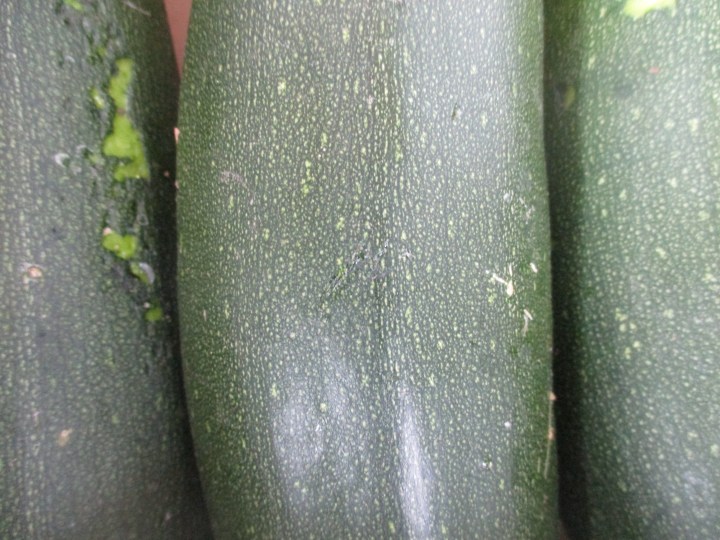
3. Zucchini is too productive. I neglected to go down to harvest it for two days or so, and then found that some fruits had gotten as big as bowling pins. They are fortunately not too tough yet.P00704-3

4. Red willow is a weedy tree that I should not be growing intentionally. This is special though. I brought its cuttings from Reno. It will be coppiced, and not allowed to grow as a real tree.P00704-4

5. Gladiola got enough attention last week that I got closer pictures of them this week. This one seemed to be more purple or less blue last week, with just a bit of white, like elderly Grimace.P00704-5

6. Gladiola are more fun when someone else selects bold colors that I would not consider. This flashy orange and yellow bloom is exquisite, and looks like Grimace’s friend, Ronald McDonald.P00704-6

This is the link for Six on Saturday, for anyone else who would like to participate:

https://thepropagatorblog.wordpress.com/2017/09/18/six-on-saturday-a-participant-guide/
Horridculture – Vandalism

This would have been an ideal time for a seasonal update on the little Memorial Tree in Felton Covered Bridge Park. Until recently, it had been healthier and growing more vigorously than it had since it was installed a few years ago. It had survived major accidental damage, and was just beginning to thrive. Sadly […]

https://feltonleague.com/2020/06/28/vandalism/

via Vandalism — Felton League

Six on Saturday: Housebound


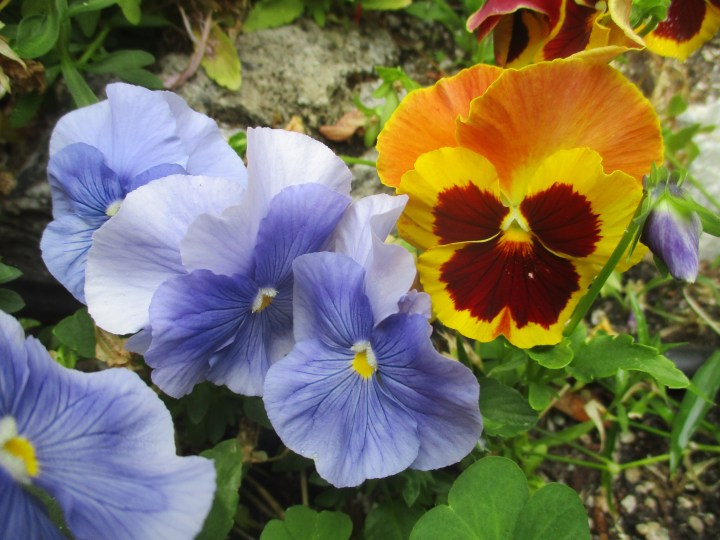
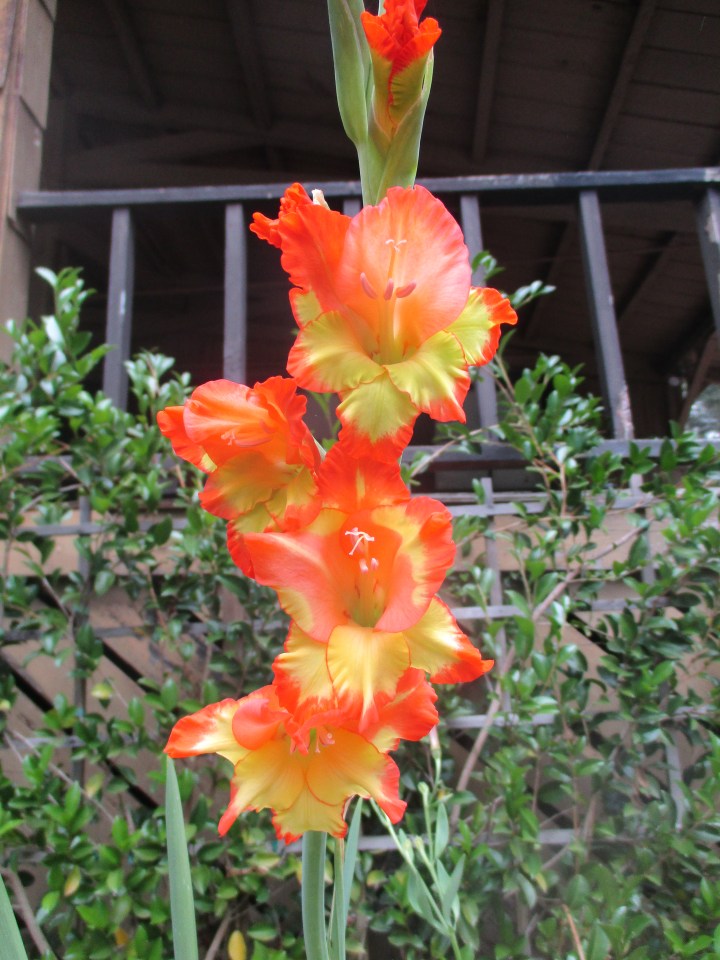
This is not a good week for my Six on Saturday. The first three are of pansies; and the last two are of gladiolus. That is not much variety. Posting six pictures of different cultivars of roses or rhododendrons is somehow different and more interesting.

I did not get out enough to get many good pictures this week. I work inside for part of the week, and needed to stay in for Thursday as well. I got outside only on Wednesday and Friday.

1. Pansies are slowly succumbing to the warmth of spring and early summer. They can continue to perform as long as they like, we will not be replacing them with any warm season annuals.00627-1

2. Pansies are even prettier up close. Foliage was unusually sparse among this group, even prior to spring. Pansies had never stayed so late before. I would not have guessed that they could.00627-2

3. Pansy is one of the favorite flowers of my colleague down south. Although he does not use many at work, or even in his home garden, he always grows one pot full of them through winter.00627-3

4. Alstroemeria, which are also known as Peruvian lilies, do very well here. I do not remember if this is pink or ‘peachy’. I believe it is ‘peachy’. There are also yellow alstroemeria here.00627-4

5. Gladiola is one of my favorite summer bulbs, but I have not planted any in many years. They are not reliably perennial here. However, this orange gladiola has bloomed for several years.00627-5

6. Gladiola, now that I think about it, is actually my favorite summer bulb, rather than just one of my favorites. This purple gladiola has bloomed as long as the other, only in a different area.00627-6

This is the link for Six on Saturday, for anyone else who would like to participate:

https://thepropagatorblog.wordpress.com/2017/09/18/six-on-saturday-a-participant-guide/
Horridculture – eBay

P00624
I certainly got good deals on these recent acquisitions. However, I have no idea what I will do with them.

It is such a bad habit! Even if I spend no money, I spend too much time perusing what I could spend a little bit of spare cash on. On rare occasion, I actually do spend a little bit on something that I can get a good deal on, not because I actually have any use for it, but merely because I got a good deal on it, . . . or because I believe that I may not be able to find it for sale again later.

Now, I have more than two hundred seed for Pygmy date palm, Phoenix roebelenii. They certainly were inexpensive, costing less than a few dollars. Most of the expense was for postage. It really was a good deal. However, I have no plan for so many Pygmy date palms. I do not expect all to germinate; but I have no plan for just half of them. Actually, I have no plan for just one.

The other seed to the right in the picture are for muscadine and scuppernong, Vitis rotundifolia. Although I purchased them as a ‘mix’, the seller kindly separated the two varieties. They are easier to accommodate than two hundred palms, and I really do have plans for them. I know growing them from seed is riskier than growing known cultivars, but I wanted them to be ‘wild’.

Regardless, I really should not have purchased even muscadine and scuppernong seed while there is so much other seed here that can not be accommodated. I really must sow all of the old seed this autumn or winter, whether I have plans for it or not. I suspect that most will not germinate. Some of the most questionable seed can be sown out in the garden rather than in flats.

No more eBay!