 As the colorful deciduous trees go bare, the evergreen trees get more attention. A weeping white spruce, Picea glauca ‘Pendula’, really stands out. It grows slowly to only about fifteen feet tall and maybe five feet wide, so does not need as much space as a typical spruce tree. What makes it so distinctive is the weirdly pendulous stems that hang limply from a strictly vertical trunk. It is hard to believe that it is only a different variety of the same species as the dwarf Alberta spruce, which is very short, dense and symmetrically conical, with stout little stems. The foliage of weeping white spruce is lighter green than that of most other spruces, but is not as blue as that of blue spruce. The short and stiff needles are rather prickly to handle.
The narrow and weirdly sculptural form of the weeping white spruce is no good as a shade tree, but is an excellent trophy tree for a prominent spot. Full sun is best. A bit of shade can cause the main trunk to lean toward sunlight. Young trees should only be staked if they need it, since they can become dependent on stakes. The lowest limbs can be allowed to creep over the ground.
 Of all the Official State Trees, the coastal redwood, Sequoia sempervirens, of California is the grandest. Seriously, it is the tallest tree in the World, so it really ‘is’ the grandest! The tallest is 380 feet tall! Although the related giant redwood of the Sierra Nevada develops bigger trunks, the bulkiest coastal redwoods are thirty feet wide at the base! The oldest are more than 2,000 years old!
 Mild autumns and arid summers keep chrysanthemums on a different schedule here than in most other regions. They can get planted in spring to grow through summer and bloom through autumn; but because they can take a bit of work, they are more often planted while blooming in autumn. Although commonly grown as autumn annuals, they are perennials that can regenerate next spring, grow through summer, and bloom even better the following autumn.
 It really would be nice to be able to transform a pumpkin into a chauffeured coach to ride to the ball, just by waving a magic wand over it. A Buick would be even more excellent! Over the years, as the variety of new Buicks has diminished to not much more than a few SUVs that are scarcely more stylish than pumpkins, the variety of pumpkins has grown crazily. Form is not following function.
 The recent unseasonably warm weather was no problem for any remaining moss rose, Portulaca grandiflora. They usually start to look rather tired as the weather gets cooler this time of year, and eventually succumb to the first frost. Where allowed to do so, they can regenerate next year from seed. I like to collect their seed during the summer or autumn so that I can sow them after the last frost of the following winter. Through spring and summer, I find that additional plants are easy to grow from cuttings.
 It is easy to mistake various cultivars of Dyckia for diminutive relatives of Agave or Yucca. They form stout rosettes of rigid leaves with wickedly sharp terminal spines. Their comparably nasty but incurved marginal teeth resemble those of most species of Agave, but are generally more abundant. Surprisingly though, Dyckia are instead related to bromeliads. They just happen to be xeric.
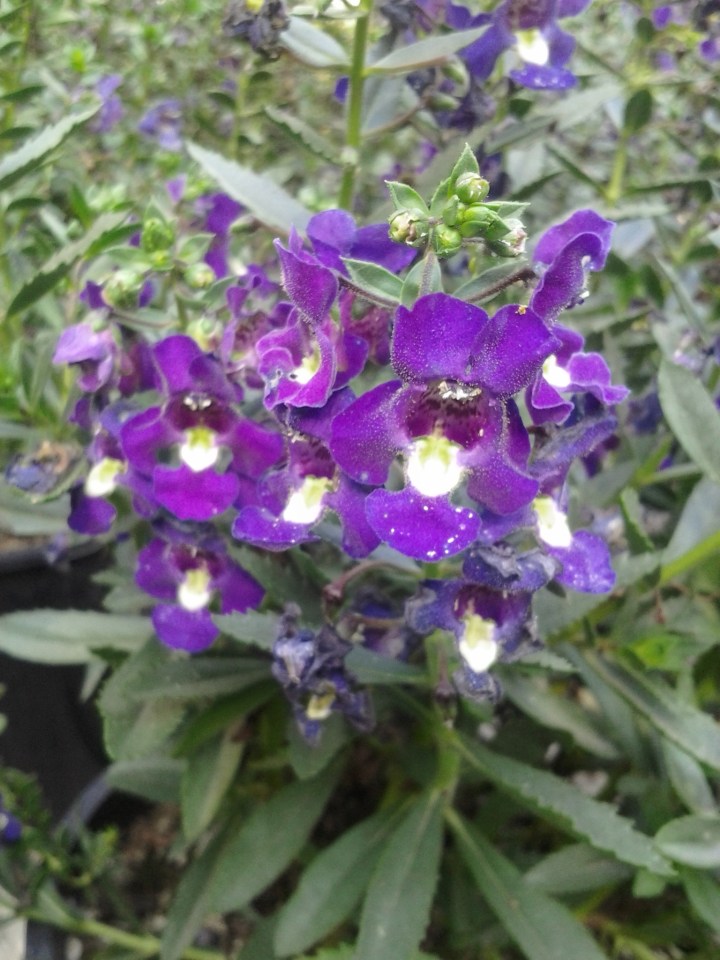 Angelonia is one of those warm season annuals that can actually survive through winter as a pernnial to bloom again next spring. It may even want to continue to bloom untill frost. The flowers can be blue, purple, red, pink or white, and look something like small snapdragon flowers. Most have spots or stripes of an alternate color or two in their throats. Some modern varieties have fragrant flowers. Plants can get a foot or two tall, and almost as wide. In sheltered spots, angelonia can be cut back as soon as it starts to look tired in autumn. Exposed plants might be happier if cut back significantly later, as winter ends. Old growth may be unsightly for a while, but can protect interior stems and roots from frost. Besides, pruning stimulates new growth that will be more susceptible to subsequent frost.
 This is not an easily defined flower. There are hundreds of species within the genus of Viola. Many are known as pansies. Many are known as violas or Johnny-jump-ups. Many are in between. The main difference between these two major groups is that, although very closely related, pansies bloom with bigger flowers, and violas bloom with smaller, simpler and more abundant flowers.
 Actually, it is a fruit; a rather BIG fruit. It happens to be one of the more familiar of winter squash, but is not too commonly eaten. Although it makes excellent pie, and provides edible seeds and flowers, pumpkin is more popularly known as jack-o’-lanterns or Cinderella’s ride to the ball. Pumpkin is not for every garden, since each big and coarsely foliated annual vine needs regular watering, rich soil and considerable space to grow all through summer to produce only one or two big fruit in autumn.
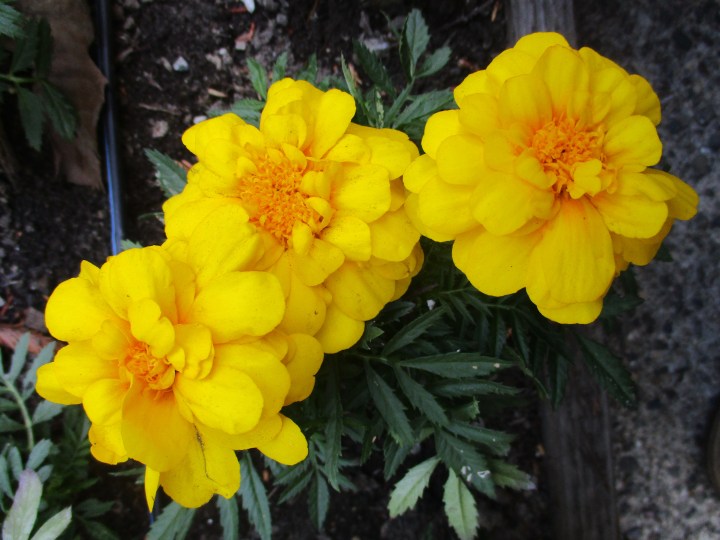 Actually, French marigold, Tagetes patula, is no more French than African marigold is African. All are from Mexico and Guatemala. They were merely popularized and bred respectively in France and Africa. There are now hundreds of varieties. Yet, their color range is surprisingly limited to hues and shades of yellow, orange and ruddy brown. White marigolds are really just very pale yellow.
