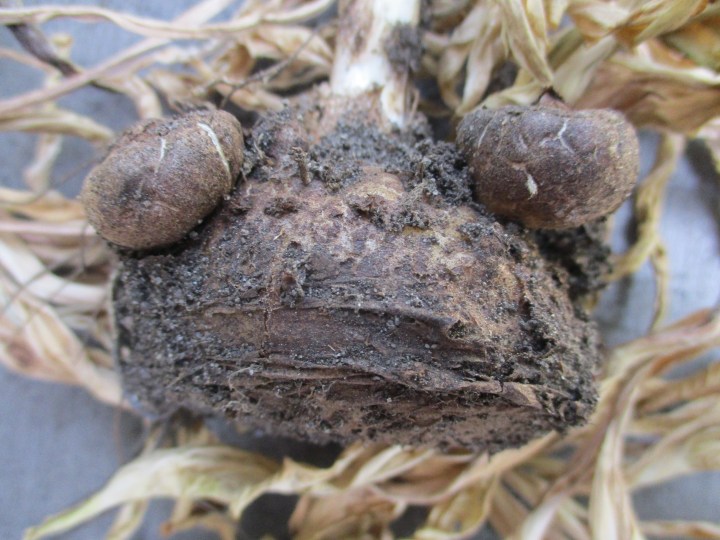
 Wednesday is my day to rant. However, I neglected to get out to find a picture or even a topic to rant about. Instead, I found this ugly little . . . what I believe to be a dormant rhizome. It looks more like a tuber or a tuberous root, and very well could be. Someone at work brought it from his home garden, where countless more naturalized and became aggressively invasive.
I do not know for certain what it is. I only know that it is some species of Arum. We refer to it as the ‘death arum’ because, while in bloom, it smells like death. Yet, it seems to be immune to death. It is extremely resilient. All attempts to eradicate any of it have only angered it, and accelerated its migration into other formerly uninfested parts of the garden. Now we have it here.
I am told that the deciduous rhizomes . . . or whatever they are, remain dormant through summer, and then regenerate foliage once the rain starts in autumn. Their visually unimpressive but olfactorily objectionable flowers bloom by late spring or early summer. Foliage and bloom shrivel in warm summer weather, and the remaining seeded stalks collapse shortly afterward.
The thin rubbery leaves are intricately lobed and spotted, which is very distinct from foliage of other arums. Each thin bloom is comprised of a sickly greenish white spathe and a comparably sickly pale tan or yellowish spadix. Seeds are contained in tiny round fruits that resemble capers, that linger briefly on top of the spotted stalks of faded blooms. It all is as weird as it sounds.
I will can (pot) the rhizome . . . (let’s just leave it at that) before autumn, and see what it does. I certainly do not want to plant it into the ground where it can get established and proliferate. Perhaps I will just grow it as a potted foliar oddity, and snip off floral stalks before they bloom. Perhaps I should send it to my colleague in Los Angeles, three hundred and sixty miles away!
Like many of the genera in the family Araceae, what we know as the death arum exhibits an objectionable floral fragrance because it is pollinated by flies. It does what it must to attract the pollinators whom it relies on. The technique is obviously effective, because seeded fruit develops, and the seed within gets dispersed farther and faster than the rhizomes ( . . . ) can migrate.
 The weather here is excellent for growing all sorts of fruits and vegetables, but is not exactly ideal for bell peppers. Cool nights between warm days are comfortable for us, but limit production of even the healthiest and most robust of plants. Although they like warm nights, the fruit can be sensitive to hot days, and can even get scalded. Bell pepper plants like rich soil and regular watering.
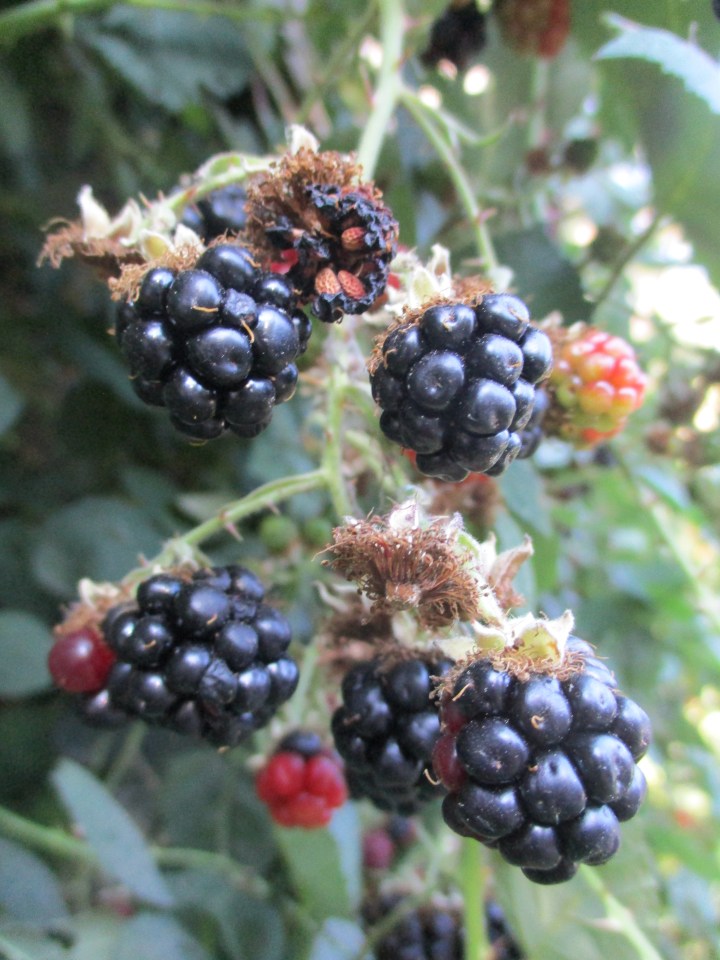 Of all the aggressively invasive exotic species on the West Coast, Himalayan blackberry, Rubus armeniacus, could be the nastiest! It seems to be impossible to kill. It forms dense thickets of wickedly thorny canes that develop roots where they touch the ground. Even if canes are cut to the ground, and the roots are pulled out, new plants regenerate quickly from remaining bits of roots.
 It may not look too nasty, but barberry, Berberis thunbergii, is the sort of small hedge that one goes through only once. It does not have big strong branches to hold anyone back. In fact, the limber branches are quite twiggy. The tiny spines are not impressive either, and might go unnoticed by cursory observation. Yet, they are sharp enough and plentiful enough to make quite an impression!
 From formerly dormant bulbs just below where their foliage shriveled in the warmth of last spring, the naked brown floral stalks of naked lady, Amaryllis belladonna, grow fast to about two feet tall. They bloom suddenly with a few or several garish pink lily flowers about three inches long. They are sneaky about it too. Without foliage, and prior to flashy bloom, the bare stalks are easy to miss.
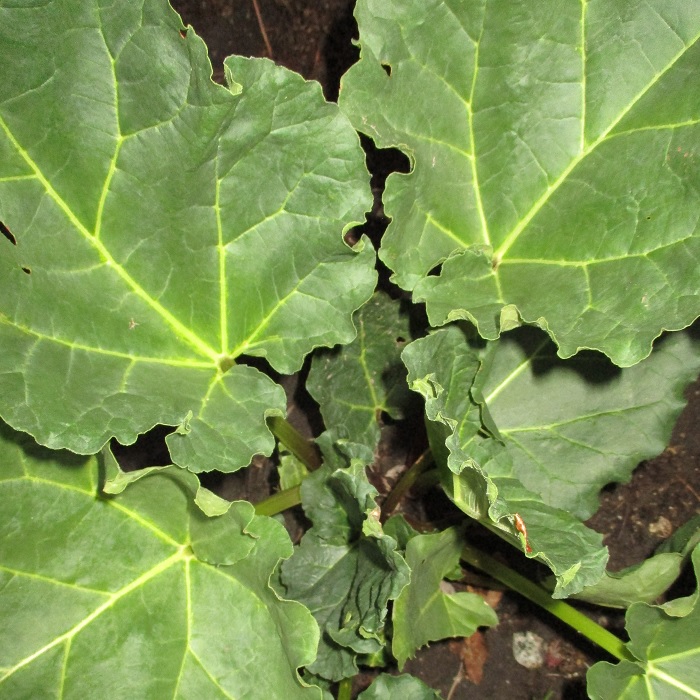 It is not easy to get a pretty picture of rhubarb, Rheum rhabarbarum. The big and sometimes flabby leaves are only impressive to those who know about the succulent petioles (leaf stalks) below. The petioles do not look like much either, until they are cooked into pies or garnet colored preserves. Shabby stalks of tiny flowers rarely bloom, and should get cut out to favor more foliar growth.
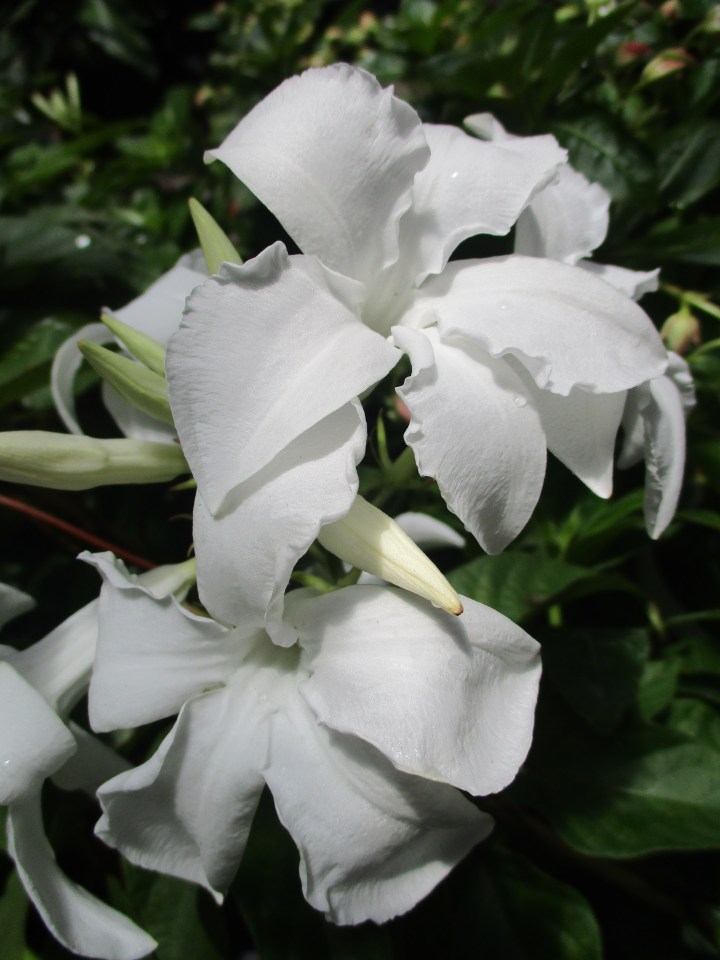 This is not just another mandevilla. Well, maybe it is. Mandevilla laxa is special though. It is known as Chilean jasmine because, unlike other mandevillas, it is so delightfully fragrant, particularly on warm summer evenings. Some say the fragrance is similar to that of gardenia, but not as strong. Others say it has a bit of vanilla mixed in. Sporadic bloom continues through most of summer.
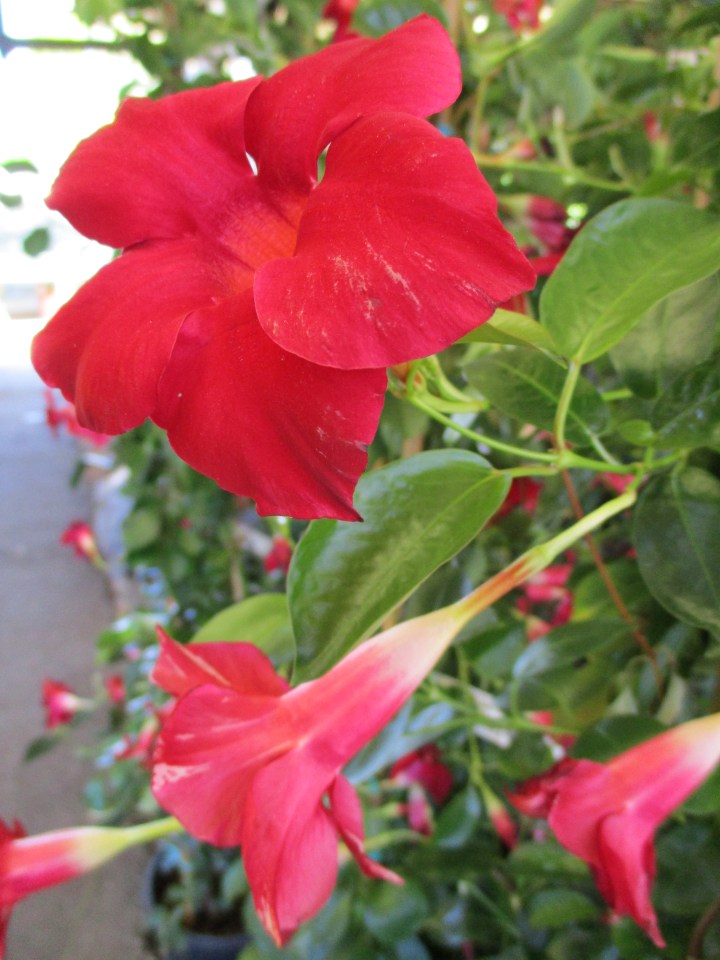 ‘Alice Dupont’ mandevilla that was so popular through the 1980’s was already a cool vigorous but not too overwhelming vine, with big clear pink radial flowers. It grows rather vigorously to upstairs eaves, and tends to get bunched where it reaches the top of its support. Modern cultivars with red, white or bright pink flowers are more compact and tame, and can stay below downstairs eaves.
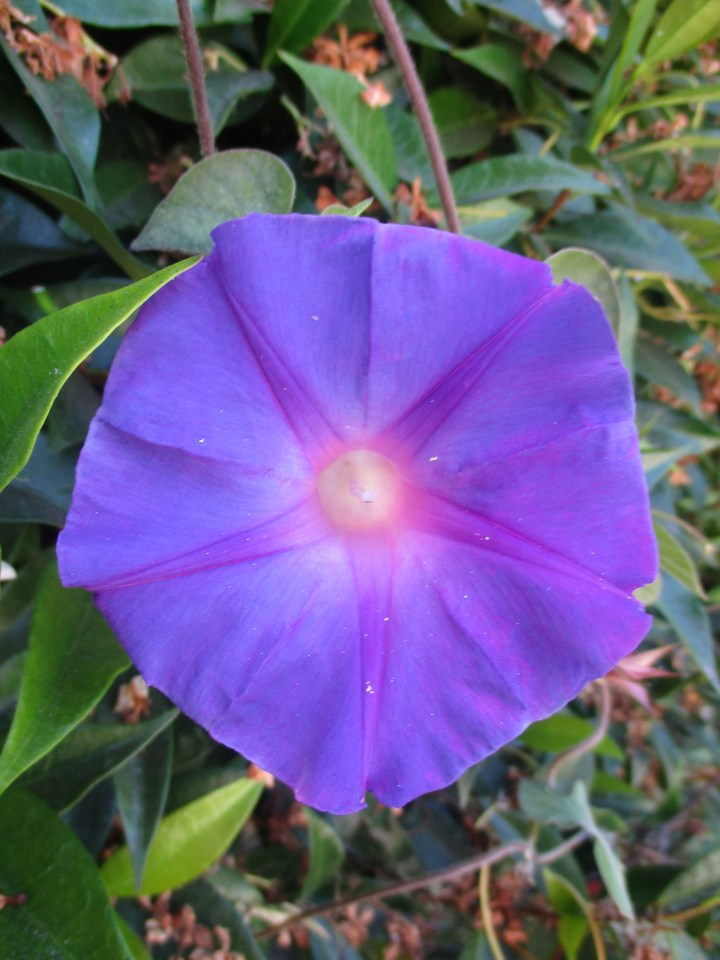 A landscape designer would have more fun describing both the modern and the good old fashioned varieties of morning glory. Their vivid colors are so resplendent. Their rich green foliage is so luxuriant. Their delicate vines are so elegant. Hey, perhaps this is not so difficult. Anyway, the popular garden varieties of morning glory are descendents of various species of the genus Ipomea.
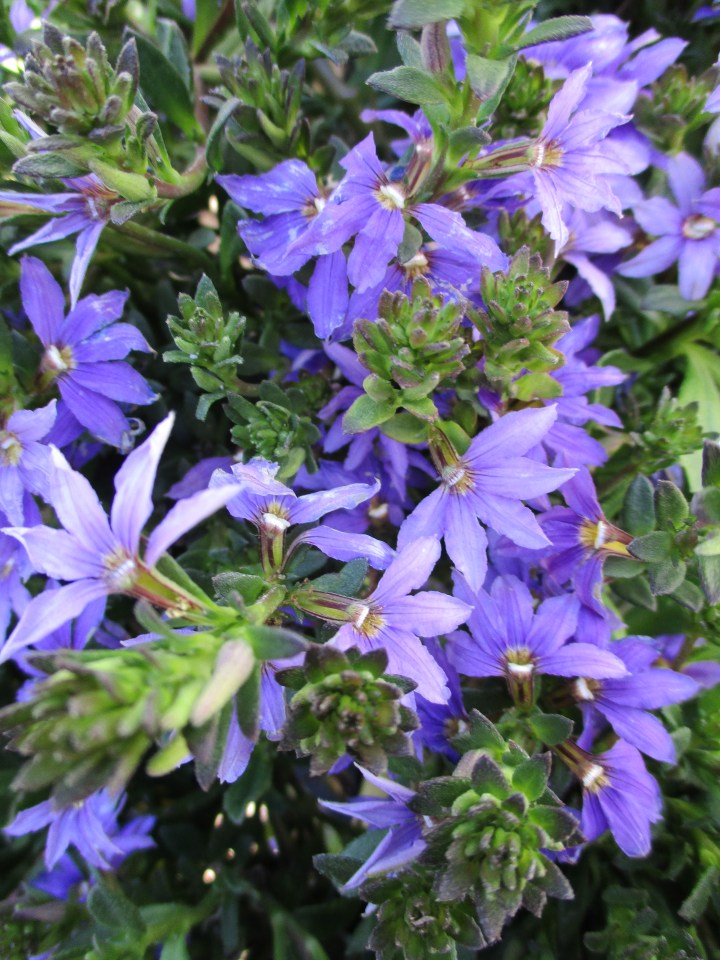 Only a few flowers are true blue. A few more are nearly blue, but slightly blushed with lavender. Of the latter group, fan flower, Scaevola albida, which is usually more lavender than blue, can be quite convincingly blue if conditions are just so. The semi-circular flowers (which are actually wide bilateral flowers) are most abundant in spring and summer, but can bloom sporadically all year.
