 Before I continue, I should mention that I have worked for some of the BEST horticultural professionals in the entire Universe! Seriously! I have worked for the single most excellent nurseryman EVER, and not one, but a FEW of the most excellent arborists EVER! YES, I am bragging! I can write about some of them another time.
I have also worked for some of the worst, including those who were involved with the maintenance of landscapes associated with various residential sites that were in the process of being renovated or demolished and redeveloped at the old Fort Ord. They engaged in more unethical activity at Fort Ord than I can write about in just a few articles. For now, I will just rant about one such incident.
Back in about 2007 or 2008, I was asked to go out to investigated a distressed ‘Marina’ madrone on Abrams Drive. The subject was easy to find because is was the only nearly dead tree within a remarkably uniform row of very healthy ‘Marina’ madrones. It had been too severely ravaged by a severe infestation of aphid to be salvaged. I prescribed removal and replacement with a new specimen of the same cultivar.
I was annoyed that the removal of this single tree would ruin the otherwise perfect uniformity and spacing of the row of trees that had been so well maintained for many years. I was even more annoyed that the people whom I worked with had not noticed that the tree was distressed before it succumbed to the aphid infestation. Aphid is not normally much of a problem for ‘Marina’ madron. It was obvious that the subject had been deteriorating for a few years before it finally succumbed, and would have exhibited very obvious symptoms of distress for at least the previous few months. Someone should have noticed a problem during that time. That is part of what the clients had been paying us significant amounts of money to do.
All that I could do was write my report to recommend removal of the subject so that the client could justify the expense.
The following week, on my way down Abrams Drive to investigate another problem, I noticed that the subject had not yet been removed. However, one of the trees next to it was missing. I stopped to investigate and found a stump with fresh sawdust. I called the project manager, but before I could ask about the missing tree, was informed that the subject had been removed. Well, one can guess what happened. The ‘tree crew’ removed the wrong specimen!
My report was very specific about the location of the subject, and cited the subject’s identification number. Now, even without that information, it should have been EXTREMELY obvious which tree needed to be removed. As I said earlier, I had no problem identifying it as the only nearly dead tree within a very uniform group of very healthy trees. Someone on the crew who removed it, or the project manager who was supposed to ‘manage’ the project, or ANYONE involved with this removal should have noticed that the wrong tree was getting cut down. Even if no one bothered to notice the dead tree that really needed to be cut down, someone . . . ANYONE of the so called ‘horticultural professionals’ should have wondered why such a remarkably healthy tree was being cut down.
So, the ‘tree crew’ returned and cut down the original subject, and actually did so with their second attempt.
Then the two trees needed to be replaced. It sounds simple enough. The problem was that these particular ‘professionals’ knew of only a few trees, and ‘Marina’ madrone was not one of them. They replaced the removed trees with the ubiquitous crape myrtle, which completely ruined the conformity of the otherwise uniform row of ‘Marina’ madrone.
The client was billed for it all.
They payed for the removal and replacement of a tree that they had already payed a significant amount of money for, to be maintained properly so that this sort of thing would not happen.
They payed for the removal and replacement of a tree for no justifiable reason . . . just because NO ONE involved could identify the difference between a healthy tree and a nearly dead tree.
In the end, the client payed a lot of money to get their formerly exemplary trees replaced with the wrong trees.
Nature Is Messy
 This sort of weather pattern does not happen very often. Late spring is normally pleasantly warm, and the weather gets progressively warmer through summer, which typically includes a few unpleasantly warm days. It rarely gets too hot here, and when it does, it does not last for more than a few days, and tends to cool off at least somewhat at night. The air is normally arid. Humidity is uncommon in a chaparral climate.
While so many in the Northern Hemisphere were experiencing unseasonable warmth, the weather here was unusually mild. When the weather became warm, it did so suddenly. There was nothing unusual about the warmth. It was well withing the normal range for this time of year. The suddenness of the change was what made it unusual.
Humidity complicated matters. Again there is nothing too strange about humidity. Although rare, it does sometimes happen. The problem was that it happened at the same time that the weather suddenly changed from pleasantly mild to somewhat warm.
This combination of the weather changing so suddenly from mild and arid to warm and humid caused an outbreak of spontaneous limb failure. It was very evident in Felton Covered Bridge Park, where several trees that experienced it could be observed in the same place.
The most recent victim was the biggest old California sycamore in the area. Half of the top of the canopy broke away and got hung up on an adjacent trunk, but started a cascade of other limbs that broke off more major limbs all the way to the ground. A large cavity that contained a very established beehive was exposed. A car parked below was clobbered (but somehow sustained only minimal damage!). The remaining trunks and limbs of the old sycamore are now even more scarred and disfigured than they were before this happened. The biggest gash is about fifteen feet long! What a mess!
Spontaneous limb failure is technically very damaging to the trees who experience it, but not all of them see it that way. Many of the riparian trees that are so inordinately susceptible to it might use it to their advantage. Fractured limbs that remain attached to the original tree while they sag onto the ground can develop roots where they touch the soil, and develop into new trees. These new trees are more stable at first, but eventually develop structural inadequacies like their parents did, and repeat the process. Willows excel at this technique. Cottonwoods and box elders do it too. Sycamore do it only rarely, but sometimes destabilize and fall over so that some of their limbs can grow into new trees as the original trunks decay. It may not be the sort of behavior that we want in our home gardens or parks, but as far as the trees are concerned, it works.
Six on Saturday: Redwoods
Both coastal and giant redwoods, are the most excellent trees. The giant redwoods are endemic to isolated colonies in the Sierra Nevada. The coastal redwoods are endemic to the coastal region from the Oregon Border to San Luis Obispo County, which happens to include this region.
Coastal redwoods are so awesome that even the dead stumps from trees harvested a century ago are awesome. Most of the stumps in this region have been charred by forest fires. Yet, even after a century, they are still quite solid. They decay very slowly, which is why their timber is such a popular and important building material. Because the stumps are so big and would be difficult to get rid of, not many of us even try.
1. Compared to some of the tacky garden art that some people pay significant money for, this old redwood stump is strikingly sculptural. It stands so proudly out on this knoll on the edge of a small creek just above where it flows into Bean Creek. It is difficult to see in this picture, but a landscaper tried to obscure this stump with potato vine. Only a bit of twiggy growth can be seen at the top of the stump. The rest of the vine is now overwhelming the adjacent dogwood above. The trunk of the dogwood is to the right. Coastal redwood forests are innately shady. The potato vine is not very happy there. Even if it were happy, and were able to obscure the stump, would it really be an improvement? 2. These two bigger stumps are just a short distance uphill and across the small creek. Old stumps are more often single, but surrounded by multiple trunks that emerged from the roots. Because almost all of the trees here had been harvested about a century ago, there are now many more secondary trunks per area than there would naturally be. It is not much of a problem yet, but these trunks will likely become more crowded as they mature.
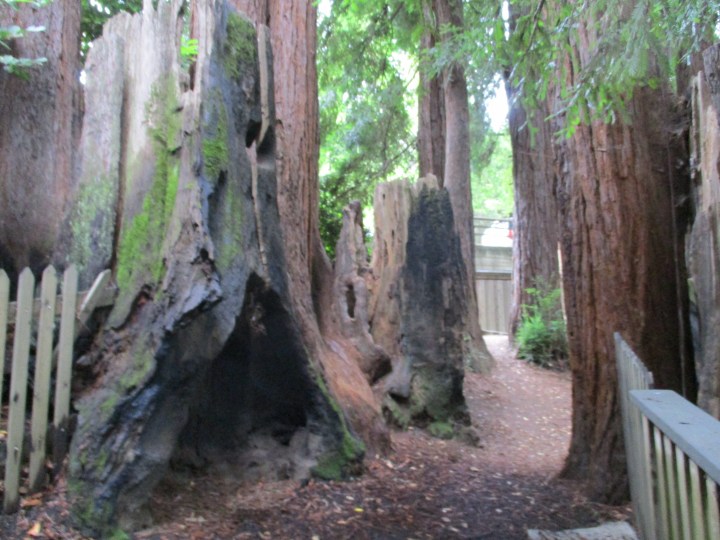 3. These are the same two stumps from the other side. This trunk coming up from within is likely from the same original root system. All trunks that develop from the same root system are genetically identical, so they look very similar from a distance. Some genetically identical groves can be quite broad, and include many trunks.
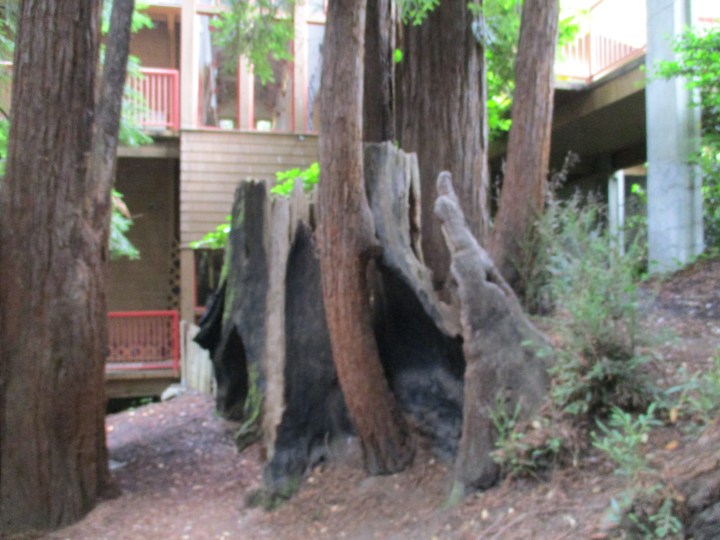 4. This small coastal redwood trunk is not happy about the fence that is nailed to it.
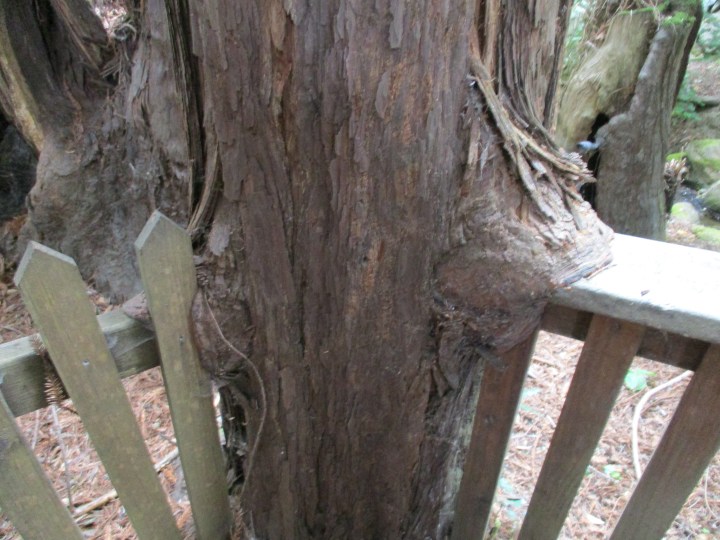 5. This is more what you expect coastal redwoods to look like. It is impossible to determine from this picture if these trunks are genetically identical secondary trees that emerged from the same root system, but their proximity to each other suggests that they likely are.
 6. This epiphyllum is the flower that I promised to those who expressed a concern than my Six on Saturday lacked adequate bloom. I shared a picture of this same epiphyllum earlier, but it has continued to bloom.
This is the link for Six on Saturday, for anyone else who would like to participate:
https://thepropagatorblog.wordpress.com/2017/09/18/six-on-saturday-a-participant-guide/
Palm Treevia
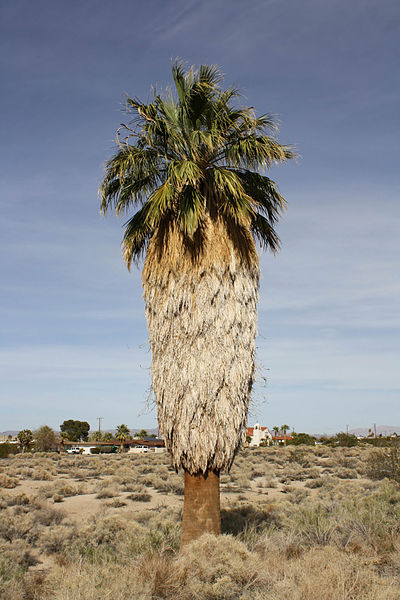
This is a quick trivia question.
Which of these three states has the most native genera of palm?
1. California
2. Hawaii
3. Oklahoma
4. None of the above

This is not a trick question. Notice that it asks about genera rather than species.
1. California is home to many exotic specie and genera of palm; but only ONE is native. The California fan palm, Washingtonia filifera, which is also known as the desert fan palm, lives in isolated groves out in the Mojave Desert. https://tonytomeo.wordpress.com/2018/06/30/oasis/ Because it prefers hot and arid desert climates, and does not like to be watered too generously through summer, it is now a very unpopular palm for landscapes.
2. Hawaii, is populated by many more exotic species and genera of palm than California is, but only species of the ONE genera of Pritchardia are native. Many of the exotic genera were imported by ancient Polynesians to produce food. Others were imported later for landscaping.
3. Oklahoma is the sort of place where only a few of the toughest of exotic palms can survive outside. Yet, McCurtain County, in the very southeastern corner of Oklahoma, is home to ONE very rare but nonetheless native variety of dwarf palmetto, Sabal minor.
4. ‘None of the above’ is the correct answer to the question because none of the other choices above have any more native genera than any of the others.
So, although Hawaii really does have more native species of palm, it has no more native genera than California or even Oklahoma. Each of these three states has exactly ONE native genus of palm.
I am sorry that I have no good pictures of any of these palms. All three of these pictures were obtained online. I have experience with neither the dwarf palmetto of Oklahoma, nor any of the species of Pritchardia of Hawaii. However, the California fan palm happens to be my all time favorite palm, even though it is not very happy here. It is such a stately palm, and those grown from the same seed batches are uniform enough for formal plantings. They are the palms that flank the famous Palm Driveway of the Winchester House in San Jose, as they were popular for flanking driveways and roadways in California and Arizona during the Victorian period. I did happen to see California fan palm in the wild outside of Palm Springs while in school in the late 1980s and can tell you that they are spectacular in their native habitat.

Note: The elderly and deteriorating California fan palms that flanked the Palm Drive of the Winchester House have been replaced with palms that are hybrids of California fan palm, Washingtonia filifera, and Mexican fan palm, Washingtonia robusta. They are more tolerant to the irrigation of the landscape around them.
More Spontaneous Limb Failure

 (This was copied and modified from the Facebook page of Felton League.)
Warm and humid weather is an uncomfortable change for an otherwise mild summer. It also causes spontaneous limb failure among trees, particular those in riparian areas or irrigated landscapes. What sounded like muffled firecrackers was the (slow but steady) fracturing of another cottonwood limb in Felton Covered Bridge Park. (Another incident of spontaneous limb failure was mentioned a few days ago.) (https://tonytomeo.wordpress.com/2018/07/01/spontaneous-limb-failure/) This one was over the picnic area adjacent to the playground. The fallen portion of the limb was less than a foot in diameter, although it was slighter wider than a foot wide where the fracture originated. It fell onto the middle of a group of picnic tables, with the fractured proximal end remaining suspended and attached to the originating tree. Because it remained attached and fractured slowly, the limb did not fall with enough inertia to damage the picnic tables. It was removed very efficiently. (continued)
Cottonwood, sweetgum, coast live oak, valley oak, Chinese elm, California bay, California sycamore, willow and various eucalypti are particularly susceptible to spontaneous limb failure. The oaks and eucalypti are particularly dangerous. Oak limbs are extremely heavy, and tend to break away cleanly and suddenly rather than fall slowly while still attached. Eucalypti limbs likewise break away cleanly, and then fall from great heights without many lower limbs to slow them down. As they start to fracture, Chinese elm and willow limbs might stay attached to the main trunks or the larger limbs from which they originate, which might slow them down somewhat.
Sadly, spontaneous limb failure does more than damage whatever the falling limbs land on. It can also disfigure the affected trees so severely that they must be removed rather than salvaged.
Spontaneous Limb Failure
 It is as scary as it sounds. Well foliated limbs or entire trees really do fall spontaneously during the calmest of warm weather. It never fails to frighten anyone who witnesses it. Those who witness it always express the same difficulty with trying to explain it to those who did not witness it, as if they know that no one will believe them.
Several people heard this cottonwood limb fall onto a bridle path in Felton Covered Bridge Park. It is not a particularly large limb. The diameter about a foot above the flared union is only about seven inches.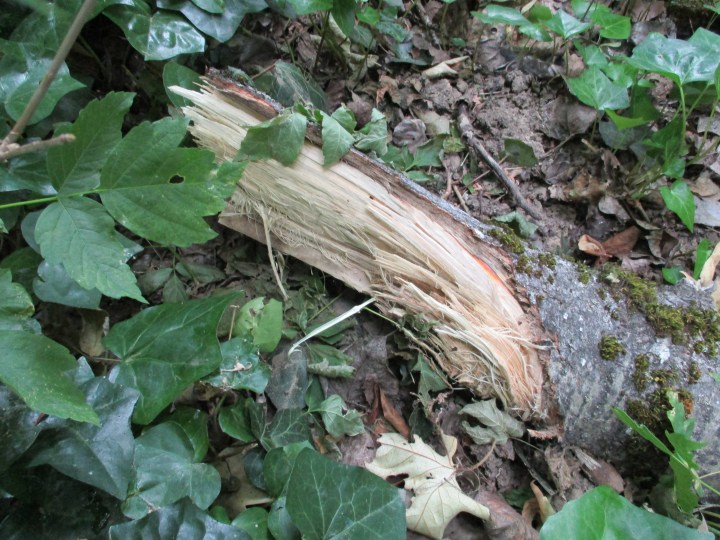
Yet, even this relatively small limb is seriously dangerous when it falls from above, and from such a height.
A much larger sycamore limb that was almost two feet in diameter fell nearby a few years ago. It was like a full sized tree falling from the sky!
What makes it so frightening is the spontaneity. We expect limbs to break when the wind is blowing. Trees are more likely to fall when the soil is saturated from an abundance of rain. Dynamic weather like wind, rain and snow are expected to be the cause of limb or tree failure. Passive weather like warmth and humidity seem like they should be innocent of causing such damage. Not so.
Warmth accelerates vascular activity, which increases the weight of healthy foliage.
Humidity inhibits evapotranspiration (evaporation from foliar surfaces) that would otherwise decrease the increasing foliar weight.
Breezes that are normally thought of as a cause of limb failure would actually enhance evapotranspiration. Therefore, a lack of any breeze actually increases the potential for spontaneous limb failure.
So, while the weather is warm, humid and still, just when you least expect it, spontaneous limb failure is most likely to happen.
Beech
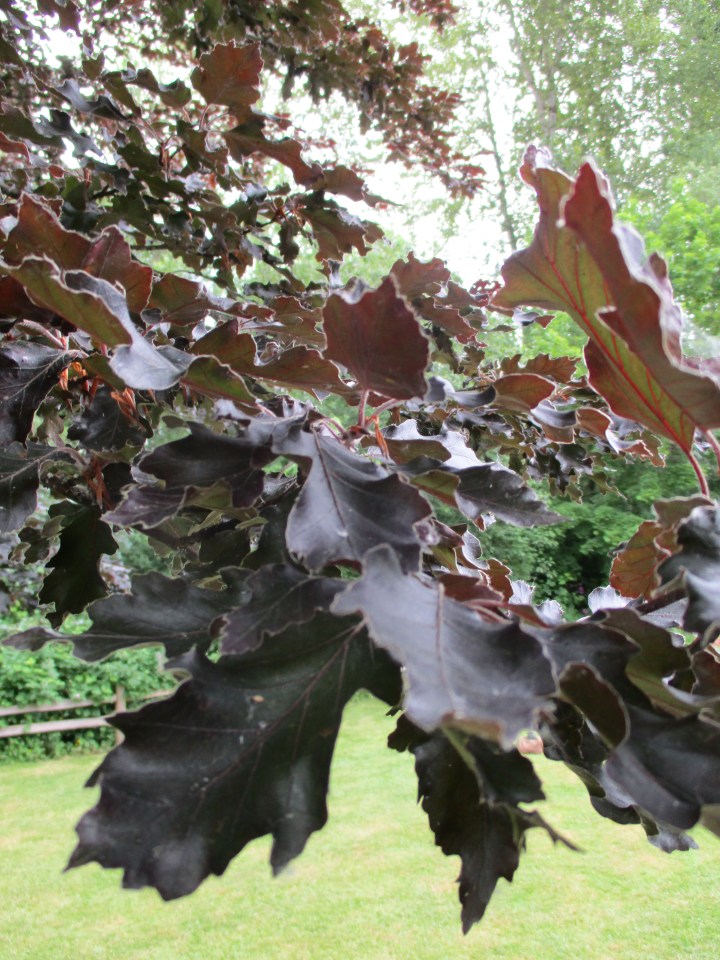 Compared to crape myrtle, sycamore (London plane) and many other more popular trees, the beech, Fagus sylvatica, is much less problematic, and really deserves more respect. Although it can eventually get almost as big as sycamore, it has remarkably complaisant roots. It is neatly deciduous, defoliating only in autumn, without noticeable floral mess. Disease and pests are rare.
Beech is probably unpopular with landscapers because new trees are a bit more demanding than other tree specie are. (Landscapers prefer easier trees.) Until they disperse their roots, they are more likely to desiccate if they do not get watered regularly enough, and more likely to rot if watered too much. They grow somewhat slowly, so need to be pruned more carefully for a high canopy.
Those of us who tend our own gardens do not mind the extra effort for such a distinctive tree. The handsome foliage can be rich green, coppery bronze, darkly purplish or variegated with white or pink that fades to white. A cultivar with sunny yellow new foliage fades to green by summer. Most beeches have spreading branch structure, but some are strictly vertical or sculpturally pendulous.
Horridculture – Stub
 How can a professional ‘gardener’ leave such a stub on the little California black oak in Felton Covered Bridge Park. It is not as if it is high in the canopy of a large tree, and out of reach to an arborist. This one is right at eye level, exactly where someone getting out of a car parked in the adjacent parking space would run into it. The entire tree needs some major corrective pruning, which would include the removal of significant limbs and portions of the canopy, but that is only because of years of neglect, and is another story. Right now, we are focusing on the eye-level stub.
It is not easy to see in these pictures because the lower branches are so congested. The stub extends from the lower left to the upper right in the first picture. It is right in the center of the second picture, protruding upward and to the left of the trunk, and then kinking back to the right. The last picture shows how easy it would be to reach from the ground. This particular tree is located right across from the Memorial Tree. https://tonytomeo.wordpress.com/2018/04/15/memorial-tree-update-to-the-updated-update-etc-the-sequel-to-all-those-other-sequels/
We are always taught to not leave stubs. They interfere with compartmentalization of the pruning wound, or in this case, grow back into a disfigured wad of useless growth that will just need to be removed later. This poor tree already has plenty structural problems. Even if it were not unhealthy for the tree, it is just plain unsightly. Seriously, this looks ridiculous.
‘Gardeners’ do it all the time, as if they all take the same class on ‘how to leave stubs’. What was the advantage to cutting the limb right there instead of two feet closer to the trunk to eliminate the entire stub?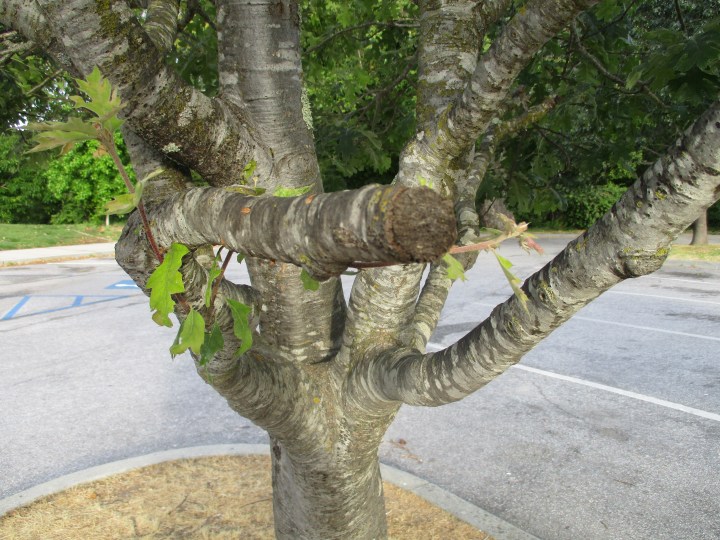

Horridculture – Satellite Dish

Satellite dishes, tater tots, fish sticks, soldiers, flat tops, gobstoppers, corks, oil tanks and trip hazards are just some of the many but less objectionable names that my colleague down south and I have developed for what should be good shrubbery, trees, vines or whatever that so-called gardeners got to with their hedge shears. Tater tots are usually Heavenly bamboo shorn into stout cylinders. Fish sticks are the same, but taller, narrower, and often composed of Podocarpus macrophyllus. Corks are commonly breath of Heaven, but could be just about anything shorn to be somewhat cylindrical, but narrower down low, and wider on top. Trip hazards are ground cover plants like creeping California lilac or creeping cotoneaster, shorn into absurd low hedges next to sidewalks. Gobstoppers could be just about anything, but tend to hang over the curbs in parking lots, ready to impale a radiator grill with a gnarly stub. You can use your imagination for soldiers, flat tops and oil tanks. You probably can not conceive anything more absurd than what my colleague and I see on our job sites.
‘Garage sales’ are probably the worst. They are a variety of plants that were probably intended to function as a practical landscape, but instead got shorn collectively into a large thicket of mixed foliage that rarely gets the chance to bloom. Bougainvillea, New Zealand flax, jade plant, pampas grass, wisteria, fruit trees and even the occasional century plant; anything goes! If the so-called gardeners can reach it, they will shear it.
The original satellite dish was a carob tree in Westchester. I first saw it in the early 1990s, when some homes that had a bit of space to spare were still outfitted with huge parabolic satellite dishes, before the much smaller ones that can be mounted on roofs were invented. This tree had a normal trunk that went up into a remarkably flat ceiling under which no foliage was allowed to hang. This ceiling was only about seven feet above the lawn below. Above that, there was a remarkably symmetrical but low dome of very tightly shorn foliage that looked something like a downward facing satellite dish. This dome was perhaps twenty feet wide, but less than four feet from top to bottom. So, with seven feet of clearance above the lawn, the entire tree was no more than twelve feet tall, barely higher than the eaves of the home behind it. I really wish I had a picture to share. Who puts so much work into ruining a tree?! Maintaining it properly would have been much less effort.
Earlier, we discussed renovating overgrown shrubbery as small trees. https://tonytomeo.wordpress.com/2018/05/21/overgrown-shrubbery-becomes-small-trees/ . The satellite dish was the exact opposite of such useful procedures. What is the point of planting trees and then not allowing them to develop as anything more than abused shrubbery?
The pair of satellite dishes in the picture above are Japanese maples. Their canopies are about the same depth as that of the carob tree in Westchester, but are only about half as broad. What is the point of planting Japanese maples if they are not allowed to look like Japanese maples? They look ridiculous. What is worse is that someone puts significant effort into making them look so ridiculous. They would be so much prettier if pruned only very rarely, and only for clearance above the driveway and away from the building behind. Such pruning would have been less work than shearing these disgraced trees just once.
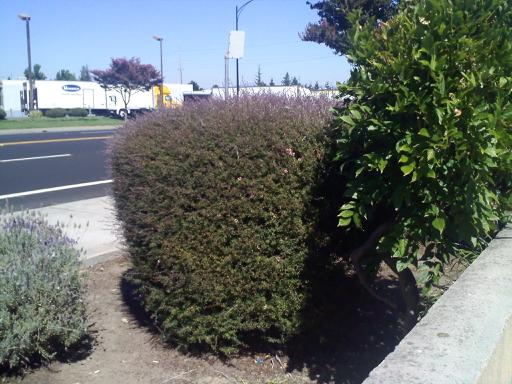
Even more effort goes into humiliating the plants in the picture below. The fish stick to the upper right is a wisteria vine that is not allowed to bloom or climb onto the trellis that was built for it (which is not visible in the picture). The trip hazard to the lower left is some sort of lavender that is not allowed to spread out over the bare soil as it was intended to do. The cork in the middle is a New Zealand tea tree that can never develop the gracefully irregular canopy and sculptural trunks that it would be pleased to display. It is just a cork.
Memorial Day
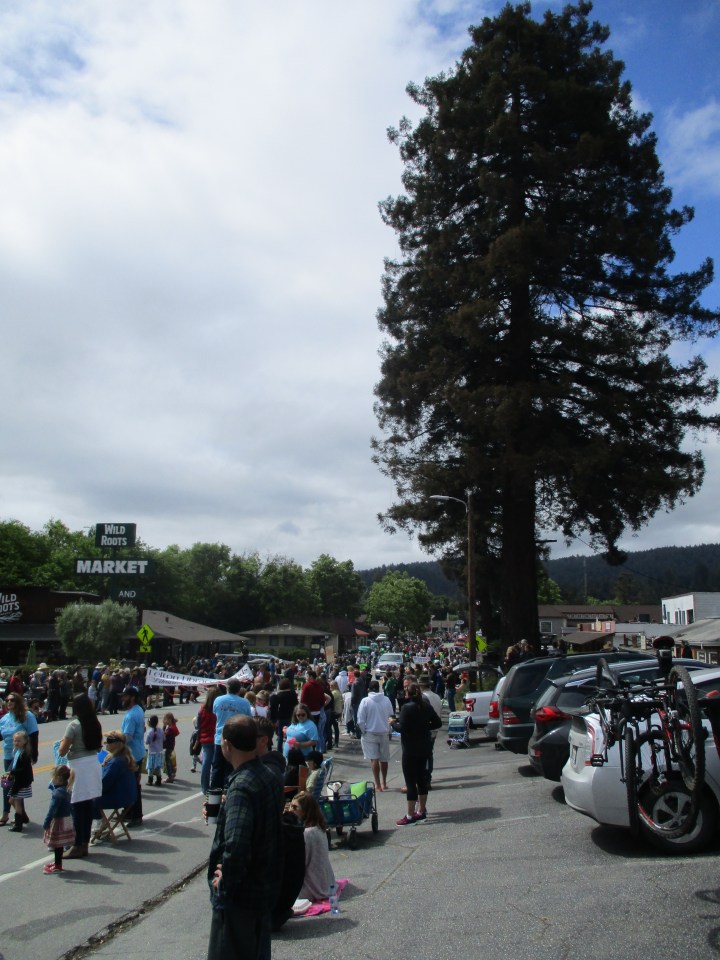
Tomorrow is Memorial Day. Yesterday was the Felton Remembers Parade and Covered Bridge Festival, which is how Memorial Day is celebrated in Felton. It was a celebration worthy of Memorial Day, with plenty of music, crafts and expensive but unhealthful food to go with it. All that was lacking was that which is ‘memorial’. It seems that we have forgotten about that which we should never forget.
There were plenty of classic cars to provide memories of how stylish cars had been. There was a Boy Scout Troop to conduct the Flag Raising Ceremony at the main interchange of Highway 9 and Felton Empire Road to provide memories of when we still respected the American Flag and traditions associated with it. We were reminded of who our local politician are, and that we are still procuring funds for a new library, and that there are too many clubs for hateful women, and that the individual members of the motorcycle club get more done around here than everyone else combined (except for our local District Supervisor who provides the memories of what a public servant used to be.)
Felton Covered Bridge Park, the venue of the Covered Bridge Festival, is surrounded by memorial trees. All the redwood trees (which are of the cultivar ‘Soquel’, rather than wild trees) are memorial trees, sponsored by friends and families of the honored deceased. Some are outfitted with plaques. One was recently added. Another sweetgum tree is a memorial for Charlie, a very respected English bulldog. The small valley oak in an island in the parking lot is known simply as the Memorial Tree, to commemorate several who did not get their own tree. All the trees were there for the festivities, but only to provide shade and beauty.
Perhaps celebration is the best Memorial, or at least the best that such a large group can collectively participate in. Actually, the Covered Bridge Festival was exactly that, a ‘festival’ that merely coincided with the Felton Remembers Parade. It was not really a Memorial by design.
The big old Featherstone Tree at the center of town, and in the picture of the Felton Remembers Parade above, is not really a memorial tree, but does happen to be outfitted with a commemorative plaque for Mr. Featherstone who planted it, and has witnessed more parades on Highway 9 than anyone has.
https://tonytomeo.wordpress.com/2017/10/05/big-tree-in-a-small-town/
The little Memorial Tree in Felton Covered Bridge Park, and in the picture below, was easier to ignore in the parking lot behind the mobile kitchens. I have written a few articles about it, beginning with this one –
https://tonytomeo.wordpress.com/2017/10/06/small-tree-in-a-big-park/
and most recently this one –
https://tonytomeo.wordpress.com/2018/05/02/may-2/

 Tony Tomeo