 We are now two days into it. Is it any different than three days ago, the last day of autumn? Not really. Even in harsher climates, the changes from one season to the next are gradual. Like the phases of the moon, the seasons are constantly phasing out of the previous, and into the next. The dates of the first and last days of each season, which are determined by the position of the Earth within its orbit around the sun, are technicalities.
Seasons in the Southern Hemisphere are of course opposite of what they are here. That seems odd to me. The calendar is the same there as here. It seems obvious to me that winter and all seasons should be determined by the same dates there that they are determined by here. If winter began last Friday here, it should have done the same there, on the the same date. Longer days and warmer weather are consequences of location, south of the Equator. It is hard to imagine that January and February are summer there.
It also seems odd to me that all maps are oriented with North directed towards the top. Shouldn’t South be at the top South of the Equator? Must Australia be the ‘land down under’ to those who live there? Things would be so much simpler if Columbus has just stayed home, and the World was still flat.
Anyway, we do not get much winter here. The weather gets a bit cooler, and we will eventually get more rain. When I went to Oklahoma six years ago, I thought that I would finally get to experience a real winter, but we left just before New Year’s Day, while the weather was still somewhat mild. This little bit of snow was about all we got.
Red Sky At Morning
 Red sky at morning; sailor take warning. Stormy weather is to be expected.
Back before modern meteorology, there were all sorts of ways to predict the weather. Some of the ways to know what to expect in the short term were obvious, such as simply observing what was happening off in the distance in the direction from which the weather comes. For the experienced, it is easy enough to feel changes in humidity and temperature in an incoming breeze.
Halos around the moon or sun, as well as the color of the sky at sunrise, provided a bit of insight about what could be expected a bit farther out than the short term. Some techniques were not always accurate, and some were not accurate at all.
Flora and fauna are better at predicting the weather than we are. Horses, dogs and cats get extra fluffy if they expect the winter weather to be colder than it normally is, and they shed early if they expect an unusually warm summer. Sycamore trees are so responsive to the weather that what they are saying about it is not always obvious. Are they browning and defoliating just because the weather got too hot and arid late in summer, or because autumn is going to be extra cool? Experts could tell, but because of modern meteorology, there are not many experts left here.
This red sky over Mount Hermon occurred at sunrise last Sunday, just prior to the storm that finished early Monday morning, and provide picture #6 for my earlier Six on Saturday post. I tried to avoid the streetlamp at the bottom of the right edge. I did not see the bird when I took the picture. The tree to the left is a golden honeylocust.
Six on Saturday: Rain On My Parade
Actually, this rain ‘is’ the parade. In parts of California, we do not get much of it, so when rain happens, it is worth celebrating. Although this side of the Santa Cruz Mountains gets significantly more rainfall than the chaparral on the other side in the Santa Clara Valley, there are not many more rainy days here. What that means is that when it rains here, it does so with more volume than in the Santa Clara Valley.
Rain is not easy to get pictures of. The first four picture just show water from one of our first major storms of the season. The fifth pictures does not even show that much. The sixth picture is from the most recent storm that came through Sunday night and finished on Monday morning.
1. This waterfall was flowing both through and over the deteriorated and also clogged gutter on the roof of the shop building across the driveway from the gardening shop at work. The gutter is so deteriorated that I would have expected all of the water to just flow through it. Incidentally, the big roll-up door to the lower left of the picture happens to be that of the plumbing shop.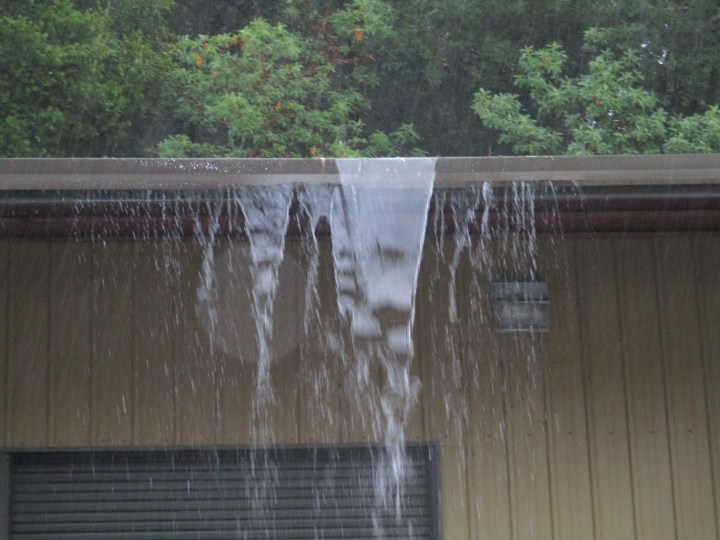
2. This waterfall was flowing through a storm drain on the Mount Hermon Road bridge over Zayante Creek, East Zayante Road, and the railroad tracks in between them.. This section of Mount Hermon Road is known to some as ‘the Bypass’ because it bypassed the older Conference Drive in picture #5. What is not visible in this picture is that the upper part of the waterfall lands in the ditch on the side of East Zayante Road below. It might have seemed like a good idea when the bridge was built, but so much water falls from so high up that it erodes the ditch, and splatters gravel onto cars driving by. The lower part of the waterfall flows into a ditch on the edge of the railroad tracks, and then under the tracks towards picture #3 below.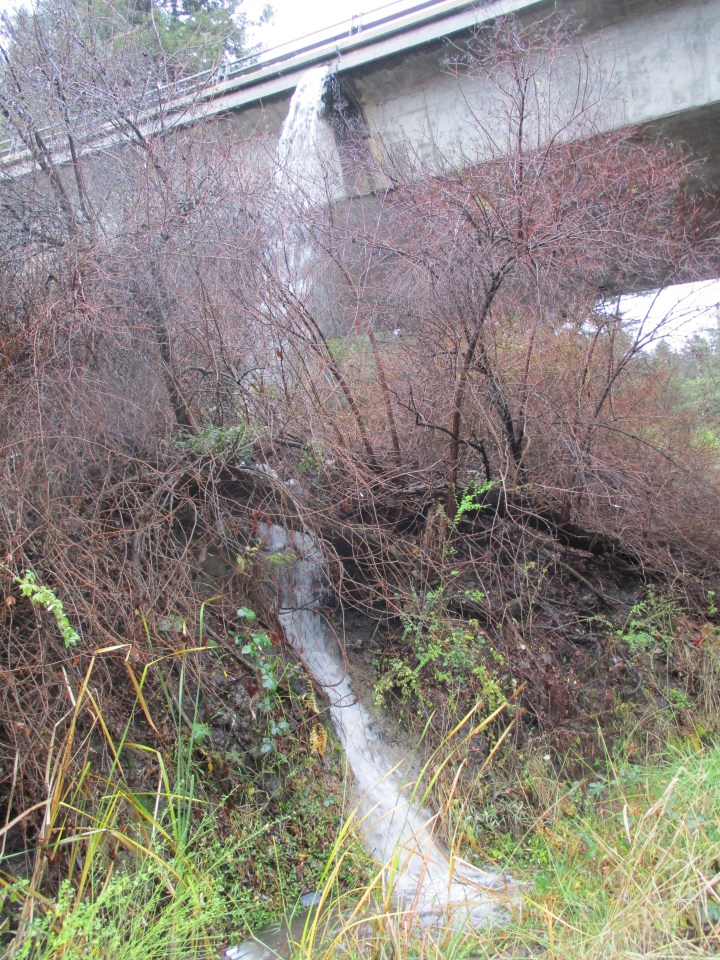
3. This waterfall was flowing out into Zayante Creek from a culvert just downhill from the culvert under the railroad tracks mentioned in #2 above. It is the same water that was falling from the Mount Hermon Road bridge.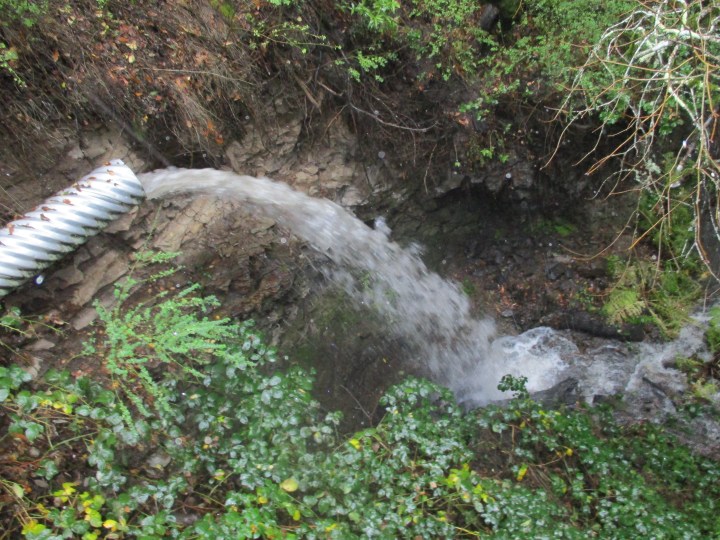
4. These two waterfalls were flowing from the roofs of the local supermarket and adjacent drug store and pharmacy, and onto the newsstand below. What is disturbing about this picture is these drains are merely back up drains that do not allow the flat roofs surrounded by parapet walls to fill with too much water if the main drains get clogged. The main drains are likely at the rear of the building where they can drain discretely and out of the way. These back up drains are on the front of the building so that they get noticed if they start to flow. All this water flowing out of them indicates that the main drains are clogged, and that the roofs are flooded.
5. This is the Conference Drive bridge over Zayante Creek, East Zayante Road, and the railroad tracks in between them. It is the bridge that was bypassed by the Mount Hermon Road bridge in picture #2. The big greenwaste pile where I dump debris from the landscapes is directly below the southern edge of this bridge, which is to the left in this picture. You can not see it in this picture that was taken before the rain started, but a bit of water drains from this bridge onto the greenwaste pile. It is not much, but it is enough to be a bother when I am unloading debris in the rain. It falls from so high up, that even if I am avoiding the spot where the falling water lands, the wind can blow it all over me. From that height, any bit of road gravel that falls with it can give me quite a sting.
6. The most recent storm finished early Monday morning, after dropping two and a half inches of rain.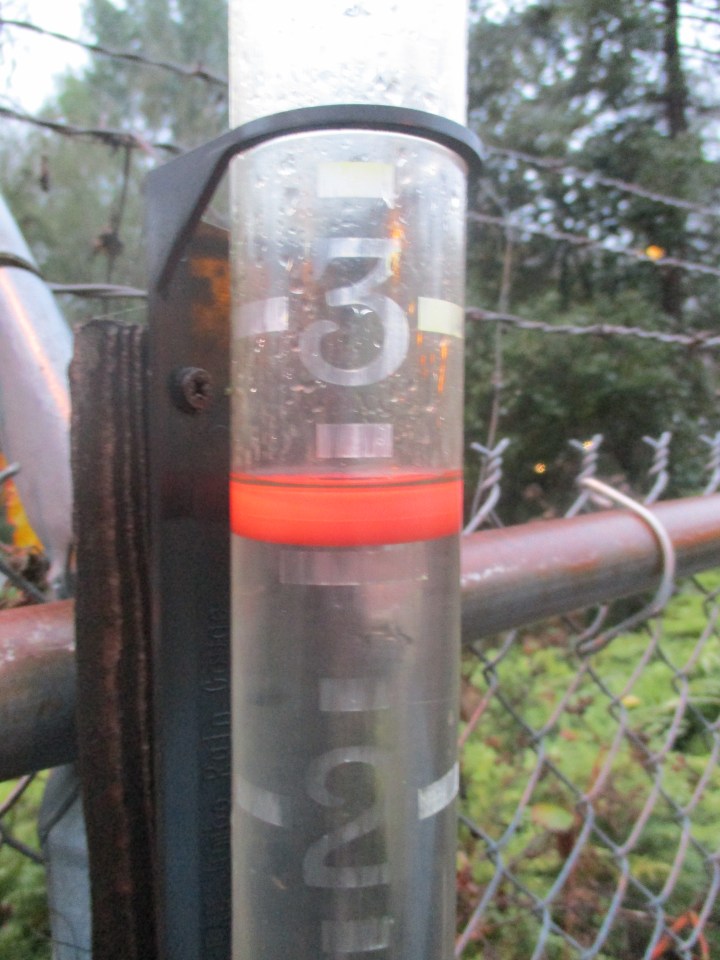
This is the link for Six on Saturday, for anyone else who would like to participate:
https://thepropagatorblog.wordpress.com/2017/09/18/six-on-saturday-a-participant-guide/
Horridculture – Three Is A Magic Number
 We learned it young from Schoolhouse Rock. Those of us who studied Landscape Design were compelled to learn why, and assume that it is always true.
Well, I am not a landscape designer. I am just a horticulturist and arborist. I can see why three is the best number for groups of trees, and that five is probably the second best option for larger groups, followed by seven, and then nine, and so on. I sort of understand why two, four, six, eight and so on are not so desirable. However, these rules are not absolute.
When I was a kid, many suburban front yards were outfitted with three European white birch trees. Such groups were typically in a corner of the rectangular yards, just outside of the curvacious mowing strips that were designed to make the rectangular spaces seem to be more irregular than they really were. Individually, the groups of three birches were appealing. Collectively, they were cliché. They were supposed to look more ‘natural’; but there is nothing natural about contrived groups of three trees, especially when it is so prevalent. That is not how they grow in forests.
Now, although I am no landscape designer, I do happen to know that good landscape design is compatible with the architecture of the building that it is associated with.
Early American architecture really should be landscaped in the Early American style. This might seem to be simple, just because Early American landscapes are simple and utilitarian, with most of the plant material at a safe distance from the buildings. The difficulty is that such landscapes are very symmetrical, with paired shrubbery and trees, and several paired and evenly spaced trees flanking roadways. The left matches the right. That means quite a bit of twos, fours, sixes, eights and so on. Early American landscape design developed at a time when nature was something to be dominated and utilized in the most efficient manner possible. Not many landscape designers comprehend this philosophy, or would adapt to it if they did understand.
The group of three dwarf Alberta spruce in the picture below was not intended to be a rebellious expression of formality. As you can see, it really is a group of three. Yet, they are also evenly spaced in a straight row that parallels the adjacent wall. Without pruning, they will always be very symmetrically conical. Cool!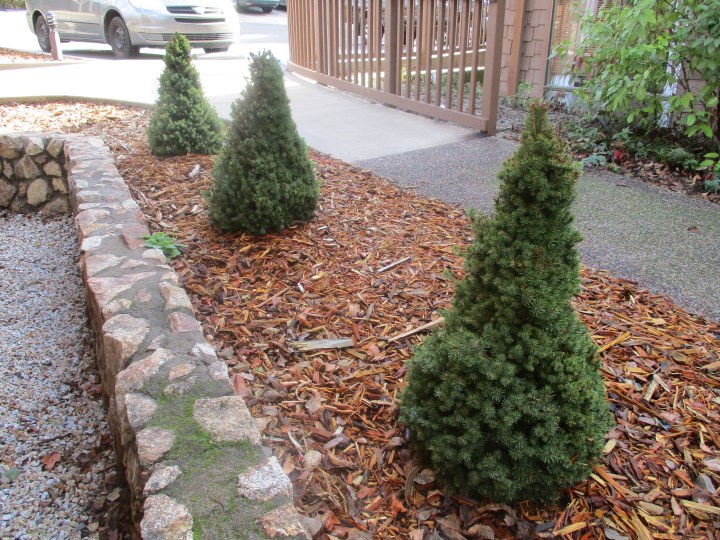
Tannenbaum
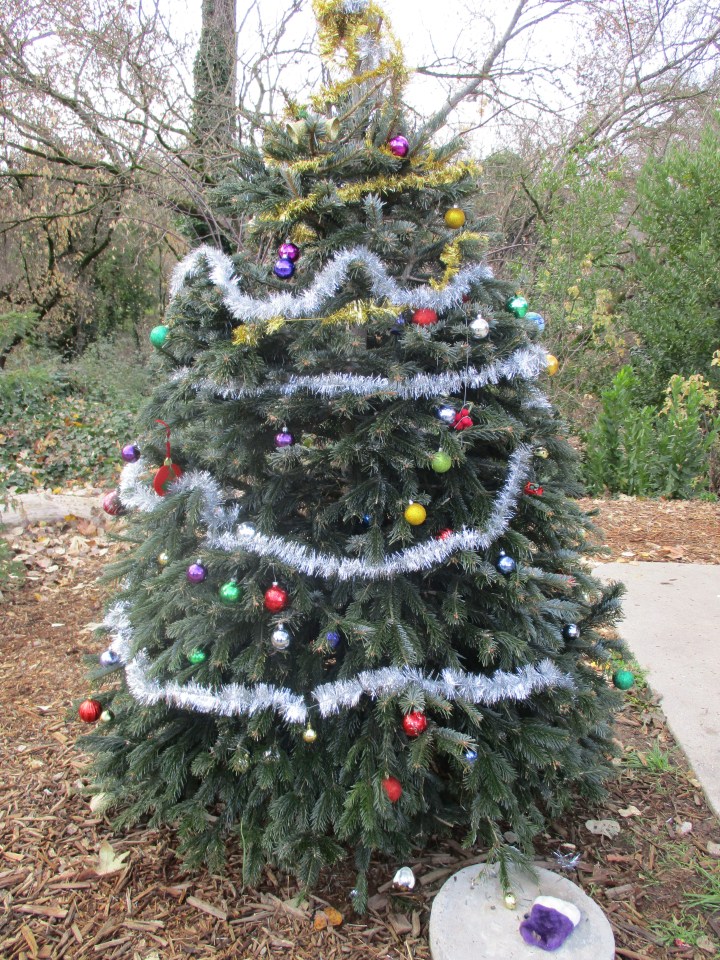 Many towns display a Town Christmas Tree in a prominent and centrally located public space.
The Town Christmas Tree in Los Gatos is a now mature but formerly feral deodar cedar that grew by chance next to the railroad tracks where they passed through downtown a very long time ago. As the railroad tracks were removed, and the rail yard was redeveloped into the Town Plaza, the maturing cedar tree survived the process to become the most prominent tree there. Because it just happened to be a symmetrically conical coniferous tree in the most prominent spot in town, it was a natural choice for the Town Christmas Tree. It gets lit up and decorated for Christmas, and is where children can meet up with Santa Claus.
The Town Christmas Tree in Felton is the Featherstone Tree, which is a mature coastal redwood tree that happened to be planted right on the edge of Highway 9 a very long time ago by Mr. Featherstone, simply because he admired the species so much, https://tonytomeo.com/2017/10/05/big-tree-in-a-small-town/ . Like the Town Christmas Tree of Los Gatos, it just happened to develop into the right sort of tree in the right spot to become the Town Christmas Tree. It too gets lit up and decorated, although it is not as conical as it used to be.
Last year, someone delivered a decorated cut Christmas tree to a picnic area in Felton Covered Bridge Park, where many of the Homeless Community congregate. No one knows who delivered it, or how he, she or they did so undetected. It was a rather fancy tannenbaum (fir) that was not cheap. Someone or a few someones put quite a bit of effort and expense into this unusual gesture, to share a bit of joy with others in the Community.
It was not like a Town Christmas Tree for the Homeless Community, as if the Homeless Community is somehow separate from the rest of Felton. It was more like a household Christmas tree for those who lack a house to live in. It certainly made the annual Christmas Luncheon for the Homeless Community there at the picnic area much homier.
Bar’berry’
 Just last Saturday, in the first of my two ‘Six on Saturday’ posts, I mentioned that I had never before seen the berries of barberry. https://tonytomeo.com/2018/12/08/six-on-saturday-too-much-autumn-color-iii-cherries-berries-plums-apples-ginkgo/ Well, just a few days afterward, which was also a few days ago, while getting pictures for the English hawthorn that will be featured on Tuesday, in the same mostly brutalized landscape that I happened to mention in a post last Wednesday, https://tonytomeo.com/2018/12/12/horridculture-disdain-for-bloom/ , I noticed that the barberry shrubs were adorned with these odd red berries. They were quite tiny, not much bigger than grains of white rice. Nonetheless, they were the berries that I had never before seen. Now I know that barberry really does produce berries.
I had heard that such berries had medicinal and culinary application, but because I had never seen the berries before, I believed that the fruit was obtained from other specie. Perhaps the barberries that I am familiar with in landscape situations produce less fruit or no fruit at all because they are sterile interspecific hybrids. Perhaps they rely on specific pollinators who are not endemic here. I never bothered to investigate the lack of berries.
Now that I found a source for the berries, I sort of want to try them. However, they are tiny, and suspended among those wiry and famously thorny stems. Those in this picture are probably all gone by now anyway. Little birds have no problem with the thorns. Besides, even if I got a few, I would not know what to do with them. They can supposedly be used as a flavoring, and taste something like tart citrus. Well, at least I know where to find them if I want to try next year, if the so-called ‘gardeners’ who just ruined the flowering crabapples do not destroy them first.
Six on Saturday: Deodar Cedar Migration
Deodar cedars that were featured in the gardening column about two weeks ago, https://tonytomeo.com/2018/11/27/deodar-cedar/ , live in a small grove adjacent to a building that I work out of. They need a bit of pruning for clearance from the roof, but are otherwise rather nice and healthy specimens.
They are also prolific. Quite a herd of seedlings is developing on the ground below. None of the individual seedlings are more than just a few years old, which suggests that the area was cleared of seedlings a few years ago. The area needs to be cleared of seedlings again, before they grow big enough to become a messy thicket.
Part of another landscape in another area happened to be in need of a few deodar cedars. There were two established specimens there already. They suit the situation so well that more are desired. However, new trees are expensive, and because there is no irrigation system in that particular site, they would need to be watered very regularly by hose until they get established.
Well, you can guess what happened. We pulled up several of the seedlings that needed to be pulled up anyway, and simply plugged them into the site where more deodar cedars are desired. It was done just prior to rain, so the relocated seedlings did not even need to be soaked in. They were pruned so that they would not desiccate so readily. We planted way more than necessary because there were plenty to spare, and also because we expect that several will not survive the process. We also expect that we will likely need to cut down a few later because, although some will not survive, too many probably will. Because they are just tiny seedlings, they will get established more efficiently than canned nursery stock, and will not be so sensitive to lapses of irrigation.
Although way more than necessary were relocated, they were not even a quarter of what was available in the original herd. More than three quarters of the herd remain available to be planted elsewhere. More will likely be relocated to other parts of other landscapes before the rainy season is half way finished. A few will be canned and put into the nursery. Whatever we do to them should be done in the early part of the rainy season to take advantage of the weather while they get established. We prefer to relocate the larger seedlings first, so that those that remain will be the smaller seedlings that will take longer to get too big to move if they must wait until next year to be relocated.
This is actually old technology, and how tree seedlings were pulled and plugged to enhance the production of woodlots since ancient history. While undesirable seedlings were pulled and discarded, more desirable seedlings that happened to be crowded around the parent trees were pulled up and plugged in more uniformly over a larger area.
1. seedlings in the ground below the parent trees
2. parent trees
3. bundle of seedlings
4. unpruned seedling
5. same seedling pruned
6. seedling in new location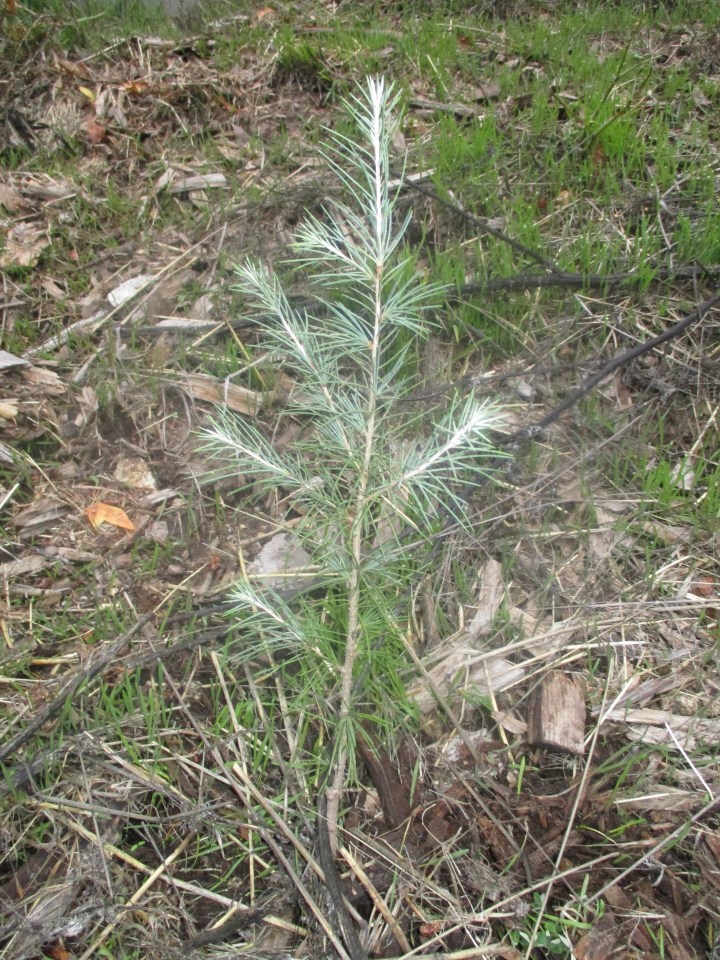
This is the link for Six on Saturday, for anyone else who would like to participate:
https://thepropagatorblog.wordpress.com/2017/09/18/six-on-saturday-a-participant-guide/
Horridculture – Disdain For Bloom
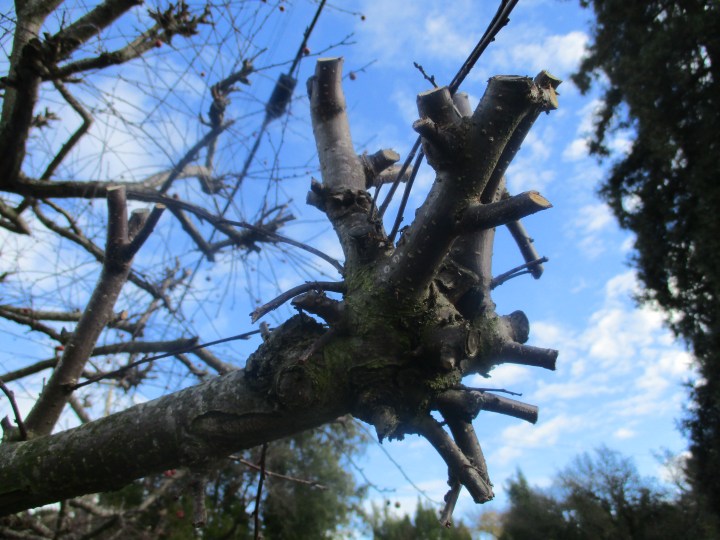 From the same landscape that, last autumn, was so dutifully deprived of its elegantly cascading rosemary and soon to be fiery autumn color of Boston ivy, https://tonytomeo.com/2017/11/05/serously/ , I procured these disturbing images of what results from of a serious disdain for flowering crabapple bloom. These trees were mentioned earlier in that article, but without such images. Similar victims were discussed last spring, https://tonytomeo.com/2018/03/07/the-good-the-bad-and-theyre-both-ugly/ and about a year ago https://tonytomeo.com/2017/12/06/sculpture/ .
The landscape where these trees live was actually rather well designed, and for a few years, had been well maintained. Seriously! The flowering crabapples were likely selected because they would not get tall enough to encroach into the utility easement above. There were pruned as much as necessary to prevent them from developing into a nasty thicket like young flowering crabapples typically do, but without significantly compromising the spectacular bloom. They really were spectacular!
About six years ago, a different crew of ‘gardeners’ was hired. It was obvious when it happened because the brutality to other features of the formerly well maintained landscape was so immediate. These flowering crabapples were somehow spared, but only temporarily. They were at their prime when they displayed exemplary bloom for the last time three springs ago. As these pictures indicate, they were hacked back two springs ago, just as the fat floral buds were showing bright pink color, and were about to pop open. All the buds and blooming stems that the trees had put so much work into were cut off and taken away, just days or maybe hours before the big show. The process was repeated in the same manner just prior to bloom last year. A scarce few twigs were somehow missed, and managed to bloom with a few blossoms that developed into the few fruits that can be seen in the second picture. I can not explain why the hacking was done earlier this year. Nor can I explain why a bit more of the twiggy growth remains. Did the ‘gardeners’ leave it for a tiny bit of bloom, or were they just lazy with their mutilation. It does not matter. As long as these trees get hacked like this, they are ruined. The client pays the ‘gardeners’ to do this.
Now, these trees could only be salvaged by renovation. This would involve pollarding, which would remove the tangles of gnarled stubs, but would leave horridly stubbed limbs to start the regeneration process. The trees would be just as deprived of bloom for the first year, but would at least be able to compartmentalize (heal) the wounds on the cleanly stubbed limbs. The secondary growth would need to be very meticulously and systematically groomed and pruned for many years to replace the canopy. It is possible, but would involve more work than even a good horticulturist or arborist would want to devote to the project.
Rhus diversiloba / Toxicodendron diversilobum
 This would be a good topic for one of my rants on Wednesday, except that it is too silly for that.
Many years ago, before I started writing my gardening column for our local newspapers, my colleague Brent and I used to exchange funny newspaper gardening articles. Some were obviously not written for local climates. Some were just very inaccurate. Back then, it was done by mail, so the articles were added to anything that we happened to be sending to each other at the time. If I sent him some seeds, I would add an article or a few from the San Jose Mercury News. If he sent my cuttings, he would add an article or a few from the Los Angeles Times. They eventually became the inspiration for my gardening column, when Brent and others told me that rather than making fun of the inaccuracies of the articles, I should provide accurate articles.
One of the silliest that Brent sent to me was an otherwise well written article about star jasmine. Most of the information about it was accurate, until it got to describing the colors of the exclusively white bloom. The article explained that star jasmine bloomed in vivid shades or blue, purple, red, orange and yellow; just about every color except for white!
Well, I topped that with an article about protecting Japanese maples from theft, which sounded crazy even before reading the article. There were three recommendations. The first was to surround the subject Japanese maple with razor wire. Ah, the ambiance! The second recommendation was to dig a hole about as big as a trash can and fill it with concrete with a curved piece of rebar to make an enclosed loop on top, and then chain the subject Japanese maple to it. How about we just do without a Japanese maple in the front yard in a neighborhood where we expect it to get stolen. The third recommendation was to plant poison oak around the subject Japanese maple. Yes, good old fashioned poison oak, Rhus diversiloba, which is also known by the more descriptive Latin name of Toxicodendron diversilobum, and commonly available at . . . . some nursery . . . . somewhere. . . . You know, one of those . . . . garden centers . . . . or something.
Silly? Yes! What is sillier is that poison oak really IS available from certain nurseries that sell native species! What is even SILLIER than that incredible degree of SILLINESS is that one of the so-called landscape companies that I worked for in about 2006 actually procured some for habitat restoration outside of, but adjacent to a newly landscaped area on the banks of where the Guadalupe River flows through San Jose. Poison oak and other native vegetation needed to be eradicated for the installation of the new poison oak and associated irrigation system, because nothing is more natural than supplemental irrigation! Then, the ‘gardeners’ had to conduct regularly scheduled weed abatement so that poison oak growing from seed tossed by the pre-existing poison oak did not grow up and compete with the new poison oak in the new ‘natural’ ‘landscape’. We certainly would not want poison oak taking over the poison oak.
Okay, this is not Wednesday, so I will finish this rant.
Poison oak happens to provide some of the best orange and red autumn foliar color in our region where almost all of such color is simple yellow. Where it is out of the way and not bothering anyone, it is sometimes left to climb high into trees, where it colors almost as well as flowering pear. Yes, it is pretty, but I will not be planting any of it.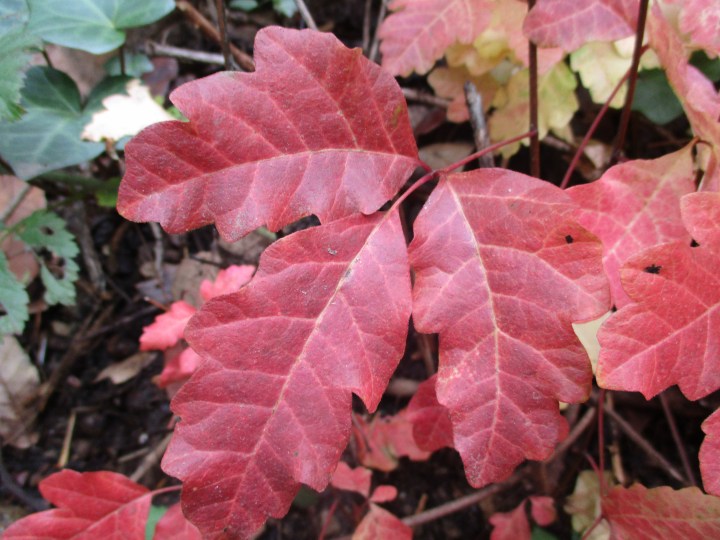
Tufts
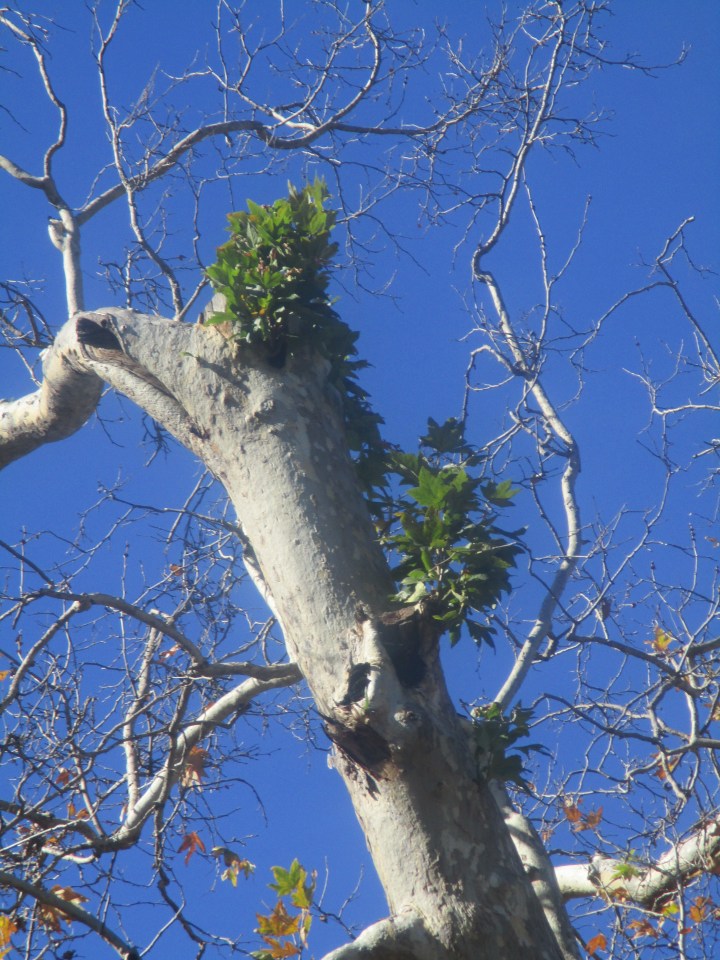 The tufts of small branches that so often develop where limbs were pruned from the trunks of a coast live oaks are sometimes referred to as ‘tumbleweeds’. They are about the same size as an average tumbleweed. By the time the get any larger, most of the smaller stems have subordinated and died out, leaving only a few more defined dominant stems, which will continue the process until even fewer or a single new branch dominates. Such tumbleweeds, as well as stems that originated from such growth, are weakly attached to the main trunks. They often get pruned off for the same reason that the limbs that were there before got pruned off, or because they are expected to be weakly attached. If they remain long enough, they can of course develop into new limbs.
Tufts of the same sort of growth on sycamores or other deciduous trees are known more simply as . . . ‘tufts’ I bet you didn’t see that coming. They can get much bigger than tumbleweeds before they develop much distinction between the dominant and subordinate growth. Because tuft growth is innately vigorous, the leaves are bigger and coarser. Then, when the rest of the deciduous trees that produce them defoliate in autumn, the tufts retain their green foliage until it gets ruined by frost.
This big sycamore dropped its top over summer. https://tonytomeo.com/2018/07/14/nature-is-messy/ The tufts developed on the big trunks that became exposed to sunlight by the loss of the upper canopy above. The tree will naturally try to replace its top, but will also naturally be even more disfigured and structurally deficient than it already was. As the tufts develop into limbs, and the limbs get heavy with foliage, they will be very likely to break away and fall. As unpleasant as all that sounds, it is quite natural for such a mature sycamore who is so old that he just doesn’t care who gets offended anymore.
 Tony Tomeo